
Why Marketing Decision Making Determines Your Success
Marketing decision making is the process of choosing how to allocate resources, set objectives, and execute strategies to achieve business growth—and it’s the single most determining factor behind marketing success.
To improve your marketing decision making:
- Base decisions on smart data (consolidated, contextualized, and linked to goals) rather than fragmented metrics
- Use an integrated measurement approach combining analytics, testing, and AI-powered insights
- Create a clear decision-making framework with defined thresholds for when to act
- Balance intuitive and analytical thinking by leveraging both human expertise and data science
- Align your team on common KPIs that tie directly to business outcomes like revenue and customer acquisition
The reality is stark: the average adult makes 35,000 decisions daily, and for marketing leaders, many of those choices bounce between conflicting analytics, budget pressures, and creative demands. Without the right systems, this leads to decision fatigue—a cognitive drain that causes even experienced marketers to second-guess themselves or default to outdated approaches.
Today’s turbulent environment demands that marketers evolve beyond their traditional roles. You’re no longer just a brand builder or campaign manager. You must be a strategist allocating scarce resources for maximum ROI, a technologist tracking and capitalizing on sophisticated tools, and a scientist embracing experimentation as core to your job.
The good news? Organizations that master marketing decision making see dramatic results. Companies using customer analytics extensively are 23 times more likely to outperform competitors in customer acquisition. Leaders who deeply integrate AI into their workflows report 60% greater revenue growth and adapt to consumer trends twice as fast as their peers.
Yet the path isn’t simple. Modern marketing environments are complex, volatile, and data-intensive. You’re navigating multiple channels, countless metrics, and a flood of technologies—all while trying to prove value to the C-suite. The key isn’t more data or more tools. It’s a fundamental shift in how you approach choices.
This guide will walk you through everything you need to make smarter, faster marketing decisions. We’ll cover the types of decisions you face daily, the proven processes that work, how to transform chaotic data into actionable insights, and how psychology and AI are reshaping strategic thinking.
I’m Steve Taormino, founder and CEO of CC&A Strategic Media, where I’ve spent 25+ years helping organizations worldwide leverage marketing psychology and human behavior to drive growth. Throughout my career—from advising the Maryland Attorney General’s office on digital marketing to presenting at major industry events—I’ve seen how mastering marketing decision making separates thriving companies from struggling ones.
Let’s start by understanding what marketing decision making truly means and why it’s become more critical than ever.
The Bedrock of Business Growth: What is Marketing Decision Making?
At its heart, a marketing decision is a crucial choice about how to guide a product or service to its target audience. It involves taking into consideration the marketing environment, understanding customer needs and preferences, and setting realistic objectives while utilizing available resources efficiently. Why is this so vital for business success? Because the quality of managerial decision-making is often the single most determining factor behind successful marketing management. It’s more influential than the marketing mix, customer behavior, competition, or even the economy itself.
Effective marketing decisions are the compass that steers your business toward its goals. They involve carefully setting objectives that are specific, measurable, attainable, realistic, and timely (SMART). They also dictate how your precious resources—time, budget, and talent—are allocated to support company priorities and maximize return on investment (ROI). For business leaders, understanding and influencing these decisions is paramount to sustainable growth. You can learn more about how marketing drives business growth by visiting our page on [/marketing-for-business-leaders/].
In today’s turbulent and rapidly changing landscape, the role of marketers has profoundly evolved. We can no longer afford to be one-dimensional. We are now expected to be dynamic, adaptable, and multi-skilled, changing into strategists, technologists, and scientists simultaneously. This new mandate requires us to accept agility, inventiveness, and reflexiveness in our approach to every challenge and opportunity.
The Modern Marketer’s Triple Threat
Gone are the days when marketing was solely about creative flair and catchy slogans. While creativity remains important, it’s now underpinned by a rigorous, data-driven approach. The modern marketer is a triple threat, blending diverse skills to steer complexity and drive results.

As strategists, we must allocate scarce resources strategically, ensuring every dollar and every hour spent supports overarching business priorities and delivers a measurable ROI. We’re constantly evaluating market conditions, competitive landscapes, and consumer trends to plot the most effective course. This strategic focus is essential for sustained [/business-growth-through-marketing/].
As technologists, we’re tracking and capitalizing on an ever-growing flood of sophisticated marketing technologies. From automation platforms to analytics tools and AI-powered solutions, we must understand how to leverage these innovations to streamline processes, gain deeper insights, and execute campaigns with precision.
And as scientists, we accept experimentation as a core part of our job. We formulate hypotheses, design tests, collect data, and analyze results to continuously optimize our efforts. This scientific rigor means that marketing is no longer just an art; it’s a discipline of continuous learning and adaptation. Indeed, organizations that use customer analytics extensively are 23 times more likely to outperform competitors in customer acquisition. And those leaders who deeply integrate AI into their workflows report 60% greater revenue growth and adapt to consumer trends twice as fast as their peers. This dynamic environment places a premium on strong [/marketing-leadership/].
The Core Types of Marketing Decisions
To simplify the vast landscape of choices marketers face, we can categorize them into primary types. Each category requires careful consideration and impacts the overall success of our efforts:
- Marketing Mix Decisions: These revolve around the “4 Ps” – Product, Price, Place, and Promotion. We’ll dig into these in more detail shortly, but they encompass everything from product features to advertising channels.
- Marketing Objectives Decisions: Before any action, we must define what we want to achieve. This involves setting SMART goals (Specific, Measurable, Attainable, Relevant, Time-bound) that align with broader business goals. These objectives could include increasing market share, improving brand awareness, or boosting customer loyalty.
- Marketing Strategies Decisions: Once objectives are set, we decide on the overarching approaches to reach them. This might include market penetration, product development, market segmentation, diversification, or positioning strategies.
- Company Targets Decisions: These are concrete, measurable goals for the business, often directly influenced by marketing. Examples include sales targets, budget allocation across different initiatives, and goals for customer loyalty and retention. Effective [/sales-strategy-optimization/] often stems from these decisions.
- Product and Market Scope Decisions: These strategic choices define the boundaries of our operations. They include deciding which target markets to pursue, what products to offer (and discontinue), and whether to expand into new markets or consolidate existing ones.
The Anatomy of a Marketing Decision: Process and Components
Effective marketing decision making isn’t a shot in the dark; it’s a structured, iterative process. It’s a continuous cycle that allows us to adapt and refine our approach based on real-world feedback.
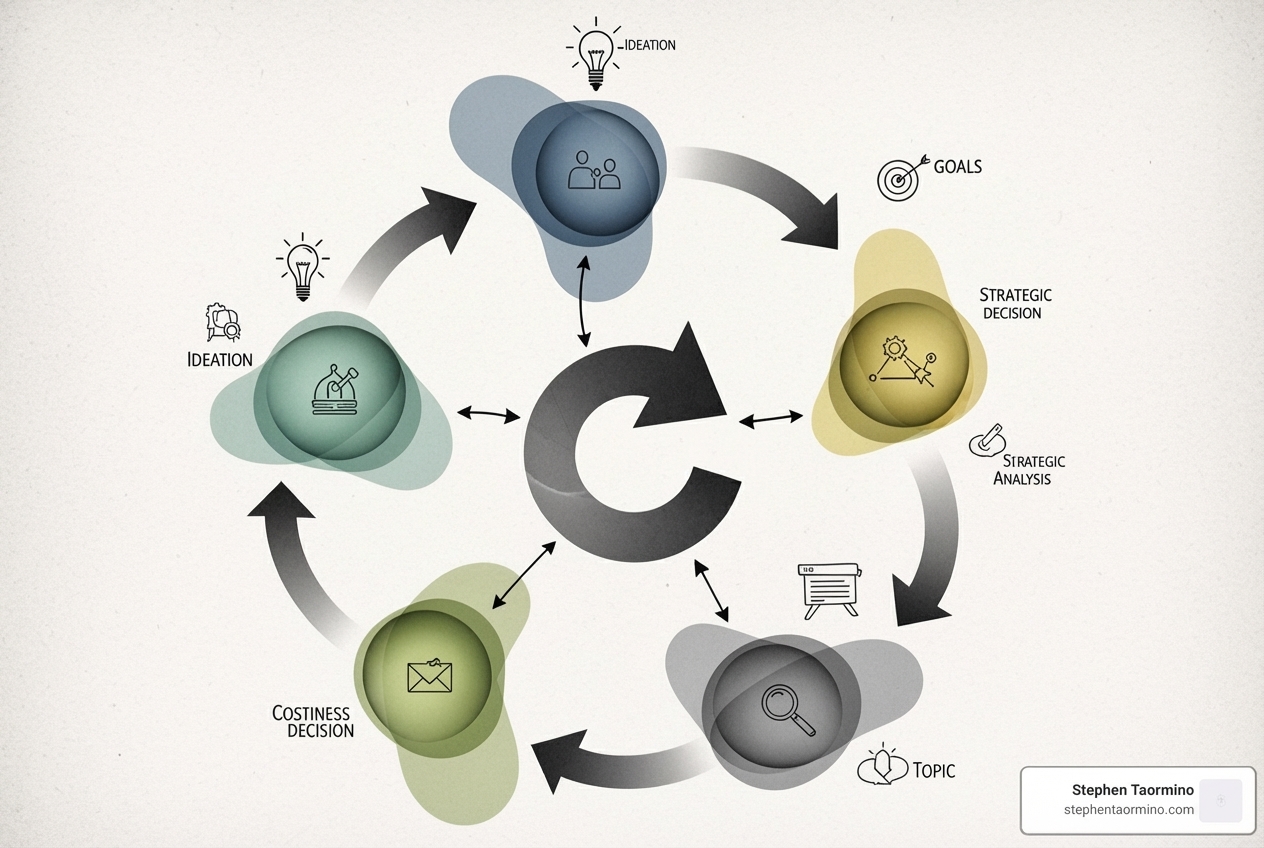
The process typically begins with clearly defining our marketing objectives. What exactly are we trying to achieve? Next, we move into gathering market intelligence, which involves collecting data about our customers, competitors, and the broader market. This intelligence allows us to analyze consumer needs, identifying pain points and opportunities. From there, we develop marketing strategies, outlining the broad strokes of our plan. We then select the specific elements of our marketing mix and define key performance indicators (KPIs) that will tell us if we’re on track. The plan is then implemented, and crucially, its performance is continuously evaluated. This evaluation feeds back into the initial stages, leading to adjustments and improvements. Mastering this cycle is a cornerstone of [/marketing-roi-best-practices/].
Deconstructing the Marketing Mix (The 4 Ps)
The marketing mix, often referred to as the “4 Ps,” provides a foundational framework for tactical marketing decision making. Each ‘P’ represents a critical area where decisions must be made:
- Product Decisions: This goes beyond just the physical item. It includes features, quality, design, branding, packaging, services, warranties, and even the product’s lifecycle. Decisions here might involve introducing a new product, enhancing existing features, or discontinuing a struggling line.
- Price Decisions: This involves setting the right price point, which significantly impacts demand, profitability, and perceived value. Decisions include pricing strategy (e.g., cost-plus, value-based, competitive), discounts, allowances, payment terms, and pricing for different segments.
- Place Decisions (Distribution): This is about making the product available to the target consumer. Decisions cover distribution channels (e.g., online, retail, wholesale), logistics, warehousing, inventory management, and market coverage. For B2B companies, these decisions are crucial for [/b2b-marketing-strategies-to-optimize-sales-conversions/].
- Promotion Decisions: This encompasses all activities designed to communicate the product’s value and persuade target customers to buy. It includes advertising, public relations, sales promotion, direct marketing, and personal selling. Decisions here involve campaign messaging, media selection, and promotional budgets.
A Step-by-Step Process for Better Marketing Decision Making
To bring structure to this complex endeavor, here’s a detailed, step-by-step process we advocate for:
- Define Objectives: Clearly articulate what you want to achieve. Ensure these objectives are SMART. For example, “Increase qualified leads by 15% in Q3 through content marketing.”
- Gather Market Intelligence: Collect comprehensive data on your target audience, competitors, and market trends. This includes market research, customer feedback, sales data, and competitive analysis.
- Analyze Consumer Needs: Use the gathered intelligence to deeply understand what your target customers want, their pain points, and how your product or service can meet those needs. This often involves segmenting your audience.
- Develop Strategies: Based on your objectives and consumer insights, formulate broad marketing strategies. Will you focus on market penetration, product differentiation, or perhaps a new market segment?
- Select Mix & KPIs: Choose the specific tactics within the 4 Ps that will execute your strategy. Simultaneously, define the Key Performance Indicators (KPIs) that will measure success against your objectives. For instance, if your objective is lead generation, KPIs might include conversion rates from landing pages or cost per lead.
- Implement Plans: Execute your chosen marketing activities. This involves coordinating teams, managing budgets, and launching campaigns across selected channels.
- Evaluate & Iterate: Continuously monitor your KPIs and analyze performance. This is where the scientific aspect comes in. What’s working? What isn’t? Use these insights to adjust your strategies and tactics, feeding back into the first step for continuous improvement. This iterative approach is key to effective [/roi-calculation-for-marketing/].
From Data Chaos to Clarity: The Key to Effective Marketing Decision Making
The digital age has brought an explosion of data, which, paradoxically, can make marketing decision making harder, not easier. We’re often overwhelmed by a deluge of information, leading to data overload and, as we’ve discussed, decision fatigue. Many marketing leaders struggle with conflicting analytics, budget choices, and last-minute creative requests. The problem isn’t a lack of data; it’s often the quality and structure of that data.
The Problem with ‘Dumb Data’
We call it ‘dumb data’ because it demands attention without offering clarity, creating more noise than signal. This type of data actively hinders effective marketing decision making through several characteristics:
- Fragmented: Data lives in silos—advertising platforms, analytics tools, CRM systems—all telling slightly different stories. This fragmentation leads to conflicting conversion rates, making it impossible to get a unified view of performance and causing marketers to second-guess budget decisions.
- Not Actionable: Dashboards might show “total page views,” but without context or benchmarks, this metric offers little guidance. It’s a vanity metric that doesn’t tell us why people are visiting or what we should do next to drive business outcomes.
- Redundant: Multiple platforms often report the same metrics, but with slight variations due to different tracking methods. This redundancy forces teams to waste precious time reconciling numbers instead of analyzing insights.
- Misleading: High click-through rates might look good, but if they don’t translate into meaningful business outcomes like sales or qualified leads, they can be deeply misleading. This type of data can send marketers down rabbit holes, optimizing for the wrong things.
The consequences are significant. Inadequate data skills are a major risk for businesses. According to a Data Camp literacy report, 41% of respondents across the US and the UK consider inadequate data skills the number one risk for business. This lack of proficiency, coupled with dumb data, leads to inaccurate decisions, wasted marketing spend, and missed opportunities. Changing your data strategy is a critical step in [/data-change-strategy/].
What is ‘Smart Data’ and How Does It Help?
In contrast to ‘dumb data,’ ‘smart data’ is the marketer’s best friend. It’s not about having more data, but about having the right data, presented in a way that empowers confident, effective decisions.
| Characteristic | Dumb Data | Smart Data |
|---|---|---|
| Structure | Fragmented, siloed, inconsistent | Consolidated & Normalized, unified view across all sources |
| Context | Raw numbers, lacking benchmarks | Contextualized with Benchmarks, insights, and historical performance |
| Relevance | Vanity metrics, not tied to business outcomes | Linked to Goals & Outcomes, directly supporting objectives |
| Processing | Manual, time-consuming, prone to error | Automated & AI-Powered, real-time updates, predictive insights |
| Actionability | Overwhelming, noisy, ambiguous | Filtered for Noise, highlighting only what truly matters |
Smart data is consolidated and normalized, pulling information from all your marketing sources into a single, consistent view. It’s contextualized with benchmarks and insights, so you immediately understand what the numbers mean in relation to your goals and past performance. Crucially, smart data is linked to business goals and outcomes, ensuring every metric you track directly informs your path to revenue and growth. It leverages automation and AI to process information, spot trends, and even provide predictive insights. Finally, smart data is filtered for noise, presenting only the most critical information needed for decision-making, reducing cognitive load. This proactive approach is foundational to [/predictive-marketing-analytics/].
Practical Steps to Transition from Dumb to Smart Data
The journey from data chaos to clarity might seem daunting, but it’s entirely achievable with a structured approach. Here are practical steps we recommend to transition from ‘dumb data’ to ‘smart data’:
- Prioritize the Right Metrics: Don’t track everything. Identify three to five core business objectives (e.g., revenue growth, customer acquisition, customer lifetime value) and then develop team-specific metrics that correlate directly to these. For instance, instead of just “clicks,” focus on “qualified leads” or “cost per acquisition.”
- Automate Data Collection: Connect all your marketing data sources—ad platforms, analytics, CRM, email marketing software, social media—to a central data hub. Use consistent naming conventions across all platforms for better organization. Schedule automated data refreshes that align with your decision-making cycles, ensuring you’re always working with the freshest insights. This can significantly improve efficiency and effectiveness. In fact, 58% of marketing leaders believe that adopting marketing automation tools has improved their team’s efficiency and effectiveness. This is a key component of any [/digital-change-technology/].
- Use AI to Simplify Decisions: AI isn’t just for sci-fi movies anymore; it’s a powerful tool for simplifying marketing decision making. Leverage AI to answer specific questions, spot trends, and even test recommendations on a smaller budget before full implementation. Tools like modern analytics platforms offer basic predictive metrics, while business intelligence platforms allow natural language queries to explore data. Marketing Management Support Systems (MMSS), as computer-enabled devices, are designed precisely to help marketers make better decisions, evolving from data repositories to predictive tools and prescriptive advisors. The good news is that 71% of marketers enjoy using marketing dashboards, which are often the front-end of these systems.
- Reduce Fatigue with a Decision-Making Framework: Build a repeatable decision-making framework for frequent, stressful choices like budget allocation or campaign continuation. Define specific thresholds and rules for action. For example, “if CAC exceeds X, pause campaign,” or “if marginal ROAS remains above Y, scale spend.” This structured approach reduces cognitive drain and empowers your team to make faster, smarter choices with confidence.
The Psychology of Choice: How Your Brain Shapes Marketing Strategy
Understanding marketing decision making isn’t just about data and technology; it’s also about understanding the human element—both in our customers and in ourselves. Behavioral decision-making concepts reveal how our brains, with their inherent biases and shortcuts, influence the choices we make.

Taming Decision Fatigue and Cognitive Bias
We’ve already touched on decision fatigue, the cognitive drain that impacts marketing leaders. Consider this fun fact: the average adult makes 35,000 decisions a day. At that rate, our brains are running on fumes by mid-afternoon! Marketing leaders, bouncing between conflicting analytics, budget choices, and last-minute creative requests, often struggle to make wise decisions even on a good day. Steve Jobs famously wore the same outfit daily not as a fashion statement, but to conserve mental energy for truly important decisions.
This is where smart data truly helps. By filtering out noise, consolidating information, and providing clear context, smart data significantly mitigates decision fatigue. It allows us to focus our mental energy on strategic thinking rather than sifting through irrelevant data.
However, even with smart data, our brains are prone to cognitive biases. Behavioral decision-making research highlights common pitfalls, such as:
- Exemplar-based learning: Relying too heavily on specifics from past successful campaigns, which can lead to incremental, safe, but potentially suboptimal behavior. We might copy a past ad design without truly understanding why it worked then and if it’s relevant now.
- Confirmation bias: Seeking out data that confirms our existing beliefs and ignoring contradictory evidence.
Building ‘good’ intuition is about getting the right type of feedback from our environment that helps us learn from both successes and failures. It’s about combining our gut feelings with rigorous analysis. For a deeper dive into the fascinating world of how our brains make decisions, explore [/behavioral-economics-marketing-techniques/].
The Rise of AI in Modern Marketing Decision Making
Artificial Intelligence (AI) is rapidly changing marketing decision making, enhancing both efficiency and effectiveness in unprecedented ways. It’s not about replacing marketers, but empowering us to make more informed and impactful decisions.
AI accelerates data flows and decision-making, allowing us to move beyond slow, sequential campaign processes. For instance, CMOs expect that marketing effectiveness (57%) and personalization (45%) will be among the top ways that AI will create value in the future. AI’s capabilities include:
- Predictive Insights: AI models can analyze vast datasets to forecast future trends, predict customer behavior, and identify potential risks or opportunities. This allows for proactive strategy adjustments rather than reactive responses.
- Real-time Segmentation: AI can define and reach highly granular audience segments in real-time based on precise signals, enabling hyper-personalized messaging and offers.
- Dynamic Budget Allocation: AI can automate budget shifts across platforms and channels to maximize outcomes, continuously optimizing spend based on performance and market conditions.
- End-to-End Creative Development: From generating copy to designing visual assets and even video creative, AI can accelerate the entire creative lifecycle, allowing for more variants and faster testing. This is a game-changer for [/digital-marketing-innovation/].
- Agentic AI: This advanced form of AI can drive complex processes and make decisions autonomously. It’s projected to grow to handle more than one-fifth of marketing’s total workload within two to three years, taking on tasks like campaign optimization and routine reporting.
The integration of AI also addresses challenges related to Marketing Management Support Systems (MMSS). While MMSS have existed for decades as computer-enabled devices to aid decisions, their effectiveness has sometimes been limited by under-utilization or a poor match with user needs. AI boosts MMSS by providing real-time insights, automating data ingestion, and offering more sophisticated predictive and prescriptive advice. This leads to more effective [/ai-driven-customer-engagement-solutions/].
Frequently Asked Questions about Marketing Decision Making
We often get asked about the practicalities of improving marketing decision making. Here are some common questions and our expert answers:
How can I improve the speed of my team’s marketing decisions without sacrificing quality?
To improve speed without sacrificing quality, focus on creating a clear decision-making framework with defined thresholds for action. Empower your team with ‘smart data’ dashboards that consolidate contextualized, actionable insights. Automate reporting to reduce the time spent on data collection and analysis. For instance, set clear rules: “if campaign A’s ROAS drops below X for three consecutive days, pause it automatically or trigger a review.” This allows for rapid, data-informed responses to market changes.
What is the single biggest mistake marketers make in their decision process?
The single biggest mistake marketers make is relying on fragmented, ‘dumb data’ or vanity metrics that aren’t directly tied to business outcomes. This leads to decision paralysis, wasted budget, and an inability to accurately prove ROI. When data is scattered, inconsistent, or misleading, marketers spend more time trying to reconcile numbers than making strategic choices. This directly impacts their ability to [/increase-digital-marketing-roi/].
How does marketing psychology directly impact strategic decisions?
Marketing psychology directly impacts strategic decisions by helping us understand the cognitive biases of both our customers and our own team. By applying principles from [/behavioral-economics-marketing-techniques/], you can design more effective campaigns that resonate with consumer behavior. Internally, understanding cognitive biases helps you build decision-making processes that are more rational, data-informed, and less susceptible to common pitfalls like confirmation bias or overconfidence. This deep insight into human behavior is a hallmark of effective marketing decision making.
Conclusion: Making Smarter, Faster Choices
In today’s , data-rich environment, effective marketing decision making is no longer a luxury—it’s a necessity for survival and growth. We’ve seen how the role of the marketer has expanded, requiring us to be strategists, technologists, and scientists. We’ve explored the various types of decisions we face and a structured process for making them, moving from defining objectives to continuous evaluation and iteration.
The key to open uping superior performance lies in changing ‘dumb data’ into ‘smart data.’ By prioritizing relevant metrics, automating data collection, and leveraging the power of AI, we can cut through the noise and gain the clear, contextualized insights needed for confident choices. Furthermore, understanding the psychological underpinnings of decision-making—from dual-process models to the impact of emotions and expertise—helps us to tame decision fatigue and cognitive biases, ensuring our human judgment is as sharp as our data.
The future of marketing leadership is about guiding AI, not competing with it. It’s about empowering teams with the right insights, at the right time, within a clear decision-making framework. This holistic approach allows marketers to make faster, smarter choices, driving measurable business growth and solidifying marketing’s strategic role within the organization.
Take the next step in mastering your strategic choices by exploring our [/workshops/].