English
  Spanish
  French
  German


Understanding What Facilitated Workshops Really Mean
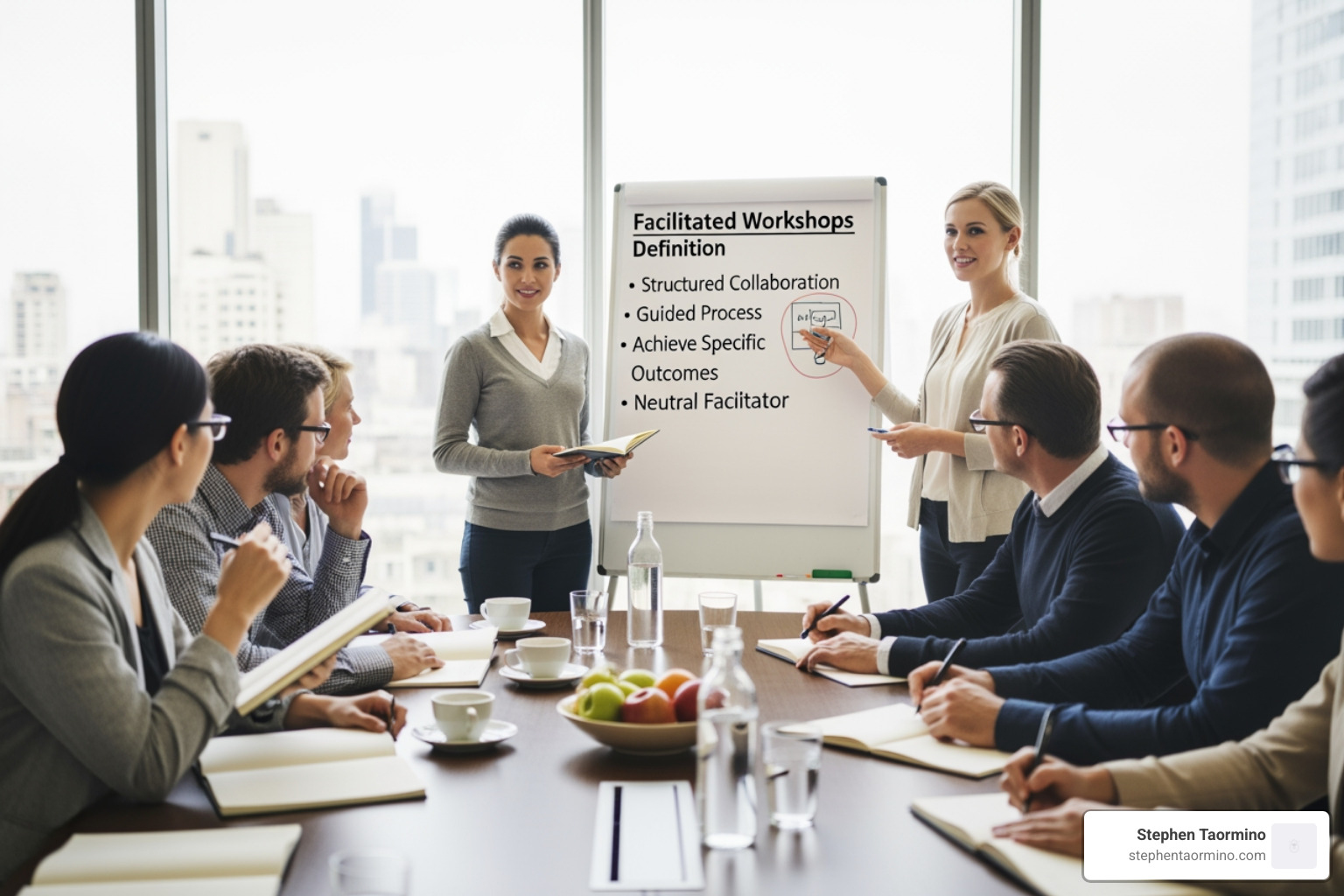
The facilitated workshops definition is simple: it’s a structured, interactive session where a neutral guide helps a group achieve a specific, shared goal. Unlike typical meetings where information flows one way, these workshops are collaborative events designed for active participation, problem-solving, and collective decision-making.
At their core, facilitated workshops are distinguished by several key components:
- A Clear Objective: Every workshop must have a specific, measurable outcome. What will be created or decided by the end of the session?
- A Neutral Facilitator: This individual guides the process, not the content. Their role is to ensure the group stays on track and all voices are heard, without imposing their own opinions.
- Active Participants: The attendees are subject matter experts who bring the necessary knowledge and are empowered to contribute and make decisions.
- A Fixed Timeframe: Workshops operate within a defined “timebox,” from a few hours to several days, to maintain focus and momentum.
- Interactive Activities: The process is driven by structured exercises—like brainstorming or storyboarding—that encourage collaboration and creative thinking.
- Documented Outcomes: The results of the workshop, including decisions and action items, are recorded to ensure accountability and follow-through.
This powerful format is used across industries for everything from requirements gathering and strategic planning to problem-solving and team building. It’s especially valuable in project management and agile environments where rapid, collaborative decision-making is critical. By bringing the right people together in a structured way, organizations can open up their collective intelligence and achieve results that would be impossible in siloed, traditional meetings.
Terms related to facilitated workshops definition:
Understanding the Core Facilitated Workshops Definition
At its core, a facilitated workshop definition describes a specialized type of meeting. It’s not just any gathering; it’s a purposefully designed event with distinct characteristics that set it apart. Imagine a highly interactive session, where everyone is engaged, ideas flow freely, and decisions are made with collective buy-in. That’s the essence.
According to industry facts, a facilitated workshop is a specialized type of meeting characterized by:
- A clear objective in terms of deliverables: What are we trying to achieve? What tangible outcome will we produce?
- An owner who needs the outcome: Someone who champions the workshop and drives its necessity.
- Several participants with relevant knowledge: These individuals are empowered to produce the deliverables and bring diverse perspectives.
- A fixed timeframe (“Timebox”): Ensuring efficiency and focus.
- A facilitator: Responsible for the process, structure, and context, enabling the group to work together towards the agreed goal.
This focused approach makes it easier for a large number of people to interact with one another, ensuring that complex information and organizational challenges can be addressed collectively. In project management, for instance, these workshops are a powerful technique for bringing cross-functional stakeholders together to define product requirements or solve project problems. They foster trust, improve communication, and can uncover underlying issues far quicker than individual sessions. For more insights into how such sessions can transform your collaborative efforts, explore our /workshops/.
The ‘Why’: Open uping Collaboration, Innovation, and Results
We’ve all been in meetings that dragged on, accomplished little, and left us wondering, “Why couldn’t this have been an email?” The power of a facilitated workshop lies in its ability to transform these unproductive gatherings into dynamic, results-driven sessions.

The benefits are truly remarkable, acting as a catalyst for improved communication and much-improved decision-making:
- Maximizing Hidden Potential: Organizations often tap into only a fraction of their employees’ knowledge, energy, and creativity. Facilitated workshops are designed to open up this hidden potential, bringing diverse perspectives to the forefront.
- Genuine Involvement and Buy-in: By providing a platform for everyone to propose ideas, express observations, and offer solutions, workshops foster a greater sense of ownership. This buy-in is crucial for implementing cultural change and ensuring commitments are met.
- Clarity and Focus: Workshops provide a structured environment to clarify objectives and required outcomes, cutting through ambiguity.
- Efficient Information Elicitation: They offer a quick and effective means of gathering crucial information, especially in complex projects.
- Knowledge Sharing and Broader Perspectives: Bringing together people from various business areas facilitates knowledge exchange and offers a more holistic view of challenges and solutions.
- Conflict Resolution: Workshops create a forum for resolving conflicts, differences of opinion, and averting misunderstandings, leading to stronger relationships within the team.
- Time and Cost Efficiency: Compared to endless one-on-one meetings, a well-run workshop can significantly manage time efficiently, accelerating problem-solving and decision-making.
The output of a workshop, both tangible (like action items) and intangible (like shared language and ideas), is only useful if everyone buys into it. This collective commitment is a cornerstone of building high-performing teams, and you can learn more about this by exploring our insights on /building-high-performing-teams/.
Primary Goals of a Facilitated Workshop
When we talk about the facilitated workshops definition, we’re inherently talking about purpose. These aren’t just feel-good sessions; they have clear, strategic goals. Some of the most common objectives include:
- Requirements Gathering: In project management, workshops excel at bringing cross-functional stakeholders together to define product requirements, ensuring all perspectives are heard and integrated.
- Strategic Planning: Whether it’s setting long-term visions or outlining quarterly objectives, workshops provide a collaborative space for leadership teams to align on strategy.
- Problem-Solving: When faced with complex challenges, workshops enable groups to diagnose situations, explore root causes, and collectively brainstorm innovative solutions.
- Idea Generation: From new product features to process improvements, workshops are fantastic for releaseing creativity and generating a multitude of ideas.
- Consensus Building: They are invaluable for gaining agreement between multiple parties on a subject, especially when diverse perspectives exist, fostering a shared understanding and direction.
- Process Improvement: Workshops can be used to examine and streamline existing workflows, identifying bottlenecks and opportunities for efficiency.
- Team Alignment: Beyond specific tasks, workshops help teams get on the same page, fostering a shared language and a unified approach to their work.
How Workshops Drive Agile Practices and Project Management
Facilitated workshops are an incredibly powerful, yet often under-used, tool in agile environments and project management. They are designed to thrive on collaboration, rapid feedback, and iterative progress—all hallmarks of agile methodologies.
In project management, the facilitated workshops definition extends to a technique that uses focused sessions to bring cross-functional stakeholders together. The goal? To define product requirements, build plans, solve problems, and make critical decisions efficiently. They provide a team-based approach that significantly improves communication within the team and among all project stakeholders.
Here’s how they contribute to agile practices:
- Requirements Elicitation: Agile teams use workshops to quickly gather and refine user stories and acceptance criteria, ensuring a shared understanding of what needs to be built.
- Sprint Planning & Retrospectives: Workshops are central to planning upcoming sprints, defining tasks, and conducting retrospectives to learn from past iterations and continuously improve.
- Reducing Ambiguity: By bringing all relevant parties into a single room (or virtual space), workshops minimize misunderstandings and clarify scope early in the development cycle.
- Accelerating Findy: Instead of sequential, individual interviews, a workshop can accelerate the findy phase, quickly surfacing information and fostering collective intelligence.
- Stakeholder Engagement: They provide a forum for stakeholders to actively participate in the project’s direction, leading to greater buy-in and a higher likelihood of project success.
The group dynamic established in these sessions is incredibly helpful in project management. It’s a key practice for business agility, allowing organizations to adapt and respond quickly to change. For leaders looking to drive this kind of agility, understanding the strategic application of workshops is vital. Learn more about how effective leadership fuels growth in our guide to /leadership-for-business-growth/.
The ‘Who’: A Deep Dive into Key Roles and Responsibilities
The success of a workshop hinges on participants understanding and fulfilling their specific roles. Just like a well-orchestrated play, every actor has a part, and the collective performance depends on individual contributions. If we consider the facilitated workshops definition, it inherently implies a group effort, but that effort is most effective when roles are clear. This clarity ensures the group’s work is as engaging and effective as possible, allowing for the maximum use of knowledge and creativity. To truly harness this potential, explore our /group-facilitation-training/.
The Role of the Workshop Facilitator
The facilitator is the guardian of the process, ensuring the group stays on track, everyone contributes, and objectives are met. They are a neutral guide, not a content expert.

A facilitator’s key responsibilities include:
- Guiding the Process: Designing and managing the flow of activities to move the group from problem to solution.
- Maintaining Neutrality: Remaining impartial on the content of the discussion to foster trust and open communication.
- Encouraging Participation: Creating a safe and inclusive environment where all voices are heard, especially quieter ones.
- Managing Group Dynamics: Navigating disagreements, managing dominant personalities, and keeping the energy positive and productive.
- Keeping Time: Ensuring the workshop stays on schedule and achieves its goals within the allotted time.
The facilitator’s job is to make it easier for the group to do their best work together. For a deeper dive into this pivotal role, check out our insights on becoming an effective /workshop-facilitator/.
The Role of Participants, Scribes, and Sponsors
While the facilitator guides the journey, the other roles are equally vital for reaching the destination.
- Participants (Subject Matter Experts – SMEs): The heart of the workshop. They bring the necessary knowledge, contribute ideas, and are empowered to make decisions. Their active engagement is crucial for a successful outcome.
- Workshop Owner (Sponsor): The person or team who needs the workshop’s outcome. They define the objective, provide context, and champion the process and its results.
- Scribe: The official note-taker. The scribe captures key discussions, decisions, and action items on whiteboards, flip charts, or digital tools, creating a shared visual record for the group.
The ‘How’: Your Blueprint for Planning and Executing a Flawless Workshop
A great workshop doesn’t just happen; it’s the result of meticulous planning and skillful execution. The research consistently shows that much of the work that makes a workshop successful takes place before the session itself. This structured approach, deeply embedded in the facilitated workshops definition, ensures that you maximize your collective time and energy. For a comprehensive guide on running successful workshops, refer to these Ten Simple Rules for Running Interactive Workshops.
Step 1: Planning, Preparation, and Choosing Your Venue
This foundational step sets the stage for everything that follows.
- Define Objectives: What specific, measurable outcome must be achieved by the end of the workshop?
- Create an Agenda: Outline the flow of the workshop, including activities, timings, and breaks. Share it with participants beforehand.
- Select Participants: Invite the key stakeholders and subject matter experts who have the knowledge and authority to contribute and make decisions.
- Choose a Venue: Whether physical or virtual, the space should be conducive to collaboration. For in-person events, ensure you have enough room, whiteboards, and supplies. For virtual workshops, select reliable and user-friendly collaboration tools.
- Handle Logistics: Send invitations, manage RSVPs, and share any pre-reading materials well in advance.
A well-planned workshop, with a clear objective and the right people, is already halfway to success. For more guidance, explore our guide on /how-to-facilitate-a-training-workshop/.
Step 2: Common Techniques, Activities, and Workshop Styles
The heart of the facilitated workshops definition lies in its interactive nature. These methods ensure full participation, shared understanding, and collaborative decision-making.
Here are some popular activities:
- Brainstorming: A classic for generating a high volume of ideas in a short time.
- Post-it Ideation: Participants write ideas on sticky notes, which are then grouped and discussed. This is a great way to ensure all voices are heard.
- Round-Robin: The facilitator goes around the room, giving each person a turn to speak. This prevents a few people from dominating the conversation.
- Affinity Mapping: After brainstorming, the group organizes ideas into related clusters to identify themes and patterns.
- Storyboarding: A visual technique for mapping out a process or user journey, step by step.
- “Speed Boat” Activity: A creative way to identify what’s helping (“sails”) and hindering (“anchors”) a project or process.
The key is to select activities that align with your objectives and encourage interaction. Group activities are critical for fostering communication and building relationships. For more on this, see our resources on /communication-skills-training/.
Step 3: Adapting to the Virtual World: Remote Facilitation
The shift to remote work has made virtual facilitation a crucial skill. While challenging, effective online workshops are entirely possible with the right approach and tools.
Key considerations for virtual workshops:
- Technology is Key: Use reliable video conferencing (Zoom, Teams) and a digital whiteboard (Miro, Mural) to enable real-time collaboration.
- Boost Engagement: Remote attention spans are shorter. Use interactive features like polls, breakout rooms, and chat to keep participants engaged.
- Set Clear Expectations: Establish “rules of the road” for virtual interaction, such as keeping cameras on and muting microphones when not speaking.
- Plan for Breaks: Schedule more frequent, shorter breaks than you would for an in-person session to combat screen fatigue.
- Test Everything: Do a dry run of your technology and activities to ensure a smooth experience on the day.
With careful planning, you can create a virtual workshop that is just as productive and engaging as a face-to-face one.
Step 4: Documenting Outcomes and Driving Action
A workshop’s value is realized in the actions taken after it ends. The facilitated workshops definition includes producing a tangible result, which must be captured and acted upon.
- Capture Everything: Photograph whiteboards and flip charts. Save digital collaboration boards. These “workshop artifacts” are a valuable record of the group’s work.
- Define Action Items: For every task, assign a clear owner and a due date. This creates accountability and ensures follow-through.
- Summarize and Share: The facilitator or scribe should compile and distribute a summary of the key discussions, decisions, and action items within 24-48 hours. This maintains momentum and keeps everyone aligned.
- Conduct a Mini-Retrospective: End the workshop with a quick “plus/delta” to get feedback on what worked well and what could be improved for next time.
Effective documentation and a clear follow-up plan are what transform a good conversation into measurable results.
Mastering the Craft: Principles and Challenges of Effective Facilitation
Beyond structure and activities, mastering facilitation requires embracing core principles and learning to steer common challenges. It’s a craft that combines preparation with intuitive delivery, guiding groups to achieve their goals. For leaders committed to continuous improvement, this is a key skill. To dive deeper into leadership development, explore our /professional-development-for-leaders-complete-guide/.
The Guiding Principles of an Expert Facilitator
An expert facilitator doesn’t just run a meeting; they create an environment where a group can do its best thinking together. These principles are the essence of the facilitated workshops definition:
- Neutrality: Remain impartial on the content, focusing solely on guiding the process. This builds trust and ensures all ideas are considered fairly.
- Active Listening: Pay attention to both verbal and non-verbal cues to understand the group’s dynamics and needs.
- Adaptability: Be prepared to deviate from the plan. A skilled facilitator reads the room and adjusts the agenda to best serve the group’s progress.
- Inclusivity: Create a safe space where every participant feels comfortable sharing their perspective. Actively invite contributions from quieter members.
- Accept Constructive Conflict: Don’t shy away from disagreements. Instead, guide the group through them productively to reach stronger, more innovative solutions.
- Be a Servant Leader: The facilitator’s primary role is to serve the group’s needs and help them achieve their collective goal.
The Facilitated Workshops Definition of Common Challenges (and How to Overcome Them)
Even the best-planned workshops can face problems. Here’s how to handle them:
- Dominant Personalities: One person monopolizing the conversation.
- Solution: Use structured sharing like a round-robin. Gently interrupt and redirect, saying, “Thanks for that perspective. Let’s hear what others think.”
- Disengaged Participants: Attendees are quiet, distracted, or on their phones.
- Solution: Use interactive activities, call on people by name (gently), and use breakout rooms to encourage participation in smaller groups.
- Groupthink: The team quickly agrees on the first viable idea without exploring alternatives.
- Solution: Encourage dissenting opinions. Ask, “What are the potential downsides of this idea?” or “What are we missing?”
- Scope Creep: The discussion veers into unrelated topics.
- Solution: Gently guide the conversation back to the agenda. Use a “parking lot” (a separate flip chart) to capture off-topic ideas for later discussion.
- Unproductive Conflict: Disagreements become personal or circular.
- Solution: Mediate by focusing on the issues, not the people. Re-establish ground rules for respectful communication and find common ground.
Overcoming these challenges requires strong communication skills. For more on this, see our insights on /effective-communication-skills/.
Building Your Personal Facilitator’s Toolkit
Just as a carpenter has a toolbox, a facilitator needs a well-stocked kit of materials, activities, and techniques. This toolkit allows us to be adaptable, responsive, and effective in any workshop setting.
- Materials: These are your physical (or digital) building blocks.
- Essentials: Sticky notes (various sizes and colors), Sharpies, flip charts, whiteboards (or digital equivalents like Miro), voting dots, index cards.
- Why: They enable quick ideation, visual organization, and democratic decision-making.
- Activities: These are the structured exercises you use to achieve specific outcomes.
- Foundational Activities: Brainstorming, affinity diagramming, landscape mapping, forced ranking, storyboarding, role-playing, “Speed Boat.”
- Why: They guide the group through divergent (idea generation) and convergent (decision-making) thinking processes.
- Techniques: These are the verbal and non-verbal skills you employ to manage group dynamics.
- Intentional Silence: Allowing pauses after a question to encourage deeper thought and participation from quieter individuals.
- Balancing: Actively inviting diverse opinions or challenging a dominant viewpoint by asking others for their input.
- Linking: Connecting seemingly disparate ideas or comments to find common ground and build shared understanding.
- Improvisation: Being ready to respond to what’s happening in the moment and adapt your plan as needed.
- Questioning: Asking open-ended questions that stimulate discussion and critical thinking.
Building your toolkit involves documenting what works, observing other facilitators, and practicing in various scenarios. The more tools you have, the more confidently you can steer any workshop, ensuring that the group’s collective potential is fully realized.
Frequently Asked Questions about Facilitated Workshops
What is the main difference between a meeting and a facilitated workshop?
The main difference lies in purpose and interaction. A traditional meeting is often for status updates, information dissemination, or individual reporting. A facilitated workshop, guided by the facilitated workshops definition, is a specialized, highly interactive, and collaborative session designed to produce a specific, co-created outcome through collective problem-solving, idea generation, or decision-making. Workshops prioritize active participation and group synergy.
How long should a facilitated workshop be?
The ideal length of a facilitated workshop depends heavily on its objective and complexity. While some can be as short as 2-3 hours for focused tasks like brainstorming or quick decision-making, many beneficial workshops span a full day. For complex strategic planning, requirements gathering, or significant problem-solving, a workshop might be structured across multiple days, often with breaks in between to allow for reflection and preparation. The key is a “timebox” – a fixed timeframe designed for efficiency.
Can I facilitate my own team’s workshop?
While it is technically possible for someone within a team to facilitate, it’s generally recommended to have an external or neutral internal facilitator. A neutral facilitator can remain impartial to the content and outcome, focusing solely on the process and group dynamics. This allows all team members, including the team leader, to participate fully as content experts without the added responsibility of managing the process. It also helps prevent biases, encourages more open contributions, and can be particularly beneficial when dealing with strong personalities or potential conflicts.
Conclusion: From Workshop to Lasting Impact
Understanding the facilitated workshops definition is the first step toward changing how your organization collaborates, solves problems, and innovates. By focusing on clear goals, defined roles, and a structured yet flexible process, you can open up the collective intelligence of your teams. This approach, rooted in principles of effective communication and leadership psychology, is a cornerstone of building high-performing teams and driving real business growth.
The benefits are clear: maximum use of hidden knowledge, genuine involvement, improved communication, improved decision-making, and a powerful catalyst for cultural change. Workshops are not just events; they are investments in your team’s capability and your organization’s future.
Stephen Taormino’s expertise in marketing psychology and leadership development underscores the power of a well-facilitated experience to create not just outcomes, but lasting change. By embracing the principles of facilitation, we empower individuals, strengthen relationships, and build a culture of impactful collaboration that truly transforms potential into prosperity.