
Communication excellence training: Ultimate Guide 2025
Why Communication Excellence is the Ultimate Career Superpower
Are you looking for a quick understanding of communication excellence training? Here’s what it typically involves:
- Developing Core Skills: Sharpening clarity, active listening, and non-verbal communication.
- Enhancing Professional Impact: Boosting leadership, sales, and customer service interactions.
- Fostering Positive Culture: Building trust and transparency within organizations.
- Leveraging Modern Tools: Integrating AI for feedback and strategic communication.
- Driving Measurable Results: Improving business performance, employee engagement, and customer satisfaction.
The journey from good to great communication begins with dedicated communication excellence training. In today’s world, miscommunication can cost businesses millions and derail careers. However, mastering communication can open up immense potential, driving business success and accelerating career advancement. This guide will provide actionable steps to lift your communication skills from adequate to exceptional.
I’m Steve Taormino, and for over 25 years, I’ve seen how strategic communication transforms organizations. My work in marketing psychology and human behaviors, as well as digital communications, has equipped countless leaders and teams with the insights needed to achieve communication excellence training and build prosperity.

In our complex and rapidly evolving business environment, effective communication isn’t just a “soft skill”—it’s a fundamental driver of success. Ineffective communication is, in fact, a strategic liability that wastes time, stalls decisions, and derails critical initiatives. Without strong communication, organizations risk slowing scientific objectives, losing customer trust, and hindering internal collaboration. This is why communication excellence training is so crucial; it transforms this liability into an asset, powering business performance, fueling employee engagement, and elevating customer satisfaction.
Through communication, we build trust, foster innovation, and drive decisions. Progress in any organization is made by the presentations we give, the conversations we lead, the stories we tell, the customers we engage, and the employees we listen to and inspire. Investing in this area is not merely an incremental improvement; it’s revolutionary, providing a far greater return than investing in technical skills alone.
The Tangible Business Impact
The “bottom line” of effective communication directly translates into measurable business benefits. When communication is excellent, we see:
- Increased Revenue and Shareholder Value: Clearer sales pitches, better customer service, and more effective marketing strategies directly impact financial performance.
- Improved Productivity: Efficient meetings, unambiguous project instructions, and streamlined information flow can slash meeting times and accelerate project completion. This directly translates to higher productivity and reduced operational costs.
- Reduced Employee Turnover: Employees who feel heard, understood, and connected to their organization’s vision are more engaged and less likely to leave. A positive communication culture builds a sense of belonging and value.
- Stronger Client Relationships: When we communicate with clarity and empathy, we build rapport and trust with clients, leading to long-term partnerships and increased loyalty.
- Improved Team Collaboration: Effective communication is the bedrock of high-performing teams. It allows for open dialogue, constructive feedback, and shared understanding, which are vital for Building High-Performing Teams.
The Personal Career Advantage
Beyond organizational benefits, communication excellence training profoundly impacts individual career trajectories. It equips us with the skills to steer professional landscapes with confidence and influence.
- Liftd Leadership Potential: The ability to communicate clearly and effectively with employees, within teams, and across the organization is a foundational skill for leaders. It allows us to articulate a vision that inspires action and leads change.
- Improved Influence: Whether we’re persuading stakeholders, negotiating deals, or leading projects, strong communication skills allow us to influence decisions and drive results. This extends our impact and allows us to accept larger leadership roles.
- Meaningful Professional Relationships: By practicing active listening, empathy, and clear expression, we foster deeper connections with colleagues, clients, and mentors, enriching our professional network and support system.
- Accelerated Career Progression: As one Principal Solution Engineer noted, improving communication techniques can have a material impact on one’s career, often providing a greater return than upgrading technical skills alone. This is particularly true for those aspiring to become a Leadership Development Expert.
- Increased Confidence: Mastering communication skills builds self-assurance. It empowers us to speak up, present our ideas with conviction, and handle challenging conversations with grace.
The Building Blocks: Core Principles of Effective Communication
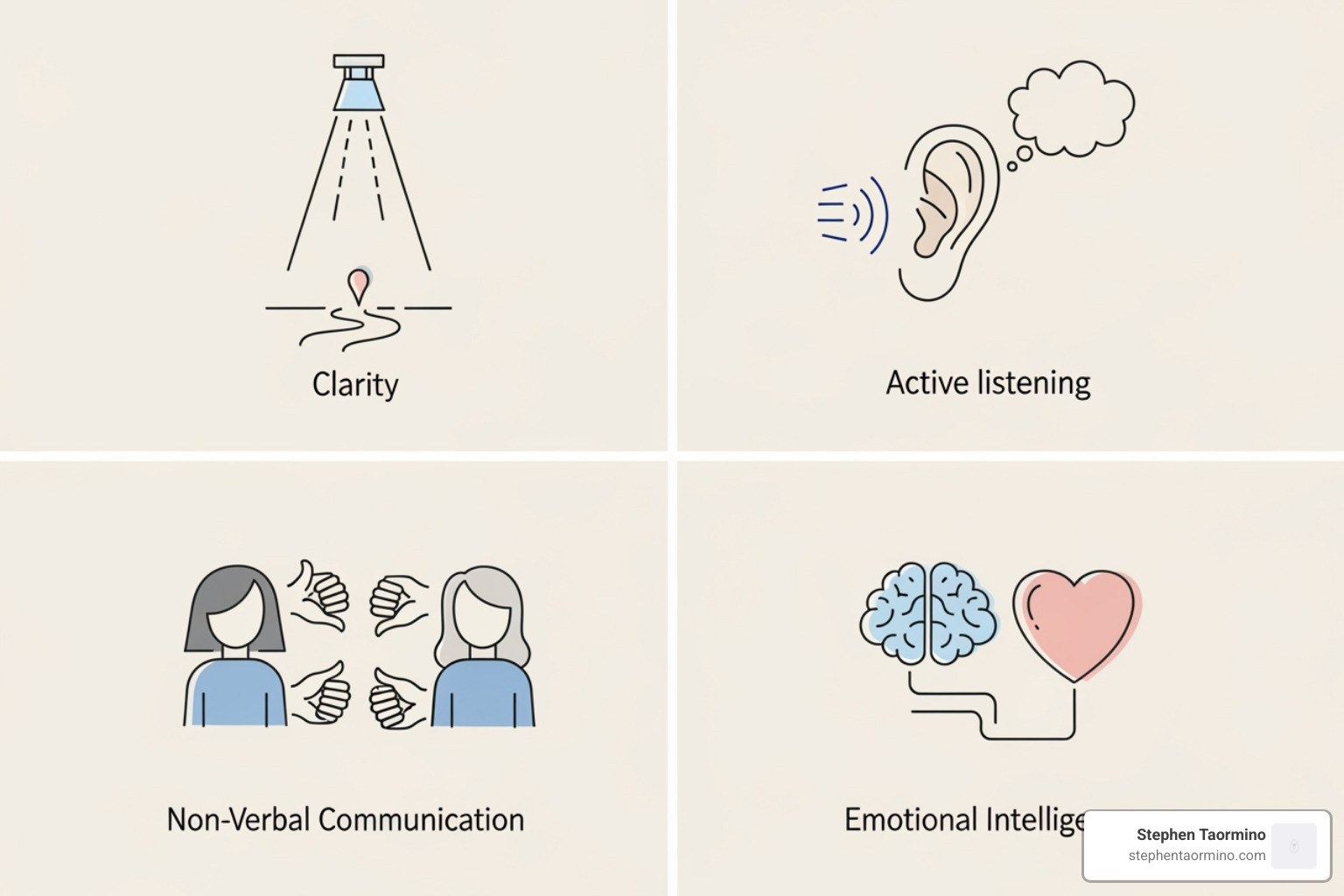
At the very heart of great communication excellence training lies a special set of fundamental skills. When you truly master these, they can completely change how you connect with others. These aren’t just fancy ideas; they’re practical, hands-on strategies. They come from understanding both marketing psychology and how people really behave. Our goal is to help you build these core abilities so that every message you send is received, understood, and acted upon, just as you intended.
Principle 1: Achieving Crystal-Clear Clarity and Conciseness
Think about it: in today’s busy world, everyone’s attention is pulled in a million directions. That’s why clarity and conciseness aren’t just good ideas—they’re absolutely essential! Your messages need to cut through all that noise.
This principle teaches us a few key things. First, we learn to eliminate jargon and ambiguity. This means using plain, simple language that everyone can grasp, steering clear of industry terms unless you know your audience is specialized. Second, it’s about structuring your message logically. Before you even open your mouth (or type), take a moment to organize your thoughts. What do you want to achieve? What’s your main point? And who are you talking to? Always define your goal and audience first. Tailoring your message to their needs and context is super important. Finally, remember to be concise. Get straight to the point! Remove any extra details or unnecessary words. As the old saying goes, “less is often more.” This takes a little practice, especially when writing, but it’s worth it.
By mastering these elements, your communication won’t just be heard; it will be truly understood. And that’s the first step to developing truly Effective Communication Skills.
Principle 2: The Power of Non-Verbal Communication
Here’s a fascinating truth: what you say is only one part of your message. How you say it often carries much more weight. In fact, non-verbal cues can have between 65 and 93 percent more impact than your spoken words. If your body language doesn’t match what you’re saying, people are far more likely to believe what they see.
So, what does this include? It’s everything from your body language – how you stand or sit, your gestures, and your overall demeanor, which can signal confidence, openness, or even defensiveness. It’s also your tone of voice, where the pitch, volume, and inflection can completely change the meaning of your words. And don’t forget facial expressions; our faces are incredibly expressive, showing emotions and reactions instantly. Even your eye contact plays a huge role, signaling engagement, sincerity, and respect when done appropriately. Being aware of your non-verbal cues and making sure they align with your verbal message is vital for showing authenticity and building real trust.
Principle 3: Mastering the Art of Active Listening
Communication is a fantastic two-way street, but often, listening is the more powerful side of it. It’s often said that we only truly hear about half of what someone else says during a conversation. Active listening is all about closing that gap. It means truly tuning in.
This skill involves a few key practices. First, you need to give full and undivided attention. That means clearing your mind of distractions, judgments, or thoughts about what you’ll say next. Put your phone away, make eye contact, and genuinely focus on the speaker. Second, practice avoiding interruption. Let the person finish their thoughts completely without jumping in. Third, try paraphrasing and summarizing what you’ve heard in your own words. This confirms you’ve understood and gives them a chance to clarify anything. Fourth, ask open-ended questions. This encourages the speaker to share more, giving you deeper context. Finally, demonstrate empathy. Try to understand their perspective and feelings, even if you don’t fully agree. This builds strong rapport and trust. Active listening isn’t just about hearing words; it’s about connecting with the person speaking.
Principle 4: Leveraging Emotional Intelligence (EQ)
Emotional intelligence, or EQ, is your amazing ability to understand and manage your own feelings, and also to recognize and influence the emotions of others. It’s a huge part of effective communication because, let’s face it, communication is deeply human and often emotional. Developing your EQ involves a few crucial areas:
First, there’s self-awareness. This is about truly understanding your own feelings, your strengths, your weaknesses, and how your actions impact others. It’s key to managing your own reactions. Second, we have self-regulation. This is the skill of controlling or redirecting those disruptive emotions and impulses. It’s incredibly important for keeping your cool during tough conversations. Third is empathy – the wonderful capacity to truly understand or feel what another person is experiencing from their point of view. This allows you to tailor your communication so it really resonates with your audience. And finally, social skills involve managing relationships, building networks, and finding common ground with others. This includes things like persuasion, negotiation, and handling conflicts gracefully. By boosting your emotional intelligence, you’ll be much better equipped to steer complex social dynamics, manage difficult talks, and foster interactions that are both productive and harmonious, especially in diverse settings that might benefit from Cross-Cultural Leadership Training.
Mastering the Craft: A Guide to Communication Excellence Training

Now that we’ve laid out the foundational principles, let’s talk about turning that knowledge into real-world skill. Communication excellence training programs are thoughtfully designed to help you master this craft. Think of it as tailoring a bespoke suit for your professional growth – finding the right program, delivered in the right way, is key to truly elevating your abilities. It’s all about skill development and continuous professional growth.
Who Benefits Most from Communication Excellence Training?
The wonderful thing about mastering communication is its universal power. While truly everyone can benefit, we often see certain roles and groups gain immense value from this training. For Leaders and Managers, effective communication isn’t just a nice-to-have; it’s essential for inspiring teams, guiding strategic initiatives, and building a thriving culture. Your ability to articulate a vision, offer constructive feedback, and lead with clarity directly shapes your leadership impact. That’s why many leaders often seek out specialized Executive Leadership Training.
Our Sales Professionals also find this training incredibly valuable. Imagine connecting deeper with clients, creating an unforgettable impression of value, and reaching agreements faster – these are all direct outcomes of superior communication. This training empowers sales teams to craft compelling messages and persuade potential buyers more effectively. Then there are our brilliant Technical Experts. Their challenge often lies in translating complex, intricate information into clear, actionable insights for non-technical audiences. This training helps them bring technical data to life and present it persuasively.
And let’s not forget our dedicated Customer Service Teams. Enhancing customer interactions, skillfully navigating difficult conversations, and building genuine rapport are absolutely critical for customer satisfaction and loyalty. This training provides specific techniques for engaging customers and resolving issues with grace and effectiveness. Finally, for High-Potential Employees on an accelerated career path, honing communication skills is non-negotiable. It’s essential for stepping into larger roles, expanding influence, and confidently embracing greater leadership responsibilities.
Choosing Your Training Delivery Method
The world of learning has truly opened up, and so have the ways you can access communication excellence training. We offer a flexible range of options, designed to fit different preferences, schedules, and organizational needs.
For those who thrive on direct interaction and a hands-on approach, In-Person Workshops offer a rich, immersive experience. These traditional sessions, held in a physical location, are fantastic for immediate feedback, dynamic role-playing, and invaluable networking with peers. Of course, they might require travel and a fixed schedule, but the deep engagement is often worth it.
If flexibility is key, our Virtual Classrooms bring the interactive experience online. These live sessions replicate many aspects of in-person training through video conferencing. You get real-time interaction without the travel, making them perfect for distributed teams and reducing costs. Just ensure you have reliable internet, and be mindful of potential ‘video call fatigue’ – though our facilitators work hard to keep energy high!
For maximum flexibility, eLearning modules allow you to learn at your own pace, anytime, anywhere. These self-paced online courses, videos, and exercises are cost-effective and deliver consistent content. They’re ideal if you prefer to digest information on your own schedule, but they do require a good dose of self-discipline. Many organizations find Blended Learning to be the sweet spot, combining structured virtual or in-person sessions with the flexibility of self-paced eLearning. This approach offers the best of both worlds, reinforcing learning and catering to diverse styles, though it does require careful design to integrate seamlessly.
For a truly personal touch, 1:1 Coaching provides highly customized sessions with an expert coach. This is where you get custom feedback and strategies that address your unique challenges, leading to rapid skill development in a confidential environment. While it’s the most intensive and often highest investment per individual, the personalized impact is profound. Finally, for teams or departments looking to grow together, Group Facilitation offers expert-led sessions focused on collective skill-building. This method is wonderful for building team cohesion, addressing shared communication challenges, and fostering a common language across your group. It’s a cost-effective way to lift an entire team’s communication prowess, though it offers less individual attention than one-on-one coaching.
Many of these interactive methods, particularly in-person and group facilitation, are often delivered as dynamic Workshops designed for truly immersive and impactful learning.
Specialized Training for High-Stakes Scenarios
Beyond general excellence, some situations demand highly specialized communication skills, where the stakes are incredibly high. Our communication excellence training can be precisely custom to these critical environments.
For spokespeople, mastering Media Interviews is absolutely essential. This training equips you with the tools to handle interviews – whether for TV, podcasts, or print – with skill and genuine confidence. We cover techniques for communicating clearly, gently steering conversations toward your objectives, and gracefully handling challenging questions. Think of it as preparing you to shine under pressure, just like a seasoned media trainer helps spokespeople for these critical moments.
In times of crisis, Crisis Communication becomes paramount. Clear, empathetic, and consistent communication can truly make or break an organization’s reputation. Specialized training prepares leaders to expertly manage messaging, address all stakeholders, and maintain trust even under immense pressure. Then there are Customer Service Conversations. Equipping your customer service staff with advanced communication techniques allows them to steer difficult conversations, skillfully de-escalate tension, and even transform complaints into opportunities for positive engagement. This significantly boosts customer satisfaction and loyalty.
For those in leadership, Leadership Communication is about more than just talking. It’s about interacting with clear intent, developing a powerful leadership presence, and perfecting your unique personal communication style. Programs specifically for leaders focus on crafting compelling presentations, overcoming public speaking anxiety, and leveraging powerful persuasion strategies. We often cover these vital topics when preparing a Public Speaker for their engagements.
And finally, Negotiation – it’s far more than just haggling over terms. Effective negotiation demands advanced communication skills to build rapport, uncover underlying issues, transform potentially confrontational situations into collaborative problem-solving, and ultimately, influence positive outcomes. This is a key area we dig into, often highlighted in our Facilitation Training Ultimate Guide, as facilitators frequently mediate complex discussions.
The Future of Connection: Integrating AI and Fostering a Positive Culture
As we look ahead, communication excellence training isn’t just about timeless principles; it’s also about staying ahead of the curve. It’s an changing journey, shaped by new technologies and a deeper understanding of how people connect within organizations. Our focus here is on leveraging modern tools like AI and cultivating environments where communication truly flourishes. This leads to greater organizational impact, continuous improvement, and the ability to clearly measure success.
The Role of AI in Modern Communication Training
Artificial intelligence (AI) is quickly changing how we learn and practice communication skills. It’s not here to replace human connection, but rather to make it even stronger and more precise. Think of AI as your smart communication assistant, helping you refine your message and delivery.
Imagine having a coach that offers AI-powered coaching and real-time feedback. These tools can analyze your tone of voice, delivery style, and even the clarity of your message during practice. This means you get instant insights, allowing you to fine-tune your executive presence and make immediate adjustments. It’s like having a mirror for your words and actions, helping you see where you shine and where you can improve.
AI can also help with tone analysis and message refinement. It can give you a better sense of how your written or spoken words might be received, helping you choose language that’s clear, concise, and truly persuasive. And with Generative AI for practice, tools like generative AI become incredibly helpful. They can create realistic scenarios for role-playing, draft presentations, summarize complex information, or even help you craft stakeholder messages. This allows you to practice and perfect your responses in a safe, low-pressure environment.
Of course, using AI responsibly is key. We also focus on ethical AI implementation, making sure we use these powerful tools as cognitive partners. This means balancing automation with human judgment, ensuring your authentic voice always shines through. This responsible use of technology is a big topic for any Digital Transformation Speaker Best 2025. These AI integrations truly equip professionals to communicate with greater precision and impact, making communication excellence training more personalized and effective than ever.
Fostering an Organizational Culture of Open Communication
Even with the best individual communication skills, a healthy organizational culture is crucial for them to truly flourish. Think of it like this: a skilled gardener needs fertile soil for their plants to thrive. A positive culture, built on trust and openness, is that fertile ground for communication excellence. We work with organizations to help them cultivate this environment.
This starts with transparency. When leaders share information openly and honestly, even when it’s challenging, it builds incredible trust and stops rumors before they start. And trust is the bedrock. When employees trust their leaders and colleagues, they feel much more comfortable speaking up, sharing ideas, and engaging in constructive conversations.
Creating open dialogue and psychological safety is also vital. This means building an environment where everyone feels safe to offer suggestions, ask questions, and even provide constructive criticism without fear of negative consequences. It’s a game-changer for innovation and solving problems effectively. We also encourage a strong feedback culture, where regular, helpful feedback flows both up and down the organization. This helps everyone continuously improve their communication and overall performance.
Finally, leadership’s role cannot be overstated. Leaders must model excellent communication behaviors themselves. If managers are closed off or unwilling to admit mistakes, their messages are likely to be ignored. On the other hand, leaders who are approachable, listen carefully, and communicate with empathy inspire these same behaviors in their teams. This creates a ripple effect, leading to significant Organizational Communication Improvement across the board.
Measuring the ROI of Communication Excellence Training
It’s important to show the real benefits of communication excellence training. Demonstrating this return on investment (ROI) helps secure resources and proves its true value. We measure success using a mix of numbers and feedback.
We look at performance metrics like improvements in sales figures, how quickly projects are completed, and overall efficiency. For example, when sales teams communicate better, they often close more deals. We also use employee surveys and engagement scores to understand how employees feel about communication within the company. Do they feel heard? Are they engaged? Their answers tell us a lot.
Customer Satisfaction Scores (CSAT) are another key indicator. We track customer feedback to see if interactions with staff are clearer, more responsive, and more positive. For individual growth, 360-degree feedback is incredibly powerful. This involves getting input from peers, direct reports, and managers to see how communication skills have improved from all angles.
We look at broader business outcomes. This includes things like reduced conflicts, faster decision-making, and more innovative solutions. By carefully tracking these indicators, organizations can clearly see how improved communication directly helps them reach their strategic goals. And for individuals, earning communication certifications can help you demonstrate your value in a very tangible way, proving your commitment to this vital skill.
Conclusion
Stepping up your communication game is a journey, not a sprint. But what a rewarding journey it is! Whether it’s for your career or your personal life, becoming a better communicator open ups incredible doors. This isn’t just about learning tricks; communication excellence training helps us truly grasp the marketing psychology and human behaviors behind every interaction. It’s a skill we build, little by little, with practice and a real desire to keep getting better.
Think back to all we’ve covered. We’ve seen how powerful great communication can be for your career – truly a superpower! We’ve unpacked the core ideas: being clear, listening well, understanding body language, and using emotional intelligence. We also looked at how special training can prepare you for big moments, like media interviews or tough negotiations. And let’s not forget how new tools like AI, along with a supportive workplace, are changing how we connect.
As Stephen Taormino, I’ve had the privilege to guide countless individuals and businesses on this path. My passion, rooted in marketing psychology, is to help you open up your full potential. I believe in building confidence, nurturing strong professional connections, and developing leaders who truly make an impact. When we invest in smarter communication and stronger relationships, we’re not just improving skills; we’re building a more prosperous future for everyone.
Ready to take that next exciting step? Don’t let your communication skills remain just ‘good’ when they can be great. Find how expert-led panel discussions can elevate your team’s communication skills and truly transform what your organization can achieve.