
Why Impactful Communication Skills Define Your Success
Impactful communication skills are the primary driver of professional growth and organizational efficiency in the modern, high-stakes business landscape. It is no longer enough to simply be the most technically proficient person in the room; success is now dictated by your ability to convey clear, targeted messages that are not just heard—but truly understood, internalized, and acted upon by your audience.
In an era of constant digital noise and information overload, the ability to cut through the static is a rare and valuable asset. Here’s a quick breakdown of what makes communication truly impactful:
- Clarity — your message is stripped of ambiguity and easy to understand at a glance.
- Empathy — you actively consider the emotional state and perspective of the person receiving the message.
- Active listening — you hear the full message, including the subtext, rather than just waiting for your turn to speak.
- Nonverbal awareness — your body language, eye contact, and tone of voice reinforce your words rather than contradicting them.
- Openness — you invite genuine dialogue and feedback, creating a two-way street rather than a one-way broadcast.
Research consistently shows that nonverbal cues alone can carry between 65 and 93 percent more weight than the spoken word—and yet, the average professional only hears about half of what someone says during a typical conversation.
That significant gap between what you say and what people receive is exactly where most professionals lose influence, trust, and opportunity. When your verbal and nonverbal signals are misaligned, your audience will instinctively trust your body language over your words, leading to confusion and a lack of buy-in.
Whether you’re leading a cross-functional team, pitching a high-value client, or navigating a sensitive internal conflict, how you communicate shapes every outcome. It’s not just a soft skill; it is one of the four fundamental core leadership skills that drives culture, creativity, and systemic change across any organization. Without it, even the most brilliant strategies will fail to gain traction.
The good news? Great communicators aren’t born with an innate gift—they are built through deliberate practice, self-awareness, and the application of the right psychological frameworks. By treating communication as a discipline rather than an afterthought, you can transform your professional trajectory.
I’m Steve Taormino, President & CEO of CC&A Strategic Media. With over 25 years of experience in marketing psychology, leadership development, and strategic communications, I have seen firsthand how mastering impactful communication skills can revolutionize a career. Helping leaders find their voice and connect more powerfully is at the core of everything I do. Let’s explore the tools and strategies that will help you lead with greater confidence and clarity.
Impactful communication skills terms made easy:
- /communication-excellence-training-complete-guide/
- /public-speaking-training/
- /ready-set-panel-your-ultimate-preparation-checklist/
The Core Components of Impactful Communication Skills
In our work at CC&A Strategic Media, we often see brilliant leaders struggle because their ideas get lost in translation. To master impactful communication skills, we must first understand that communication isn’t a single act; it’s a multi-channel experience that requires synchronization across various mediums.

There are four primary pillars we focus on to ensure /effective-communication-skills/ are firing on all cylinders:
- Verbal Clarity: This is the “what.” It involves choosing the right words, avoiding unnecessary jargon, and being precise with your terminology. It’s about the economy of language—saying more with less.
- Nonverbal Cues: This is the “how.” It includes your tone, posture, facial expressions, and even your use of space. These cues provide the emotional context for your words.
- Written Precision: In a world dominated by Slack, email, and project management tools, your ability to be concise and clear in text is a career-maker. Written communication lacks the benefit of tone, making precision even more critical.
- Visual Impact: Using data visualizations, slides, or even simple whiteboarding to anchor your message in the listener’s mind. Humans are visual creatures, and a well-placed image can replace a thousand words.
According to research on 7 Powerful Communication Skills That Separate the Best Leaders From All the Rest, the most respected leaders prioritize authenticity and emotional resonance over mere eloquence. They don’t just broadcast information; they build connections that foster trust and psychological safety.
The Power of Nonverbal Cues
If you’ve ever felt like someone was saying “yes” while their body was screaming “no,” you’ve experienced the dominance of nonverbal cues. Statistics suggest that nonverbal signals can have between 65 and 93 percent more impact than the spoken word. This is often referred to as the Mehrabian Principle, which highlights that when words and nonverbal cues are in conflict, the receiver will almost always believe the nonverbal signal.
When we talk about /executive-presence-communication/, we are largely talking about aligning your physical presence with your verbal message. If you are delivering a vision of growth but looking at your shoes or fidgeting, your team will feel the hesitation, not the inspiration. Key elements include:
- Eye Contact: Builds trust and signals confidence. It shows you are present and engaged with the person in front of you.
- Posture: An open posture invites collaboration and signals that you are receptive to ideas. Conversely, crossed arms or a hunched back signal defensiveness or a lack of authority.
- Tone of Voice: The prosody of your speech can turn a simple “Hello” into a warm greeting, a sarcastic dismissal, or an urgent command.
Written and Visual Impact
In the current business environment, we are more inundated with data than ever. To stand out, we must practice “ruthless editing.” This means cutting the fluff so the core message can breathe. If a sentence doesn’t add value or clarity, it is a distraction.
Using a /communication-excellence-training-complete-guide/ can help you master the “Power of Three”—a psychological principle where information presented in groups of three is more memorable and persuasive. Furthermore, storytelling isn’t just for entertainment. By framing a business update with a “hook, conflict, and resolution,” you increase memory retention and engagement significantly. Visual aids should support this story, not distract from it with cluttered text or irrelevant graphics.
Psychological Frameworks for Better Interactions
Effective communication isn’t just about “talking better.” It’s about understanding the underlying psychology of the person on the other side of the table. To truly influence others, you must understand how they process information and what motivates their responses. Two frameworks we swear by are the SLOW Model and the Communication Square.
The Communication Square (developed by Friedemann Schulz von Thun) suggests that every message has four levels, and a breakdown in any one of these can lead to total misunderstanding:
- Factual Information: The raw data or facts being shared.
- Self-Revelation: What the sender is unintentionally revealing about their own state of mind or personality.
- Relationship Indicator: How the sender feels about the receiver (e.g., respect, condescension, or camaraderie).
- Appeal: What the sender wants the receiver to do or think as a result of the message.
Understanding these levels prevents us from “hearing” a relationship insult when someone was actually just providing a factual update. It allows us to deconstruct a message before reacting emotionally.
Comparing Communication Frameworks
| Feature | SLOW Model | Communication Square |
|---|---|---|
| Primary Focus | Internal processing and reaction | Deconstructing the message layers |
| Best For | Conflict resolution & self-regulation | Avoiding misunderstandings in feedback |
| Core Goal | Intentionality and empathy | Clarity and alignment |
| Key Steps | Sense, Listen, Open, Why | Fact, Self-Reveal, Relationship, Appeal |
Applying the SLOW Model
The SLOW model is a fantastic tool for /organizational-communication-improvement/. It forces a necessary pause in the heat of the moment, which is essential for /how-to-build-corporate-communication-strategies-that-actually-work/.
- Sense: Become aware of your own physical and emotional reactions. Are your palms sweaty? Is your heart racing? Recognizing these physiological triggers allows you to manage them before they dictate your response.
- Listening: Focus entirely on the other person. Avoid the common trap of formulating your rebuttal while they are still talking. Paraphrase their points to ensure you actually heard them correctly.
- Open: Remain open to solutions rather than being focused on being “right.” This mindset shift moves the interaction from a zero-sum game to a collaborative problem-solving session.
- Why: Reflect on the “why” behind the interaction. What is the ultimate goal? Is it to win an argument, or to move the project forward?
Mastering Impactful Communication Skills through Active Listening
We only hear about half of what the other person says. That is a staggering statistic that highlights the inefficiency of most workplace interactions. To bridge this gap, we teach the 80/20 rule: listen 80% of the time, and talk 20% of the time. This ensures you have all the necessary context before you offer your input.
Active listening is a cornerstone of /communication-skills-training/. It involves:
- Paraphrasing: “What I’m hearing you say is…” This confirms understanding and makes the other person feel valued.
- Open-ended questions: Instead of asking “Is the project done?”, ask “What challenges did the team encounter with the project timeline?” This invites a more detailed and honest response.
- Psychological Safety: Creating an environment where people feel safe to speak up without fear of retribution. This is the foundation of all high-performing teams.
As noted in Top Tips for Communicating With Impact, the goal of listening is to understand the emotion and intent behind the words, not just the words themselves.
Strategies for Clear and Concise Messaging
In high-pressure environments, brevity is a virtue. If you ramble, you lose authority and the attention of your audience. We recommend several proven methods to keep your impactful communication skills sharp and your messaging focused:
- The PREP Method: Point, Reason, Example, Point. This structure ensures you never lose the thread of your argument and always end on a strong, actionable note.
- The Pyramid Method: Start with the conclusion or “the ask,” then provide the supporting details. This respects the time of busy executives who need the bottom line first.
- The Brief-back Technique: After giving instructions, ask the receiver to “brief back” what they understood. This prevents the “telephone game” where messages get distorted as they move through the organization.
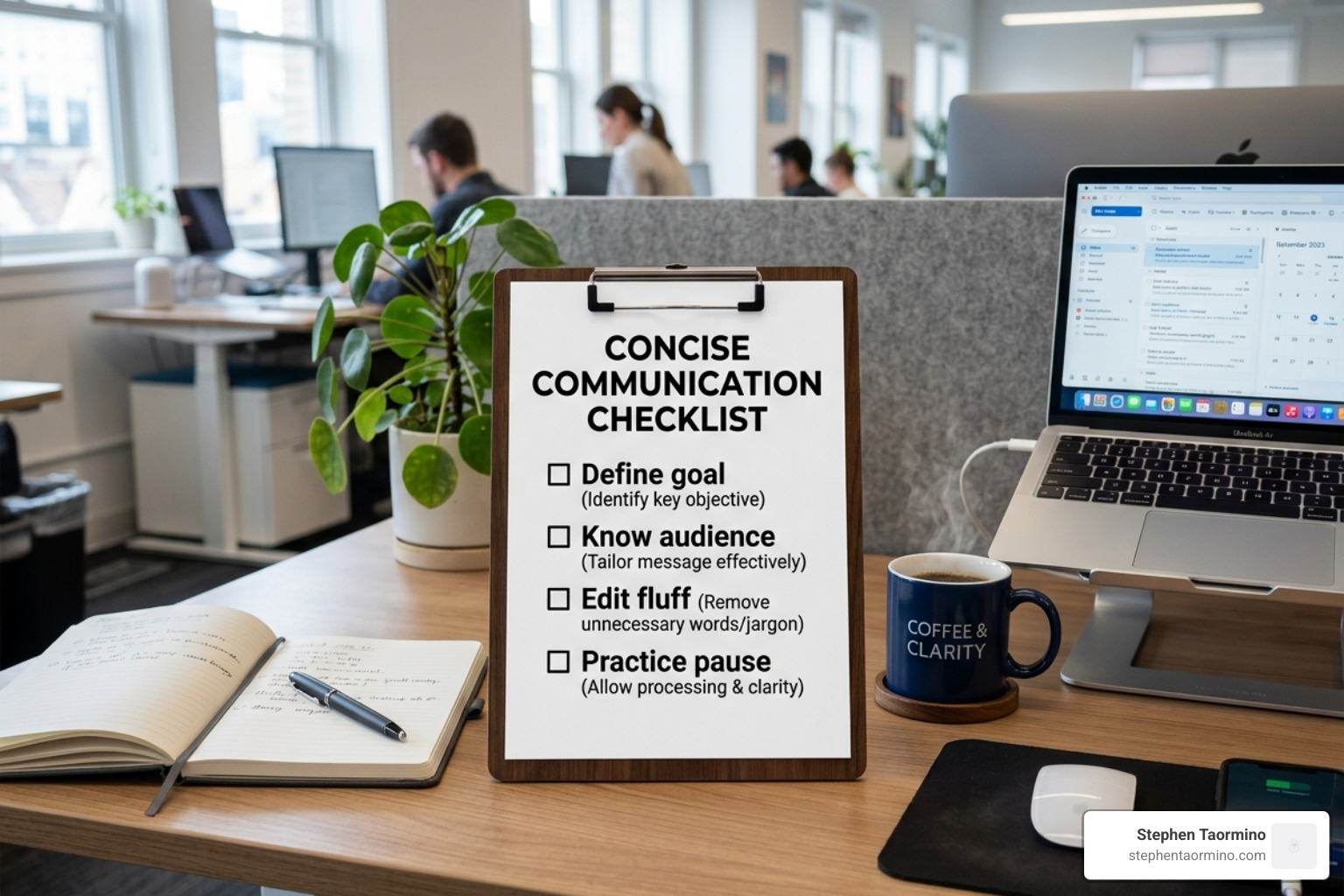
When we work with leaders on /from-mumbles-to-magnificence-elevate-your-leadership-communication-skills/, we emphasize the “Kill Your Darlings” rule. If a sentence, anecdote, or slide doesn’t directly serve the main point, delete it—no matter how clever or well-RESEARCHED it sounds. Clarity is more important than cleverness.
Adapting Impactful Communication Skills for Leadership and Teams
Leadership communication is about more than just giving orders; it’s about fostering a culture of transparency and trust. This requires high levels of emotional intelligence (EQ). Leaders with high EQ can read the room and adjust their tone, pace, and delivery to meet the team’s immediate needs.
For /strategic-communication-training-for-leaders-who-actually-want-to-be-heard/, we focus on creating robust feedback loops. A leader who only talks at their team is just a broadcaster. A leader who communicates with their team is a builder. This involves regular check-ins, town halls, and an “open door” policy that is actually practiced, not just stated.
Preparing for High-Stakes Dialogue
Whether it’s a board meeting, a high-stakes pitch, or a salary negotiation, preparation is non-negotiable. We use the Five W’s to frame our preparation:
- Who is my audience? What are their biases, needs, and pain points?
- What is the single most important thing they need to remember after I leave?
- Why do they care about this? What is the “What’s In It For Me” (WIIFM) factor?
- When is the best time to deliver this? Timing can be as important as the message itself.
- Where (which medium) is most appropriate? Should this be a face-to-face meeting, a video call, or a formal document?
For those seeking /executive-communication-coaching/, we also practice anticipating objections. If you know the “hard questions” are coming, you can prepare thoughtful, data-backed responses that keep you in control of the narrative.
Overcoming Barriers in the Modern Workplace
The workplace of today is hybrid, global, and incredibly fast-paced. This brings a host of new challenges: digital miscommunication, information overload, and cultural nuances that can lead to friction if not managed correctly.
To /stop-playing-telephone-with-these-essential-organizational-communication-tools/, we must establish clear team norms. For example:
- Email should be reserved for formal records, long-form information, and non-urgent updates.
- Slack/Teams is for quick updates, social interaction, and immediate, low-complexity questions.
- Video Calls/In-Person should be the default for complex, emotional, or high-stakes discussions where nonverbal cues are essential.
Digital etiquette is now a core part of impactful communication skills. A simple “k” response on a text might mean “okay” to a Gen Z employee but feel dismissive or even aggressive to a Baby Boomer manager. Awareness of these generational and cultural differences is key to maintaining harmony and productivity.
Navigating Tough Conversations
No one likes delivering bad news or giving “corrective” feedback. However, avoiding these conversations leads to toxic cultures and stagnant performance. The secret is to initiate the conversation from a neutral perspective and focus on the future rather than the past.
Instead of saying, “You were late with the report,” try, “I noticed the report didn’t arrive by the deadline; let’s look at what blocked the process and how we can solve it together for the next cycle.” This moves the conversation from blame to collaborative problem-solving. We offer /elevate-your-voice-executive-communication-training-options/ specifically designed to help leaders find their voice and maintain their composure in these uncomfortable but necessary moments.
Frequently Asked Questions about Impactful Communication
What are the 5 C’s of communication?
The 5 C’s are Clear, Concise, Concrete, Correct, and Coherent. A message that is clear avoids ambiguity; a concise message avoids fluff; a concrete message uses specific facts; a correct message is accurate; and a coherent message follows a logical flow. If your message hits all five, you are far more likely to achieve your desired outcome.
How does nonverbal communication impact a message?
Nonverbal communication provides the essential emotional context. If your words say you’re excited but your voice is flat and your arms are crossed, people will believe your body language over your words every single time. It accounts for the vast majority of how a message is perceived and interpreted by others.
How can I improve my communication skills quickly?
Start with active listening. In your next three conversations, focus on asking one more question than you usually do and paraphrasing what the other person said before you respond. Additionally, record yourself speaking during a presentation or meeting; you’ll be amazed at the filler words (“um,” “like”) and posture habits you didn’t know you had. Awareness is the first step toward improvement.
How do I handle communication in a hybrid team?
In hybrid teams, over-communication is often necessary. Ensure that decisions made in person are documented digitally for remote members. Use video whenever possible for meetings to capture nonverbal cues, and be intentional about scheduling “water cooler” moments to maintain social bonds that are often lost in a digital-only environment.
Conclusion
Mastering impactful communication skills is a continuous journey, not a final destination. At CC&A Strategic Media, we’ve seen how smarter communication serves as the foundation for building prosperity, fostering innovation, and creating stronger professional relationships across the globe. By leveraging marketing psychology and a deep understanding of human behavior, you can move from simply “exchanging information” to truly connecting and conquering your professional goals.
If you’re ready to take the next step in your leadership development and elevate your influence, here is your immediate action plan:
- Assess your current skills: Take note of your nonverbal habits and filler words this week.
- Practice the SLOW model: Use it during your next high-stakes meeting or difficult conversation.
- Refine your messaging: Apply the PREP method to your next three important emails or presentations.
- Seek expert guidance: Explore our specialized /panel-discussions/ and training options to sharpen your edge and lead with authority.
Communication is the true currency of influence. Spend it wisely to build the career and the organization you envision.