German
  English
  Spanish
  French


Introduction: The Blueprint for Agency Growth
A marketing strategy for a digital agency is your roadmap to sustainable growth and a distinct competitive advantage. At its core, it involves:
- Setting SMART Goals: Define specific, measurable objectives for business growth.
- Identifying Your Target Audience: Research and create detailed buyer personas.
- Crafting Your Unique Value Proposition: Articulate what makes your agency different.
- Choosing Key Marketing Channels: Select the right mix of content, SEO, social media, and paid ads.
- Establishing KPIs: Track metrics like lead generation, client acquisition cost, and revenue.
- Implementing and Optimizing: Execute the plan, measure results, and continuously improve.
Without a clear strategy, agencies struggle. A Smart Insights report found that only 17 percent of businesses clearly define their digital marketing strategies, a gap that represents both a challenge and an opportunity.
Thriving agencies build comprehensive strategies rooted in strategic focus, competitive positioning, and a deep understanding of their target market. They know how to attract ideal clients, demonstrate expertise, and scale efficiently.
In a crowded marketplace, your marketing strategy is a survival tool. It is how you prove your value, attract high-quality clients, and build the authority needed to command premium pricing. Yet many agency leaders get trapped in reactive mode, chasing leads and responding to RFPs instead of building a sustainable growth engine.
This is where a well-crafted marketing strategy for a digital agency changes everything. It provides the framework to align your team, ensure efficient resource allocation, and create a clear path to your agency’s ambitious future. For a deeper dive into how strategy fuels sustainable expansion, explore the insights on Business Growth Through Marketing.
This guide will walk you through building a strategy that delivers real results and reflects the marketing psychology principles Stephen Taormino uses with organizations worldwide.
The Foundation: Strategy vs. Tactics in Agency Marketing
To build an effective marketing strategy for a digital agency, it is vital to distinguish strategy from tactics. Think of it like constructing a house: the strategy is the blueprint, campaigns are the construction phases, and tactics are the individual tools like hammers and nails.
A strategy is the long-term, high-level plan to achieve business goals. It is the “why” and “what” of your marketing. Campaigns are targeted, medium-term efforts within that strategy, while tactics are the short-term, granular actions, the “how.”
| Aspect | Strategy (The ‘Why’) | Campaigns (The ‘What’) | Tactics (The ‘How’) |
|---|---|---|---|
| Goal | Long-term vision, overarching business objectives | Medium-term objectives within the strategy | Short-term actions, specific tasks |
| Focus | Direction, market positioning, audience identification | Thematic efforts, specific outcomes (e.g., product launch) | Tools, methods, specific actions (e.g., social media post) |
| Scope | Broad, guiding principle for all marketing | Focused, time-bound initiatives | Detailed, day-to-day activities |
| Change | Stable, evolves slowly | Adaptable, can be modified based on campaign performance | Flexible, can change rapidly |
A well-defined strategy ensures your efforts are cohesive. Without it, you risk wasting resources on disconnected tactics. The long-term benefits are clear: better efficiency, improved Marketing ROI Best Practices, and greater scalability for your agency.
Why a marketing strategy for a digital agency is non-negotiable
With hundreds of thousands of agencies operating worldwide, the market is saturated. A clear strategy is essential for survival and success.
- Market Saturation: A strategy helps you carve out a unique niche and communicate your value effectively.
- Building Credibility: A strong strategy demonstrates deep expertise and builds Authority in Marketing for your agency.
- Attracting Ideal Clients: Defining your target audience attracts clients who are a strong fit, leading to more successful projects.
- Demonstrating Expertise: Your own marketing is a living portfolio. Consistent execution proves you can deliver results.
- Aligning the Team: A shared strategy ensures everyone is working toward the same goals, fostering cohesion and efficiency.
- Resource Allocation: A strategy guides where to invest time and money for maximum impact.
A thoughtful marketing strategy for a digital agency also supports the kind of long-term vision Stephen Taormino champions in his work with leaders, where marketing is tightly aligned with business development and leadership goals.
The crucial difference between your agency’s marketing and client marketing
Marketing your own agency is fundamentally different from marketing for clients. Many leaders refer to this as “eating your own dog food”; in practice, it is about proving that your methods work in the real world.
Your agency’s internal marketing strategy is about:
- Proving Your Methods: You must demonstrate that the strategies you recommend to clients work for your agency first.
- Generating Agency Leads: Your marketing aims to attract potential clients for your services, focusing on your unique expertise and the problems you solve.
- Budgeting for Internal Growth: You need to allocate a dedicated budget and resources to your own marketing to Drive Business Results for your brand.
- Showcasing Results: You use your own success stories and case studies to build trust, turning your agency into its own best client.
When you treat your internal marketing with the same rigor you apply to client work, you create a powerful proof point that reinforces your authority and gives prospects confidence in your approach.
The Blueprint: Core Components of a Winning Agency Strategy
Every successful marketing strategy for a digital agency is built on three foundational pillars: Goals, Audience, and a Unique Value Proposition (UVP). These form the blueprint for your entire marketing effort and keep day-to-day tactics aligned with the bigger picture.
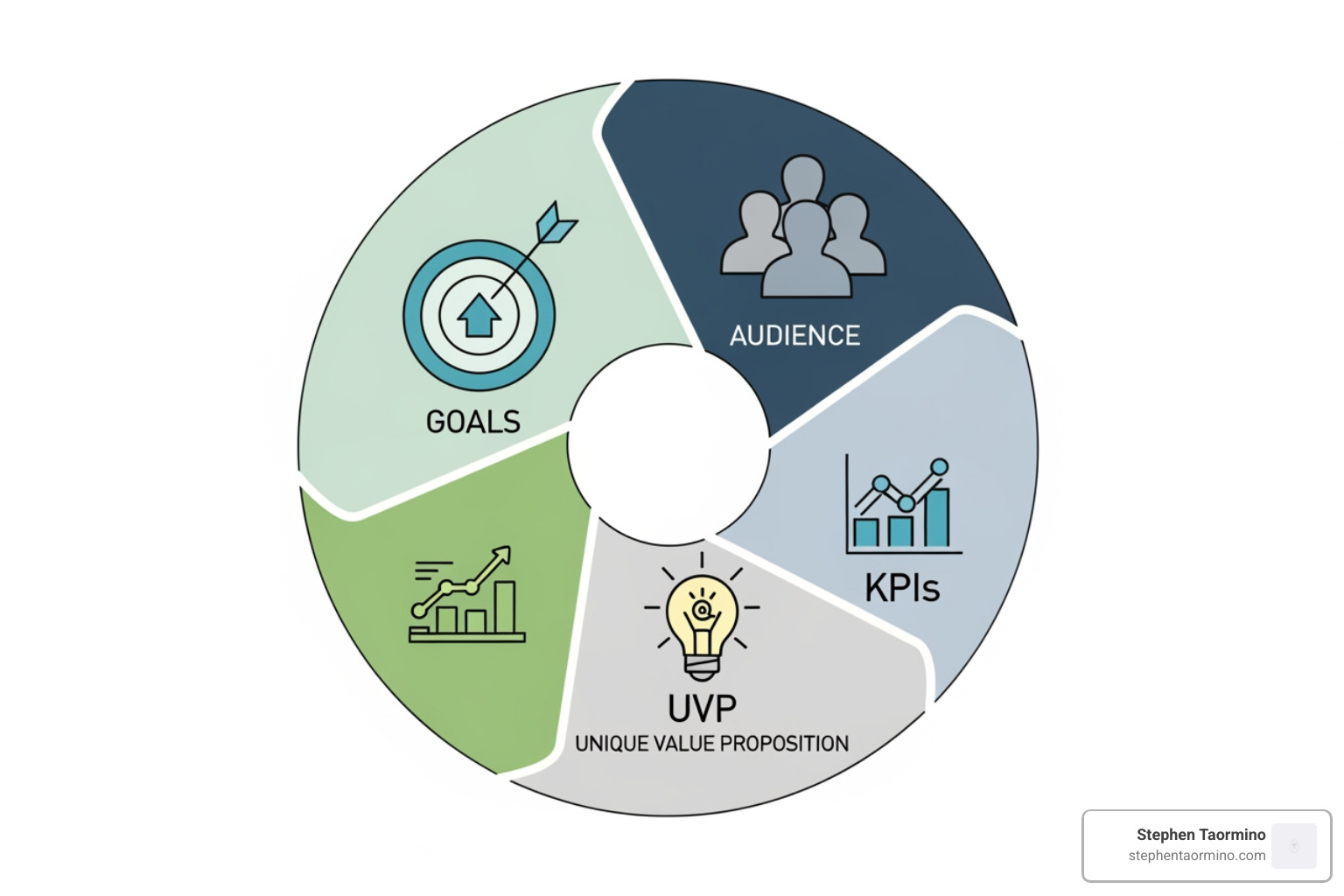
Effective marketing is rooted in a deep understanding of human behavior and Marketing Psychology Insights. This understanding informs how you set goals, define your audience, and craft your message, an approach that is key for Marketing for Business Leaders to excel.
Setting SMART Goals and Objectives
Before deciding how to market, define what you want to achieve with SMART goals. They provide clarity, focus, and a way to measure progress.
SMART stands for:
- Specific: Goals must be clear and well-defined (for example, “Acquire 5 new retainer clients in the SaaS industry”).
- Measurable: Use concrete criteria to measure progress (such as lead conversion rates or website traffic).
- Achievable: Goals should be realistic and attainable given your resources.
- Relevant: Marketing goals must align with overall business objectives and long-term agency positioning.
- Time-bound: Every goal needs a deadline to create urgency.
Example agency goals might include:
- Increase website traffic by 30% in the next six months.
- Boost social media engagement by 15% next quarter.
- Achieve a 90% client satisfaction score in the next survey.
For leadership teams, connecting these goals back to broader growth plans helps ensure marketing is viewed as a strategic investment rather than a cost center.
Defining Your Target Audience and Niche
Trying to market to “everyone” is futile. Your target audience is a specific group of businesses that genuinely need what you offer. Create detailed buyer personas based on research and data:
- Demographics: Industry, company size, revenue, job title.
- Psychographics: Goals, challenges, pain points, motivations.
- Behavioral Data: How they search for solutions and what content they consume.
Tools such as Google Analytics, keyword research platforms, and CRM data are invaluable for this research.
Once you understand your audience, identify your niche, a specialized area where you can be the go-to expert. For example, an agency might focus on B2B technology, professional services, or home-service businesses, allowing the team to tailor services and messaging for maximum impact. Focusing on a niche makes you more efficient and effective, and it simplifies your Competitive Analysis Strategies.
Crafting Your Unique Value Proposition (UVP)
Your Unique Value Proposition (UVP) answers the question: “Why should a client choose us over any other agency?” It is the core benefit you provide that sets you apart.
A great UVP for an agency:
- Clearly identifies the target client.
- Highlights the specific problem you solve.
- Explains the tangible results clients will achieve.
- States how you are uniquely different.
- Is supported by evidence like case studies or data.
For example, instead of “We do great SEO,” a stronger UVP might be: “We help B2B SaaS companies generate more qualified leads by leveraging behavior-driven content and analytics, an approach that goes beyond traditional keyword optimization.”
For additional guidance, you can review The Expert Guide to Crafting a Strong Value Proposition and then refine your own statement so it fits your agency’s strengths and the outcomes you consistently deliver.
A clear UVP not only improves your marketing strategy for a digital agency, it also lays the groundwork for Industry Thought Leadership by defining the lens through which you communicate your expertise.
Building Your Marketing Strategy for a Digital Agency: A Step-by-Step Guide
With the foundational components in place, it is time to build your marketing strategy for a digital agency. Think of this as an iterative process of planning, execution, and optimization that creates a practical Digital Business Model Framework to support sustainable growth.
Strategic planning is most effective when it is documented and time-bound. Many high-performing agencies use 90-day planning cycles to translate annual goals into focused, achievable projects that align sales, marketing, and operations.
Step 1: Conduct a Thorough Situation Analysis
Before charting a new course, you need to know where you stand. A situation analysis provides a data-driven foundation for your strategy.
- Internal Audit: Review your current marketing efforts. What is working and what is not? What resources (team, budget, tools) do you have?
- Competitor Research: Analyze your main competitors. What are their strengths, weaknesses, and marketing strategies? Tools like professional SEO platforms are invaluable for analyzing their keywords and content.
- Market Trends Analysis: Identify current and emerging Digital Marketing Industry Trends, such as AI integration and evolving privacy regulations.
- SWOT Analysis: Combine the above into a Strengths, Weaknesses, Opportunities, and Threats (SWOT) analysis to get a clear snapshot of your agency’s position and strategic priorities.
This step ensures your marketing strategy for a digital agency is grounded in reality rather than assumptions.
Step 2: Choose Your Key Marketing Levers and Channels
Based on your goals, audience, and UVP, select the marketing channels that will deliver the best results. Prioritize channels where your target audience is most active and where you can reliably execute.
Common marketing channels for digital agencies include:
- Content Marketing: Creating valuable content (blogs, case studies, white papers) to attract and retain your target audience.
- Search Engine Optimization (SEO): Optimizing your website and content to rank higher in search results for relevant keywords.
- Pay-Per-Click (PPC) Advertising: Running paid ad campaigns on platforms like Google Ads and social media for immediate, targeted traffic.
- Social Media Marketing: Building brand awareness and engaging with your audience on platforms such as LinkedIn for B2B.
- Email Marketing: Nurturing leads and building relationships through personalized email campaigns.
- Account-Based Marketing (ABM): A highly targeted strategy for high-value accounts, personalizing marketing and sales efforts. This is effective for B2B Marketing Strategies to Optimize Sales Conversions.
- Webinars & Events: Hosting events to showcase expertise, generate leads, and build community.
When Stephen Taormino advises leadership teams, he often emphasizes that the right channel mix is the one your team can execute consistently while staying aligned with your positioning and sales motion.
Step 3: Develop a Powerful Content Marketing Engine
Content marketing is the cornerstone of an effective marketing strategy for a digital agency. It is how you prove expertise, build trust, and attract organic traffic.
- Blogging: Regularly publishing blog posts optimized for relevant keywords establishes topical authority and attracts organic search traffic.
- Case Studies: These provide concrete social proof of how you have helped clients achieve measurable results. They also showcase your process and thinking.
- White Papers & E-books: In-depth, long-form content positions you as a thought leader and serves as a valuable lead magnet.
- Video Marketing: Engaging video content, from explainers to testimonials, can significantly boost your online presence.
- Lead Magnets: Offer valuable resources like templates or checklists in exchange for contact information to build your email list.
Your content should be optimized for search engines and social sharing to fuel your inbound marketing efforts. For help planning and structuring that content, you can discover how to create compelling content with this content creation resource.
Step 4: Establish KPIs and a Measurement Framework
What gets measured gets managed. Establishing clear Key Performance Indicators (KPIs) is essential for tracking progress and optimizing your strategy.
Common marketing KPIs for agencies include:
- Website Traffic: Total visits, unique visitors, and traffic sources.
- Conversion Rates: The percentage of visitors who complete a desired action (for example, filling out a contact form).
- Cost Per Lead (CPL): The average cost to acquire one lead.
- Customer Acquisition Cost (CAC): The total cost to acquire a new paying client.
- Client Lifetime Value (CLV): The predicted total revenue from a client relationship.
- Social Media Engagement: Likes, shares, comments, and follower growth.
- Email Marketing Metrics: Open rates, click-through rates, and conversions.
- Search Engine Rankings: Your position in search results for target keywords.
Tools like Google Analytics and SEO analytics platforms are indispensable for tracking these KPIs and calculating your return on investment. For a deeper look at how to structure this analysis, review the guidance on Marketing ROI Measurement Tools.
When your KPIs are tightly linked to business outcomes, it becomes much easier to communicate the value of your marketing strategy for a digital agency to internal stakeholders and clients alike.
Execution and Future-Proofing Your Agency’s Growth
A great marketing strategy for a digital agency is only half the battle; success lies in execution and continuous adaptation. This phase is about turning your blueprint into a dynamic operation, ready to pivot based on data and new market realities. It is also about building strong Business Relationship Building Strategies and ensuring your strategy is future-proof.
Agencies that thrive in fast-changing environments treat execution as an ongoing learning process, not a one-time campaign push. That mindset aligns with Stephen Taormino’s work in helping leaders adapt quickly without losing sight of core business objectives.
Leveraging Data, Analytics, and AI
Data allows you to move beyond guesswork and make informed decisions to continuously optimize your marketing strategy.
- Data-Driven Decisions: Use analytics to understand audience behavior, identify trends, and A/B test everything from ad creative to landing pages.
- Campaign Optimization: Fine-tune campaigns in real time, allocating your budget to the highest-performing channels to maximize ROI.
- AI Integration: Leverage AI for tasks like generating content ideas, drafting copy, and analyzing large datasets to uncover insights faster. This aids in AI-Driven Customer Engagement Solutions and can significantly boost productivity.
- Predictive Analytics: Use advanced analytics to forecast future trends and customer behavior, allowing you to proactively adjust your strategy with Predictive Marketing Analytics.
Research such as the analysis from MIT Sloan on how generative AI can boost highly skilled workers’ productivity underscores how powerful these tools can be when used thoughtfully.
Scaling Your Strategy: Systems and Processes
To scale effectively, you need robust systems and processes that automate repetitive tasks and streamline operations.
- Automating Reports: Use reporting tools to automate the creation of client reports. This saves significant time and improves client communication.
- Client Onboarding: A structured, repeatable onboarding process, including a clear questionnaire and kickoff meeting, sets the stage for a successful relationship.
- Systemizing Proposals & Contracts: Use digital signature software to create templates and automate the signing process, shortening the sales cycle.
- Streamlining Sales: Optimize every step of your sales process. Research shows that firms contacting potential customers within an hour are seven times more likely to close the deal. Use automated scheduling tools to automate appointments.
- CRM Optimization: Implement and optimize a robust CRM platform to manage client relationships and nurture leads. This is a core part of CRM Optimization Strategies for Sales Teams.
These systems free your team to focus on higher-value strategic thinking and creative work, the kind of contributions that leaders bring Stephen Taormino in to help amplify.
Communicating Your Strategy and Results to Clients
Even the best strategy is only as effective as its communication. Transparent and effective communication builds lasting partnerships.
- Set Expectations: From the outset, clearly communicate your strategy, goals, and process to manage client expectations.
- Report Transparently: Provide clear, concise reports that focus on business goals like lead generation, sales, and ROI, not just vanity metrics.
- Tell a Story with Data: Explain why metrics are important, what they mean for the client’s business, and how your actions are driving those outcomes.
- Demonstrate Value Beyond Metrics: Highlight qualitative successes, such as improved brand perception or positive customer feedback. This requires strong Executive Communication Coaching skills.
When you combine clear communication with a strong marketing strategy for a digital agency, you position your team as a true partner rather than a vendor.
Conclusion: Turning Strategy into a Competitive Advantage
You now have the core elements needed to craft a robust marketing strategy for a digital agency, from foundational components to execution and future-proofing. A well-defined strategy is what differentiates you in a crowded market, attracts ideal clients, and drives sustainable growth.
The key steps we covered include:
- Setting SMART goals that align marketing with overall business objectives.
- Defining a focused audience and niche, supported by detailed buyer personas.
- Crafting a clear, evidence-backed UVP.
- Conducting situation and SWOT analyses to ground your decisions in reality.
- Choosing the right mix of channels and building a content engine that demonstrates expertise.
- Establishing KPIs and a measurement framework that tie activity to outcomes.
- Leveraging data, AI, and systems to execute, scale, and adapt.
In a world of constant change, your strategy must be a living document, continually refined by data, market trends, and new technologies. As an expert in marketing psychology and digital transformation, Stephen Taormino emphasizes that the best strategies are rooted in a deep understanding of human behavior. It is about knowing not just what to do, but why it resonates with the people you want to reach.
A well-defined strategy is your roadmap to becoming an industry leader and to building the kind of resilient, people-centered organization Stephen advocates in his keynotes and advisory work. To build a forward-thinking, adaptable agency, explore the Digital Marketing Transformation Framework and consider how these principles could shape your next 90 days of focused execution.
If you are ready to take the next step in aligning your agency’s marketing with a clear, psychology-driven strategy, use the insights in this guide as your blueprint and revisit it often as your agency grows.