German
  English
  Spanish
  French


Why Psychological Marketing Strategies Are the Key to Winning More Customers
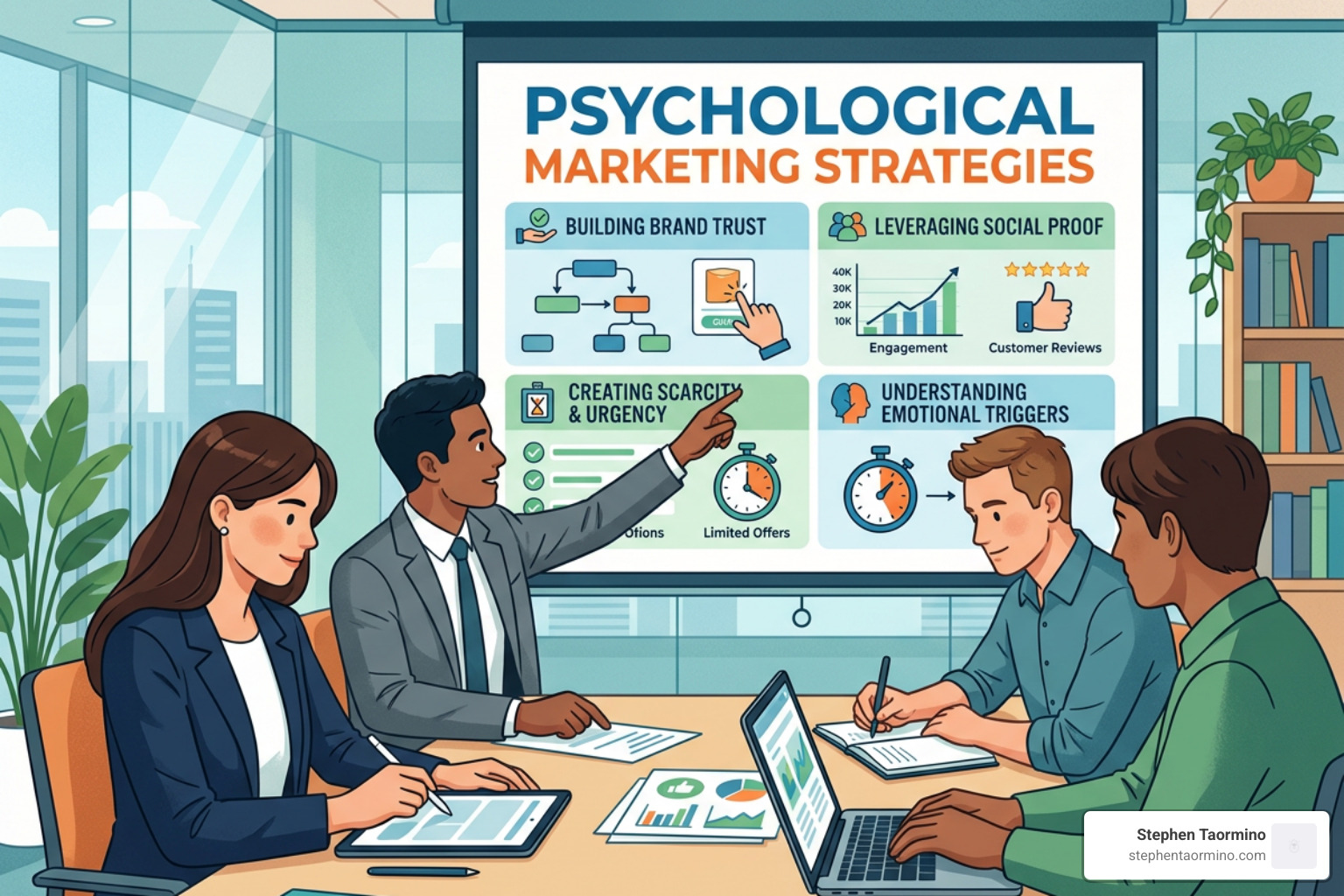
Psychological marketing strategies help businesses influence buying decisions by aligning their messaging with how people actually think, feel, and choose. Here are the most effective ones:
| Strategy | What It Does |
|---|---|
| Reciprocity | Give value first to earn trust and action |
| Social Proof | Use reviews and testimonials to reduce doubt |
| Scarcity & Urgency | Create fear of missing out to drive faster decisions |
| Anchoring | Set a reference price to make deals feel bigger |
| Loss Aversion | Frame offers around avoiding loss, not just gaining |
| Foot-in-the-Door | Start small to build toward bigger commitments |
| Liking Principle | Build a brand people feel connected to |
Most marketing advice focuses on what to do — better ads, stronger CTAs, sharper copy. But the real edge comes from understanding why people buy.
Here’s the thing: most purchasing decisions aren’t as rational as we’d like to think. Research suggests that a significant portion of consumer choices are driven by subconscious processes — emotions, instincts, and cognitive shortcuts that happen before logic even enters the picture.
That means if your marketing is only speaking to your customer’s rational mind, you’re missing most of the conversation.
The businesses that consistently win customers aren’t just selling better products. They’re communicating in ways that align with how the human brain actually works.
I’m Steve Taormino, President & CEO of CC&A Strategic Media, and for over 25 years I’ve helped organizations worldwide apply psychological marketing strategies to drive real growth — from early-stage digital campaigns to enterprise-level brand positioning. In the sections below, I’ll walk you through the exact principles that move people from passive browsers to loyal buyers.
The Science of Choice: Understanding Psychological Marketing Strategies
To master psychological marketing strategies, we first have to look at the engine under the hood: the human brain. We often imagine ourselves as “Homo Economicus”—perfectly rational beings who weigh every feature and benefit before making a choice. In reality, we are “predictably irrational,” as behavioral economists often say.
The American Marketing Association defines consumer behavior as the study of how customers make decisions regarding the products they purchase. It’s not just about what they buy, but why they buy it, how they use it, and how they feel afterward.
The Dual-Process Theory: System 1 and System 2
Psychologist Daniel Kahneman famously described two systems of thinking. System 1 is fast, instinctive, and emotional. System 2 is slower, more deliberative, and logical. Most of our daily choices are dominated by System 1 because our brains are designed to conserve energy.
There is a common “95% myth” in marketing circles—the idea that 95% of all purchasing decisions are purely subconscious. While scholarly reviews from Harvard Business School caution against assigning an exact percentage, the core truth remains: our non-conscious mind plays a massive role in our preferences. Successful marketing earns an intuitive preference from System 1 first, then provides the “facts” so System 2 can justify the purchase later.
Foundational Behavioral Theories
To build a strategy that sticks, we rely on several psychological pillars:
- Maslow’s Hierarchy of Needs: This tiered model of human needs ranges from basic physiological survival to self-actualization. If your product solves a “safety” need (like insurance) but your marketing focuses on “self-actualization” (prestige), you’ll likely see a disconnect in conversions.
- Theory of Planned Behavior: This psychological theory suggests that a person’s intention to perform a behavior is the best predictor of whether they actually do it. Intentions are shaped by attitudes, social pressure, and perceived control.
- Cognitive Dissonance: This is the mental discomfort we feel when our beliefs don’t match our actions. In marketing, VeryWell Mind describes cognitive dissonance as the regret or “buyer’s remorse” a consumer feels after a purchase. We use marketing to reinforce their decision and prove they made the right choice.
Understanding these fundamentals allows us to move beyond “hacks” and toward a comprehensive strategy for /human-behavior-marketing.
7 Core Tactics to Win More Customers
When we apply these theories to the real world, we see specific patterns emerge. These aren’t just tricks; they are reflections of how we are “hard-wired” to connect and act. For a deeper dive, check out our /marketing-psychology-insights.
Leveraging Reciprocity and Social Proof as Psychological Marketing Strategies
The principle of reciprocity is simple: if you do something for someone, they feel a natural urge to do something for you. Dr. Robert Cialdini, the godfather of persuasion science, highlights this as a primary driver of human behavior.
Consider the “mint experiment”: research found that when a server provides a single mint with the bill, tips increase by about 3.3%. If they provide two mints, the tip increases by 20%. In digital marketing, we use this by offering free e-books, webinars, or high-value audits before asking for a sale.
Social proof is the other side of that coin. We look to others to see what is “correct” or “popular.” This is why 93% of consumers read online reviews before buying. By showcasing user-generated content, testimonials, and influencer endorsements, we reduce the perceived risk for the new customer. You can learn more about these triggers in our /category/psychology section.
Scarcity, Urgency, and Loss Aversion
We are evolutionarily programmed to value things that are in short supply. This is known as the scarcity principle. When something is “limited edition” or “only 2 left in stock,” it triggers a “positive tension” that pushes us to act now.
This is closely tied to Loss Aversion theory, which suggests that the pain of losing is twice as powerful as the joy of gaining. In other words, telling a customer they will “save $50” is good, but telling them they are “losing $50 every month they wait” is often more persuasive.
Pricing Mastery with Anchoring and the Decoy Effect
How do you know if $1,000 is a good price for a service? You don’t—unless you have a reference point. This is anchoring. By presenting a higher-priced “Premium” option first, the “Standard” option seems like a bargain by comparison.
The Decoy Effect takes this further. Imagine two coffee sizes: Small ($3) and Large ($7). Most people pick the Small. But if you introduce a “Medium” at $6.50, the Large suddenly looks like an incredible value for just 50 cents more. The Medium is the “decoy”—it exists only to make the Large more attractive.
Implementing the Foot-in-the-Door Technique in Psychological Marketing Strategies
It is much easier to get a “yes” to a large request if you’ve already secured a “yes” to a small one. This is the Foot-in-the-Door technique. By getting a lead to sign up for a newsletter or download a free guide, you are building a “consistency” loop. Humans have a deep-seated need to be consistent with their past actions. Once they see themselves as someone who “uses your resources,” they are more likely to become someone who “buys your products.” We explore these nuances of /behavioral-economics-marketing-techniques.
The Liking Principle and Brand Personality
We prefer to say yes to people—and brands—that we like. According to the liking principle, we are drawn to those who share our values, pay us compliments, or are simply attractive and relatable.
Statistics show that individuals who build an emotional connection with a brand are 8.4 times more likely to trust that brand and 7.1 times more likely to make a repeat purchase. This is why storytelling is so vital. When a founder shares their personal “why,” or a brand uses a friendly chatbot that feels human, they aren’t just giving information—they are building a relationship.
Information-Gap Theory and Curiosity
Economist George Loewenstein proposed that curiosity is like an itch we have to scratch. When there is a gap between what we know and what we want to know, it creates a powerful emotional response.
Marketers use this to drive massive click-through rates. A headline like “The 3 things you didn’t know about SEO” creates an information gap. To close that gap, the user must click. Tools like the CoSchedule headline analyzer can help you craft these curiosity-driven hooks effectively.
The Baader-Meinhof Phenomenon and Frequency Illusion
Have you ever bought a new car and suddenly started seeing that exact model everywhere? That’s the Baader-Meinhof phenomenon. Once your brain is “primed” with a piece of information, it starts noticing it more frequently.
In marketing, we use retargeting ads to create this effect. By showing your brand to a prospect across different platforms, you aren’t just “staying top of mind”—you are creating a familiarity heuristic. The more often they see you, the more they trust you, and the more “important” your brand seems in their world.
Visual and Sensory Triggers in Marketing Psychology
Our brains process visual information much faster than text. In fact, 90% of the data the brain processes is visual. This is why the design of your website and ads is just as important as the copy.
Color Psychology and Imagery
Colors aren’t just aesthetic choices; they are emotional triggers.
- Red creates urgency and is often used for “Clearance” sales.
- Blue evokes trust and calmness, which is why it’s a favorite for financial institutions.
- Green is synonymous with health, nature, and sustainability.
Research shows that 62% to 90% of impulse decisions are based on colors alone.
Furthermore, the angle of your imagery matters. Taking a photo of a product from a low angle can produce a “heroic” type image, suggesting strength and superiority. High-angle shots, conversely, can make a product seem more approachable.
The Power of White Space and Fluency
“Cognitive fluency” is the ease with which our brains process information. If a website is cluttered, our brains have to work harder, which creates a subtle feeling of “distrust.” By using ample white space, we make our content easier to read and our brand feel more credible.
Neuromarketing: The Future of Insights
Some of the most advanced psychological marketing strategies now involve neuromarketing, which uses medical technology like MRIs to measure brain activity in response to marketing stimuli. This allows us to see what truly excites a customer, rather than just what they say excites them in a survey.

Ethical Implementation: Persuasion vs. Manipulation
With great power comes great responsibility. Using psychology to influence behavior can easily slip into manipulation if we aren’t careful. Manipulation involves tricking someone into doing something that isn’t in their best interest. Persuasion, on the other hand, involves helping them make a decision that solves their problem.
To stay on the right side of the line, we use the Transparency Test: If you were to fully and honestly explain the psychological principle you are using to your customer, would they thank you for helping them, or would they feel deceived?
We also have to consider how social media affects users’ mental wellness. Using unrealistic beauty standards or creating “fake” scarcity can lead to a quick sale, but it destroys long-term brand trust. In an era where consumers are increasingly distrustful of big corporations, authenticity is your greatest competitive advantage.
Finally, ensure your psychological tactics are aligned with the strategic goals of your organization. Don’t just add a countdown timer because “it works”—ensure it serves the broader mission of providing value to your community.
Frequently Asked Questions about Psychological Marketing
What is the most effective psychological marketing strategy?
There is no single “magic bullet,” but Social Proof is arguably the most universal. Because humans are social creatures, we are almost always influenced by the actions and opinions of others. Whether it’s a “Bestseller” tag or a 5-star review, social proof consistently lowers the barrier to purchase.
How do you measure the success of psychological tactics?
We track specific metrics based on the tactic used. For curiosity-driven headlines, we look at Click-Through Rates (CTR). For scarcity and urgency, we monitor Conversion Rates during specific windows. For the Liking Principle, we look at Customer Lifetime Value (CLV) and repeat purchase rates. A/B testing is the gold standard for seeing which psychological trigger resonates most with your specific audience.
Is using psychology in marketing ethical?
Yes, provided it is used to connect people with products and services that actually benefit them. Psychology in marketing is simply about understanding human communication. It becomes unethical when it uses deception, creates false fear, or targets vulnerable populations with products they don’t need.
Conclusion
Mastering psychological marketing strategies isn’t about “tricking” people; it’s about becoming a better communicator. When you understand the science of choice, you can stop shouting into the void and start building meaningful connections that lead to real business growth.
At CC&A Strategic Media, we specialize in this intersection of human behavior and digital transformation. We help you look past the “what” of your marketing and master the “why.” Whether you’re looking to refine your pricing architecture or build a more relatable brand personality, we have the expertise to help you unlock your potential.
Ready to see these principles in action? Watch more on marketing psychology to discover how we help businesses like yours win more customers through the power of behavioral insights.