
Digital Marketing Innovation Is Rewriting the Rules of Growth
Digital marketing innovation is the engine driving modern business growth, fundamentally altering how brands interact with their audiences in an increasingly fragmented digital landscape. It is the ongoing process of applying new technologies, strategies, and data-driven thinking to reach, engage, and convert customers more effectively. In an era where consumer attention is the most valuable currency, innovation is no longer a luxury—it is a survival mechanism.
| Area | What’s Changing |
|---|---|
| AI & Automation | Campaigns that learn and optimize in real time |
| Personalization | Hyper-relevant experiences powered by first-party data |
| Omnichannel | Seamless digital-physical customer journeys |
| Emerging Tech | AR, voice search, and immersive metaverse experiences |
| Privacy | Consent-based, trust-first data strategies |
| Agentic Marketing | AI systems that autonomously execute decisions |
The pace of change is hard to overstate. Digital marketing now commands nearly 75% of global marketing budgets — a figure projected to hit three-quarters of a trillion dollars by 2026, according to data from Statista. At the same time, up to 30% of those budgets are still being wasted, according to most marketers. The gap between brands that innovate and those that don’t is widening fast, creating a “digital divide” that separates market leaders from those struggling to maintain relevance.
What’s driving this shift? A few forces are converging at once. Generative AI is moving from experiment to essential infrastructure. Consumers expect personalized experiences — 71% feel frustrated when they don’t get them. Privacy regulations, such as GDPR and CCPA, are forcing a rethink of how data is collected and used. Furthermore, emerging technologies like augmented reality and voice search are creating entirely new ways to connect with audiences. This evolution requires a shift from traditional campaign-based thinking to a more fluid, adaptive approach.
The brands pulling ahead aren’t just adopting the newest tools. They’re rethinking how they market — building systems that learn, adapt, and build genuine trust with customers. This involves a deep understanding of the “Innovation S-Curve,” where early adoption of transformative tech leads to exponential growth before reaching maturity. By staying ahead of the curve, businesses can capture market share while others are still trying to understand the basics.
This guide cuts through the noise and gives you a clear, practical look at where digital marketing innovation is headed and what it means for your business. We will explore the technical, strategic, and psychological shifts that are defining the next decade of commerce.
I’m Steve Taormino, President & CEO of CC&A Strategic Media, with over 25 years of experience in SEO, SEM, digital reputation management, and marketing psychology — fields that sit at the very center of today’s digital marketing innovation conversation. I’ve seen this industry transform from basic website design to AI-driven autonomous campaigns, and I’ll walk you through what actually matters for your growth. My focus has always been on the intersection of human behavior and technological capability, ensuring that every innovation serves a clear business objective.
Basic digital marketing innovation terms:
Hyper-Personalization: The Heart of Digital Marketing Innovation
In the early days of the internet, personalization meant putting a customer’s first name in an email subject line. Today, digital marketing innovation has pushed us into the era of hyper-personalization. This isn’t just about knowing a name; it’s about predicting a need before the customer even articulates it. It involves the use of real-time data and AI to deliver content, products, and services that are uniquely relevant to the individual user at a specific moment in time.
The data is clear: 75% of consumers are more likely to purchase from brands that deliver personalized content. Furthermore, companies that lead in personalization are 48% more likely to exceed their revenue goals. Why? Because they move beyond static personas and use real-time micro-signals—such as browsing behavior, location, and even weather patterns—to tailor the journey. This level of relevance reduces friction and builds a sense of being “understood” by the brand.
However, we are also hitting a “privacy wall.” With third-party cookies crumbling, the focus has shifted to first-party data (information you collect directly, like email sign-ups) and zero-party data (information customers intentionally share with you, like preference center choices). According to Forrester, the shift toward zero-party data is one of the most significant changes in the relationship between brands and consumers, as it relies on explicit consent and value exchange.
To succeed, we must build privacy-friendly strategies that turn compliance into a competitive advantage. Instead of “creepy” tracking, we use data to provide genuine value. When a customer feels that a brand truly “gets” them, loyalty follows naturally. For a deeper dive into these foundational shifts, check out our digital marketing strategies ultimate guide and stay ahead of the latest digital marketing industry trends.
How Generative AI Fuels Digital Marketing Innovation
If hyper-personalization is the heart, then Generative AI (GenAI) is the engine. We are seeing a massive shift in how content is produced. Currently, 46% of marketers use AI to scale creative, and 95% are testing AI for creative production. This technology allows for the democratization of high-quality creative, enabling even smaller brands to compete with larger players in terms of content volume and quality.
GenAI allows us to create thousands of variations of an ad or an email in the time it used to take to write one. This isn’t just about “more” content; it’s about “smarter” content. Imagine a system that sees a user is browsing from a rainy city and automatically adjusts the hero image on your website to reflect a cozy, indoor vibe. This dynamic creative optimization (DCO) ensures that the message always matches the context of the consumer.

At CC&A, we often talk about the Centaur Model. This is the ultimate form of human-AI collaboration. In this model, the AI handles the heavy lifting—data crunching, drafting variants, and initial optimization—while the human marketer provides the strategy, brand voice, and ethical guardrails. As a digital-advertising-speaker, I often emphasize that AI is an amplifier, not a substitute. It allows your team to focus on high-level digital marketing presentation topics while the machine handles the repetitive tasks. This synergy is where true innovation happens, combining the speed of silicon with the empathy of the human mind.
The Shift to Omnichannel Customer Loyalty
Innovation doesn’t happen in a vacuum; it happens where the customer lives. Today’s consumer doesn’t see a “social media channel” or a “physical store”—they see a single brand. 71% of consumers expect tailored interactions across every touchpoint and feel frustrated when the experience is disjointed. This expectation has led to the rise of “unified commerce,” where the boundaries between online and offline shopping are completely blurred.
True digital marketing innovation involves stitching together these digital and physical interactions. This includes:
- Retail Media: Leveraging data from retail platforms to show ads at the exact moment of purchase intent. This is one of the fastest-growing segments in digital advertising.
- Social Commerce: Allowing users to buy products directly within apps like Instagram or TikTok without ever leaving the platform. This reduces the steps in the conversion funnel and capitalizes on impulse buying.
- Conversational Messaging: Using AI-powered chatbots on WhatsApp or SMS to guide a customer through a sales funnel with the ease of a text conversation. This provides a 24/7 concierge service that can handle everything from product discovery to post-purchase support.
When these elements work in harmony, you create a frictionless journey that rewards loyalty and drives repeat business. The goal is to create a “flywheel effect” where every interaction provides data that makes the next interaction even better.
From Automation to Agentic Marketing Systems
For years, we’ve relied on marketing automation—if a user does X, then do Y. But we are now entering the fourth era of marketing: Agentic Marketing. This represents a shift from deterministic systems to probabilistic ones, where the software can make decisions based on goals rather than just following a script.
The difference is profound. While automation follows rigid rules, agentic systems “reason” and act independently based on goals we set. They can analyze vast datasets, identify patterns that a human might miss, and execute complex workflows across multiple platforms simultaneously.
| Feature | Marketing Automation | Adaptive (Agentic) Marketing |
|---|---|---|
| Logic | Rule-based (If/Then) | Goal-based (Reasoning) |
| Execution | Static workflows | Autonomous execution |
| Optimization | Manual A/B testing | Real-time, self-correcting |
| Budgeting | Pre-set allocations | Dynamic spend redistribution |
By moving to agentic systems, brands have seen a 40% reduction in campaign management time and a 31% average improvement in ROAS (Return on Ad Spend). These systems process hundreds of signals in milliseconds to place the perfect bid or show the perfect creative variant. This shift is a core component of any modern digital marketing transformation framework. It allows marketing teams to scale their efforts without a linear increase in headcount, focusing instead on the strategic direction of the “agents.”
Adaptive Marketing and Self-Evolving Campaigns
The most exciting frontier of agentic systems is adaptive marketing. Imagine a campaign that isn’t refreshed quarterly or monthly, but minute-by-minute. These are “living” campaigns that learn from every impression, click, and conversion. They use reinforcement learning to understand which combinations of creative, audience, and placement are performing best and automatically shift resources toward them.
According to research on how AI builds self-evolving campaigns, these systems use Emotion AI and sentiment analysis to detect shifts in audience mood. If a travel brand notices a spike in “nostalgia” sentiment in social comments, the AI can autonomously rewrite ad copy to emphasize “reconnecting with family” rather than “adventure seeking.” This level of agility was previously impossible for human teams to achieve at scale.
This real-time learning loop ensures that your creative never goes stale. It’s a powerful way to increase digital marketing roi by ensuring every dollar is spent on the message that is resonating right now. Furthermore, it allows brands to respond to cultural moments or market shifts in seconds, rather than days or weeks. In a world where trends can go viral and disappear in 48 hours, this speed is a massive competitive advantage.
Immersive Technologies Revolutionizing Engagement
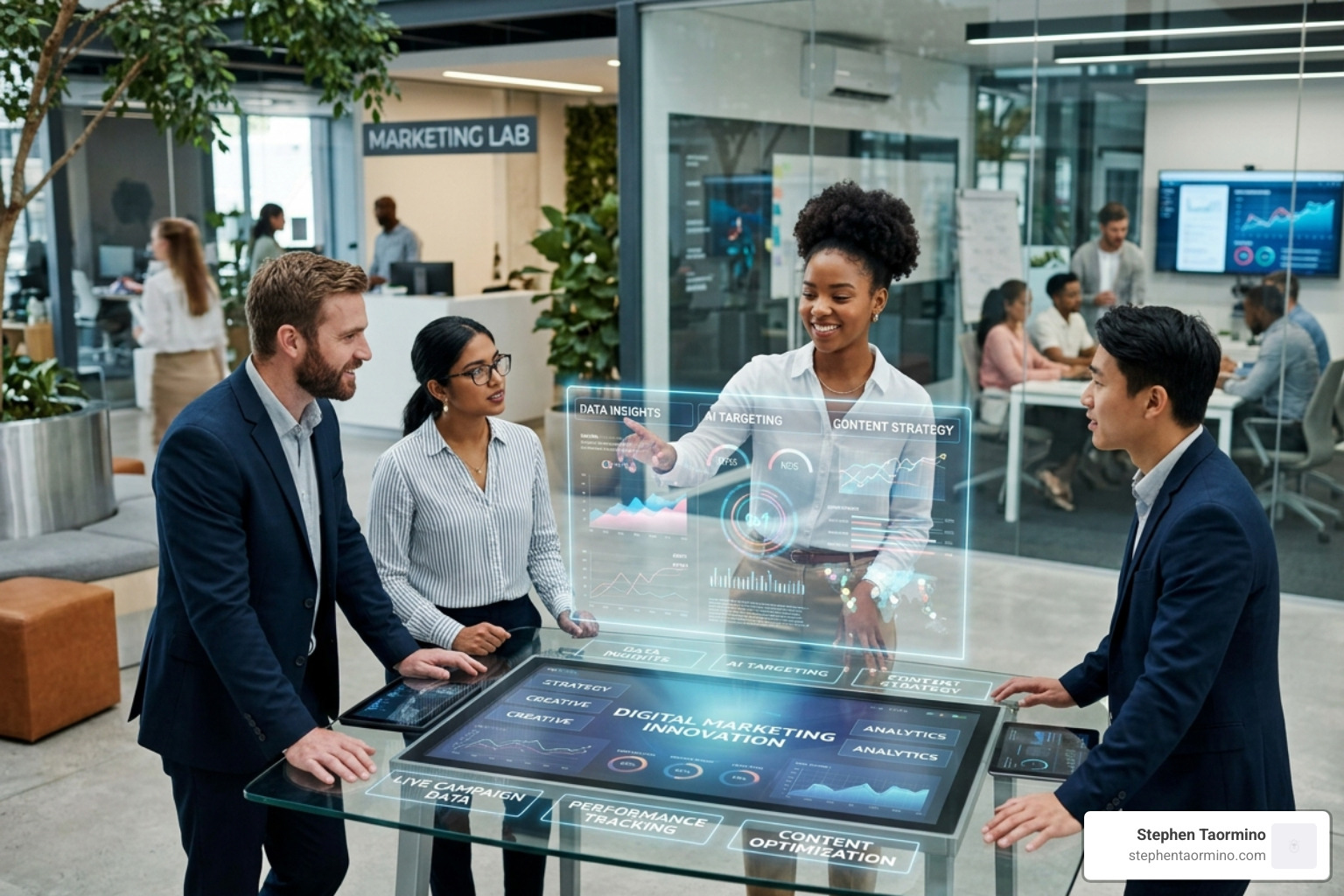
We are moving past the era of “flat” marketing. Immersive technologies are turning passive viewers into active participants, creating deeper emotional connections and higher brand recall. These technologies are no longer just for gaming; they are becoming essential tools for product discovery and customer education.
Augmented Reality (AR) is perhaps the most practical of these innovations. From virtual try-ons in fashion to visualizing how a new piece of machinery fits in a factory via a healthcare dashboard, AR bridges the gap between digital browsing and physical ownership. It reduces the “uncertainty gap” that often prevents online purchases, leading to higher conversion rates and lower return rates.
Other key technologies include:
- Voice Search Optimization: As smart speakers become ubiquitous, we must optimize for conversational, long-tail queries. This requires a shift from keyword-based SEO to intent-based SEO, focusing on how people actually speak rather than how they type.
- The Metaverse: While still evolving, the metaverse offers branded environments where communities can interact with products in 3D space. This is particularly relevant for Gen Z and Gen Alpha, who are already accustomed to social interactions in virtual worlds like Roblox and Fortnite.
- 5G Impact: The rollout of 5G enables richer, high-definition mobile experiences and seamless AR without lag. This will unlock new possibilities for real-time, location-based marketing that was previously limited by bandwidth constraints.
- Gamification: Adding interactive, game-like elements to loyalty programs or apps to keep users engaged longer. This taps into fundamental human psychology, rewarding participation and building long-term habits.
Measuring the ROI of Digital Marketing Innovation
Innovation is only useful if it drives the bottom line. Fortunately, 80% of marketers using generative AI report a positive ROI, citing improvements in productivity and cost control. However, measuring the impact of these new technologies requires a new set of metrics. Traditional KPIs like CTR (Click-Through Rate) are becoming less relevant in a world of immersive and autonomous marketing.
To measure success in this new landscape, we need to move beyond basic clicks. Modern digital marketing innovation relies on:
- Predictive Analytics: Forecasting future customer behavior based on historical data. This allows brands to be proactive rather than reactive, identifying potential churn or high-value opportunities before they happen.
- Multi-Touch Attribution: Understanding the role every channel played in a conversion, rather than just giving credit to the “last click.” This provides a more accurate picture of the customer journey and helps optimize budget allocation across the entire funnel.
- KPI Dashboards: Real-time visualizations that track Adaptation Speed (AS) and Creative Elasticity. These metrics measure how quickly a campaign can pivot in response to data and how well the creative resonates across different segments.
By using these tools, we can significantly reduce the 30% of marketing budgets that are typically wasted on underperforming segments. According to Harvard Business Review, the most successful companies are those that treat marketing as a data-driven science rather than just a creative exercise.
Ethical Considerations and Future-Ready Teams
As we lean into AI and data, we must not lose our moral compass. Digital marketing innovation brings significant responsibilities. Data privacy is no longer just about GDPR compliance; it’s about brand safety and human trust. In an era of deepfakes and misinformation, brands must be the “source of truth” for their customers. This requires a commitment to transparency and ethical data practices.
We must be transparent about how we use AI and ensure we are not baking algorithmic bias into our targeting. Bias in AI can lead to exclusionary practices that damage brand reputation and alienate potential customers. Regular audits of AI models and a diverse team of human overseers are essential to prevent these issues. Furthermore, brands must be mindful of the “uncanny valley”—the point where AI-generated content becomes so realistic it feels unsettling to consumers.
Technology is only as good as the people running it. Marketers must upskill their teams to be “AI-literate.” This means moving from being “doers” to being “orchestrators.” Your team needs to understand data proficiency, prompt engineering, and how to manage the “Centaur” relationship. This shift requires a culture of continuous learning and a willingness to experiment with new tools and workflows.
Whether you are building a digital marketing ppt ultimate guide for your board or restructuring your internal agency, the focus must remain on the human element. At the end of the day, marketing is still about psychology—understanding how people think, connect, and act. The most innovative technology in the world cannot replace a deep, empathetic understanding of the human condition. As we move forward, the brands that succeed will be those that use technology to enhance, rather than replace, the human connection.
Frequently Asked Questions about Digital Marketing Innovation
What are the top digital marketing trends for 2025?
The landscape will be dominated by Generative AI moving into operational trust, hyper-personalization driven by first-party data, and the rise of social commerce. We also expect a massive shift toward voice and visual search (like Google Lens) and a renewed focus on sustainability and ethical brand purpose. Consumers are increasingly looking for brands that align with their values, making “purpose-driven marketing” a key differentiator.
How does Generative AI impact content creation at scale?
GenAI acts as a “fast first draft.” It can reduce content production time by up to 70%, allowing teams to generate thousands of personalized variants for different audience segments. However, it requires human oversight to maintain brand guardrails and ensure the “voice” remains authentic. The goal is to use AI to handle the volume while humans focus on the nuance and emotional resonance that only a person can provide.
What is the difference between marketing automation and adaptive marketing?
Marketing automation is rule-based (If this happens, do that). It is static and requires manual updates. Adaptive marketing is learning-based. It uses AI to reason about a situation in real-time, meaning it can change a budget, a headline, or a target audience on the fly without a human having to manually trigger the change. This allows for a level of agility and optimization that is impossible with traditional automation.
How can small businesses leverage digital marketing innovation?
Small businesses can leverage innovation by focusing on niche hyper-personalization and using affordable AI tools for content creation and customer service. By being more agile than large corporations, small businesses can implement new technologies faster and build closer, more personal relationships with their customers. Focusing on first-party data collection through email lists and loyalty programs is also a high-impact, low-cost strategy.
What role does 5G play in the future of marketing?
5G provides the high-speed, low-latency connection required for truly immersive experiences. This includes high-definition video streaming, seamless AR/VR, and real-time data processing at the edge. For marketers, this means the ability to deliver richer content to mobile devices without worrying about load times, enabling more interactive and engaging mobile campaigns.
Conclusion
The world of digital marketing innovation is moving fast, but it doesn’t have to be overwhelming. By focusing on the intersection of marketing psychology and strategic leadership, businesses can navigate these changes not just to survive, but to lead. The key is to remain curious, stay adaptable, and always keep the customer at the center of your strategy. Innovation should never be for its own sake; it should always serve the goal of creating more value for the consumer.
At CC&A Strategic Media, we believe that the most powerful innovations are the ones that strengthen the relationship between a brand and its customers. Whether you are looking for a digital marketing speaker to inspire your team or a framework for digital transformation, the goal remains the same: building prosperity through smarter communication. The future of marketing is not just about the tools we use, but about the stories we tell and the connections we build.
Ready to see these concepts in action? Watch Stephen Taormino’s latest insights and start your journey toward a future-ready marketing strategy today. The next era of growth is waiting for those bold enough to innovate.