
Why Learning How to Facilitate a Design Thinking Workshop Transforms Teams
How to facilitate a design thinking workshop begins with understanding its core purpose: to guide a team through a structured, creative process that turns user insights into actionable solutions. While running your first session can feel daunting, facilitation is a learnable skill that transforms how teams collaborate and solve problems.
A well-run workshop breaks down silos, builds shared understanding, and sparks creativity. Teams applying these practices have even seen an ROI of up to 300%. The key is balancing structure with flexibility to create a space where every voice is heard. According to Forbes, design thinking has become essential for organizations seeking to uncover synergies and explore new possibilities in their problem-solving approaches.
Quick Guide to Facilitating a Design Thinking Workshop:
- Plan: Define clear objectives, assemble a diverse team of 6-15 participants, and prepare your toolkit.
- Set the Stage: Welcome everyone, explain the principles, set ground rules, and use an icebreaker to build rapport.
- Guide the Phases: Lead the group through Empathize, Define, Ideate, Prototype, and Test.
- Close with Clarity: Summarize outcomes, assign action items, and define the next steps.
I’m Steve Taormino, and with over 25 years in strategic communications, I’ve seen how these workshops drive innovation by leveraging marketing psychology and human behavior. Understanding how to facilitate a design thinking workshop is central to building prosperity through human-centered problem-solving. Let’s walk through what you need to become the facilitator your team deserves.
Easy how to facilitate a design thinking workshop glossary:
- [/beyond-the-buzzword-your-guide-to-facilitated-workshops/]
- [/group-facilitation-training/]
- [/workshop-facilitator/]
Foundations: Understanding the What and Why of Design Thinking Workshops
At its heart, design thinking is a human-centered approach to creative problem-solving that places the end-user at the center of every decision. A design thinking workshop is a collaborative, activity-based session designed to guide a group through this process to tackle complex challenges and generate innovative ideas.
The benefits are significant. These workshops are exceptional at solving complex problems that traditional methods miss. They break down organizational silos, foster teamwork, and align cross-functional teams on a common vision. This collaborative environment nurtures a user-centric mindset and produces tangible solutions that can be rapidly tested, reducing risk and increasing efficiency. The potential for a high ROI is substantial, with some teams calculating returns up to 300%. It’s about embedding a culture of continuous innovation within an organization. For more insights on strategic approaches, explore our resources on [/category/strategy/].
The Five Phases of Design Thinking
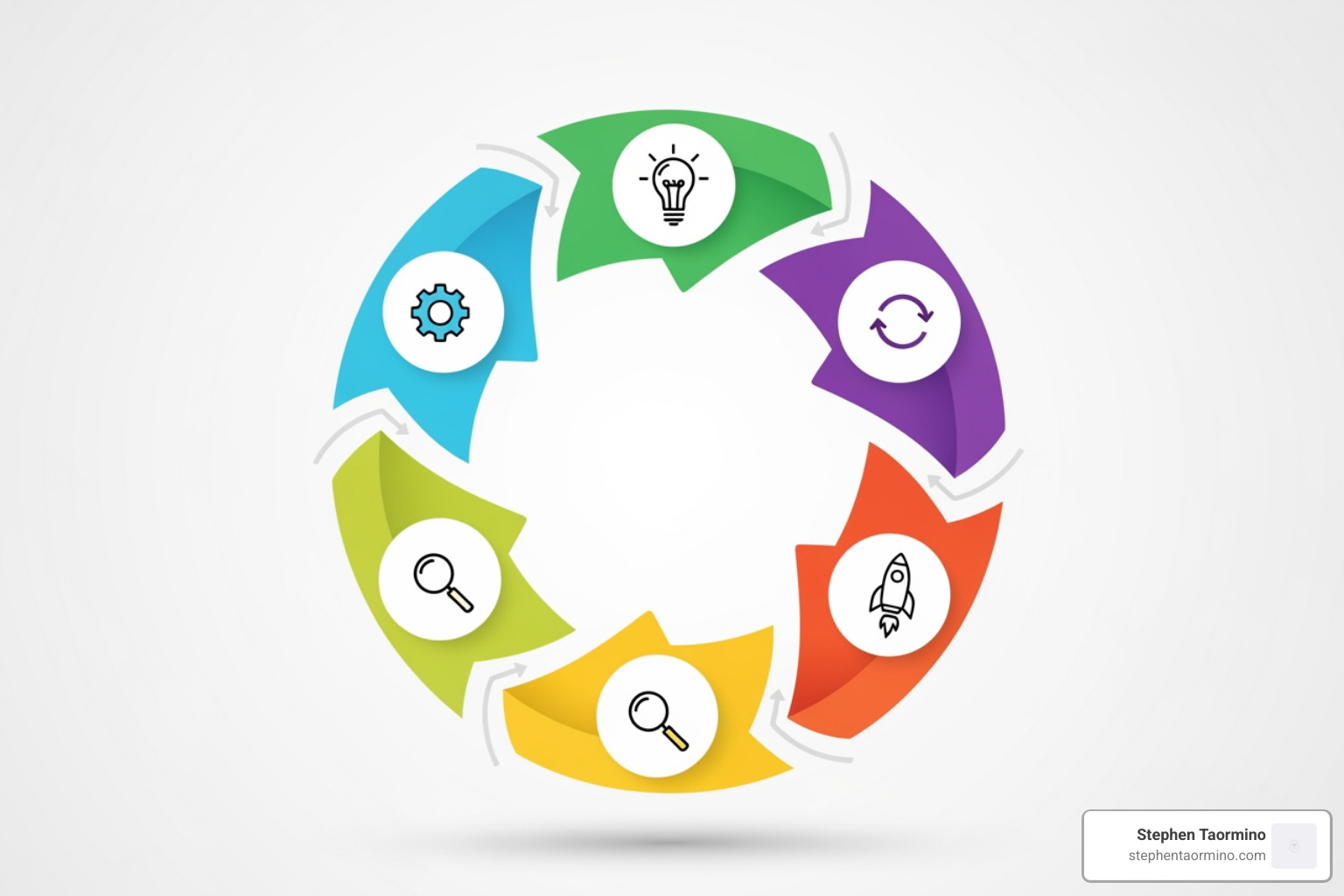
The essence of design thinking is captured in five iterative phases:
- Empathize: Immerse yourself in the user’s world to understand their experiences, needs, and pain points through observation and interviews.
- Define: Synthesize your research to articulate a clear, human-centered problem statement.
- Ideate: Generate a wide array of potential solutions, encouraging creativity and deferring judgment.
- Prototype: Transform ideas into tangible, low-fidelity models that can be tested.
- Test: Put prototypes in front of users to gather feedback, learn what works, and identify areas for refinement.
This process is not strictly linear; teams often cycle back to earlier phases as they learn and iterate.
Key Goals of a Design Thinking Workshop
- Solve Complex Problems: Untangle “wicked problems” that are ill-defined or tricky.
- Foster Teamwork: Bring diverse perspectives together to break down silos.
- Spark Innovation: Encourage out-of-the-box thinking to generate novel ideas.
- Align Teams: Ensure everyone is working towards the same goals with a shared vision.
- Generate Tangible Solutions: Move from discussion to concrete outputs like prototypes.
- Reduce Risk: Identify flaws early through rapid prototyping and user feedback.
These workshops build the foundation for [/building-high-performing-teams/] ready for continuous innovation.
The Blueprint: Planning and Preparing for a Flawless Workshop
A successful design thinking workshop is the result of meticulous planning. As facilitators, our work begins long before the session starts, involving clear objectives, the right participants, a compelling agenda, and a comprehensive toolkit. For a deeper dive, consider our resources on [/facilitation-training-ultimate-guide/].
The Ideal Facilitator and Your Role

The ideal facilitator is not the expert on the problem but a “lead learner” who guides the group. Key skills include objectivity, empathy, clear communication, time management, and confident leadership. Facilitation is the act of providing unobtrusive, objective guidance to help groups achieve their goals. This guidance is crucial for opening up the group’s collective intelligence and is a core component of [/leadership-development-expert/].
Assembling Your Team and Space
The success of a workshop hinges on who participates and where it happens.
- Participants: The sweet spot is 6 to 15 people. This allows for diverse ideas without becoming unmanageable. Aim for a cross-functional team with varied skillsets, expertise, and tenure. Before the workshop, hold brief conversations with key stakeholders to clarify objectives and manage expectations.
- Location: The physical environment impacts creativity. Look for a space with ample wall space for sticky notes, natural light, and comfortable seating. A dedicated area away from daily distractions is ideal. For remote workshops, the “space” becomes a digital platform like Miro or Mural.
Creating Your Agenda and Toolkit
Your agenda is the workshop’s roadmap.
- Objectives: Start by defining clear, specific, and measurable objectives using the SMART goals framework.
- Agenda Structure: A typical workshop includes an introduction (welcome, rules, icebreaker), the main activities (the five design thinking phases), and a summary (recap, action items, next steps).
- Timeboxing: Assign strict time limits to each activity and use a visual timer to keep everyone on track. Build in breaks to prevent fatigue.
Essential Toolkit Supplies:
- Plain paper and large easel-style Post-its
- Small Post-it notes in various colors
- Pens and Black Sharpies
- Dot stickers for voting
- A Time Timer (or a digital equivalent)
- An HDMI cable for presentations
- Prototyping materials: scissors, tape, cardboard, LEGOs—anything that encourages rapid creation.
- Snacks and drinks to keep energy levels high.
How to Facilitate a Design Thinking Workshop Step-by-Step
This is where your preparation pays off as you guide the team through each phase. For more on structuring sessions, our guide on [/how-to-facilitate-a-training-workshop/] offers valuable insights.
1. Kick-off: Setting the Stage for Success
The first 30-60 minutes set the tone.
- Welcome and Introductions: Greet everyone warmly and have participants introduce themselves.
- Set Expectations: Clearly state the workshop’s purpose, objectives, and schedule.
- Ground Rules: Establish rules for participation, such as “defer judgment” and “build on others’ ideas,” to create a safe space.
- Icebreaker Activities: Use a fun, low-stakes activity to build rapport. Favorites include Two Truths and a Lie or asking everyone about their First Job Story. Many online resources offer excellent icebreaker activities to help your team warm up before the workshop begins.
2. Empathize: Understanding Your User
This phase is about building deep empathy for your users. There are excellent guides available on developing empathy in design thinking.
- Explain Empathy: Define empathy as the capacity to understand what another person is experiencing.
- Conduct User Research: If research isn’t done beforehand, simulate it with paired interviews.
- Use Empathy Tools: Guide teams to create empathy maps (visualizing what a user says, thinks, does, and feels) or proto-personas to synthesize observations. Frameworks like Jobs To Be Done can also shift focus from features to customer needs. This phase ensures solutions are grounded in [/human-behavior-marketing/].
3. Define: Framing the Right Problem
Synthesize findings to create an actionable problem statement. Affinity diagramming is a valuable technique for this phase.
- Affinity Mapping: Group observations on sticky notes to identify themes and patterns.
- Craft a Problem Statement: Create a concise, user-centered statement focusing on the user’s need and the underlying insight.
- “How Might We” (HMW) Questions: Reframe the problem statement into open-ended HMW questions to spark ideation (e.g., “How might we help busy parents consolidate school information?”).
- Dot Voting: Use dot stickers to have the group vote on the most compelling HMW questions to tackle.
4. Ideate: Generating a Universe of Solutions
With a clear problem, it’s time to generate a wide range of ideas.
- Brainstorming Rules: Remind everyone to defer judgment, encourage wild ideas, and aim for quantity.
- Ideation Techniques:
- Crazy 8’s: A rapid sketching exercise where each person sketches 8 ideas in 8 minutes to push past obvious solutions.
- User Journey Mapping: Visualize the customer’s experience over time to identify pain points and opportunities. A journey map is a visualization of the process that a person goes through to accomplish a goal.
- Storyboarding: Sketch a sequence of frames to illustrate how a user might interact with a proposed solution.
This phase thrives on open communication and taps into the team’s [/effective-communication-skills/].
5. Prototype & Test: Making Ideas Tangible
Move from abstract ideas to concrete, testable forms, emphasizing speed and learning.
- Build Low-Fidelity Prototypes: Use simple materials like paper, sticky notes, or role-playing to create rough models of your ideas. The goal is to make an idea tangible enough for feedback, not to create a polished product.
- Gather User Feedback: Present prototypes to others to learn and gather feedback. The goal is not to validate but to understand what works and what doesn’t.
- Use Feedback Grids: Structure feedback by asking what worked, what could be improved, what questions arose, and what new ideas were sparked.
- Prioritize Ideas: Use techniques like a Value vs. Effort Matrix or Dot Voting to decide which concepts are most promising. Iteration is a key part of the design thinking process, so expect to cycle through prototyping and testing multiple times.
6. Wrap-Up: Defining Next Steps
A strong conclusion translates workshop energy into real-world impact.
- Summarize Outcomes: Recap the key insights, ideas, and prototypes.
- Define Action Items: Clearly define next steps, assign ownership, and set deadlines.
- Gather Feedback: Conduct a quick retrospective on the workshop itself to refine your facilitation skills.
- Document and Share: Capture all outputs (photos of whiteboards, digital files) and send a follow-up summary to maintain momentum. This ensures the workshop’s efforts drive business results.
Beyond the Room: Remote Facilitation and Advanced Techniques
As remote work becomes standard, design thinking workshops have adapted. This shift is part of a larger [/digital-change-strategy/] impacting collaboration. While the principles are the same, remote facilitation requires specific tools and techniques.
Best Practices for How to Facilitate a Design Thinking Workshop Remotely

- Use Digital Whiteboards: Tools like Miro and Mural are your virtual canvases. Get participants comfortable with a quick “sandbox” exercise.
- Plan for Shorter Sessions: Combat “Zoom fatigue” by aiming for shorter sessions (2-4 hours) or spreading the workshop over multiple days.
- Over-Communicate: Provide clear, concise instructions with visual aids and frequent check-ins.
- Schedule Frequent Breaks: Encourage participants to step away from their screens regularly.
- Prepare for Tech Issues: Ensure everyone has a stable connection and working equipment. Having a tech co-facilitator is a great help.
Mastering Foundational Activities and Variables
Workshop activities are like “atoms”—elementary particles you can combine and adjust. By mastering these building blocks, you can design a custom workshop for any situation.
- Foundational Activities: Post-up (writing on sticky notes), Affinity Sorting (grouping notes), Landscape Mapping (organizing notes on a canvas), Storyboarding, and Dot Voting.
- Adjustable Variables: Tweak elements like group size, time constraints, and voting mechanics to fit your specific goals.
Understanding these components gives you the flexibility to design effective workshops, regardless of the challenge.
Frequently Asked Questions about Design Thinking Facilitation
Here are answers to common questions we hear about how to facilitate a design thinking workshop.
How long should a design thinking workshop be?
The duration depends on your objectives. Comprehensive workshops often last 1-2 days, allowing time to move through all five phases. A good rule of thumb is to allocate a half-day for each major objective. For a very focused problem, a session can be as short as a few hours. Remote workshops are often best when broken into shorter sessions across multiple days.
What are the most common mistakes to avoid when facilitating?
- Poor Planning: Failing to define clear objectives, create a structured agenda, or prepare materials.
- Letting One Person Dominate: Not ensuring equitable participation from all attendees.
- Rushing Through Phases: Compromising the quality of insights by not allowing enough time for each step.
- Ineffective Time Management: Losing track of the schedule and failing to reach objectives.
- Skipping the Wrap-Up: Neglecting to define clear action items and next steps, which causes momentum to be lost.
How do you handle difficult participants or group dynamics?
Managing group dynamics is a key facilitation skill.
- Set Ground Rules Early: Establish expectations for respectful communication and active listening.
- Use a “Parking Lot”: Create a space to capture off-topic ideas to be addressed later. This validates the contribution without derailing the discussion.
- Call on Quieter Participants: Actively invite contributions from those who are less vocal to ensure all perspectives are heard.
- Address Disruptions Privately: If a participant is consistently disruptive, have a gentle, private conversation during a break.
- Reframe Negativity: Turn negative comments into opportunities to explore potential challenges or areas for improvement.
Navigating these dynamics requires empathy and assertiveness, skills honed through [/group-facilitation-training/].
Conclusion: Become the Leader Your Team Needs
Mastering how to facilitate a design thinking workshop is about more than a methodology—it’s about cultivating a skillset that empowers teams to innovate with confidence. From planning and preparation to guiding each phase, a well-run workshop builds collaboration, creates shared understanding, and translates insights into action.
Facilitation is a critical leadership skill. It’s a journey of continuous improvement where every session offers a chance to refine your craft. The power of these workshops lies not just in the solutions they generate but in the renewed sense of purpose and strengthened team dynamics they instill.
At Stephen Taormino, we focus on opening up potential by leveraging marketing psychology to build impactful leaders and foster stronger professional relationships. Our expertise in guiding global collaborations aligns perfectly with the human-centered principles of design thinking.
Ready to lift your team’s innovative potential? Explore our expert-led [/workshops/] designed to empower your organization with the skills to thrive.