
Leadership Development Consulting: 3 Ways to Transform
Why Most Leadership Programs Fail and How Consulting Can Help
Leadership development consulting has become essential for organizations struggling with ineffective training, yet many companies invest in approaches that don’t work. A sobering 83% of organizations lack confidence in their rising leaders, largely because traditional, one-off training sessions fail to create lasting change. Employees attend workshops but quickly forget what they learned in the absence of real-world application.
Effective leadership development consulting offers a better way:
- Strategic Alignment: Programs are designed to support specific business goals.
- Customized Approaches: Solutions are custom to your organization’s unique culture and needs.
- Measurable Outcomes: Data-driven programs feature clear ROI metrics.
- Ongoing Support: Continuous coaching replaces one-time events.
- Modern Methodologies: Evidence-based practices address today’s leadership challenges.
The problem isn’t a lack of commitment; it’s the use of outdated methods that rely on generic presentations rather than addressing the real motivations that drive behavior. Modern consulting takes a different approach, creating comprehensive programs that integrate assessment, personalized coaching, and real-world practice. This focus on changeal leadership skills is more critical than ever in today’s hybrid work environments.
I’m Steve Taormino, and I’ve spent over 25 years helping organizations build prosperity through strategic leadership development. Specializing in marketing psychology and human behavior, my experience in leadership development consulting has shown me that successful programs combine behavioral insights with practical business applications to create leaders who drive real organizational change.
Learn more about leadership development consulting:
- leader development
- leadership development expert
The Strategic Imperative: How Leadership Development Consulting Drives Business Success
Leadership development is not a luxury; it’s one of the most strategic investments an organization can make, directly impacting the bottom line. Every major business challenge, from digital change to employee retention, ultimately comes down to leadership. The leaders you develop today determine whether your company thrives tomorrow.
The ROI is compelling. Companies with strong leadership development programs often see employee engagement increase by 30% or more, translating into productivity gains and reduced turnover. When development aligns with business strategy, leaders are better equipped to foster innovation and steer through complex market shifts. This builds a continuous learning culture and improves talent retention, as great leaders create workplaces people want to stay in.
More info about marketing techniques.
Key Skills for the Modern Leader
The leadership playbook has changed, especially with the shift to hybrid and remote work. Today’s leaders need a new set of skills to succeed.

- Agility: The ability to pivot quickly, adapt strategies, and thrive in ambiguity has become non-negotiable.
- Emotional Intelligence: Now essential, this skill helps leaders read virtual rooms, manage pressure, and build resilient teams.
- Digital Literacy: Modern leaders must build connections through screens, facilitate engaging virtual meetings, and use data to make informed decisions.
- Inclusive Leadership: Creating psychological safety and valuing diverse perspectives builds teams that consistently outperform homogeneous groups.
- Strategic Communication: Leaders must articulate vision clearly across multiple channels, from video calls to written updates.
- Change Management: Guiding teams through constant change with confidence is now a daily requirement, not an occasional need.
- Resilience: This is about helping entire teams maintain momentum and morale through challenges, modeling optimism while acknowledging difficulties.
Identifying and Addressing Leadership Gaps
Effective development begins with an honest assessment of where your leaders stand. You can’t improve what you don’t measure.
- Needs Analysis: This starts by aligning leadership capabilities with your core business strategy.
- Competency Mapping: This process reveals individual and team-wide gaps between current and required skills.
- Performance Reviews: When structured to assess leadership competencies, reviews provide valuable data for development.
- 360-Degree Feedback: Input from peers, direct reports, and supervisors offers the most comprehensive view, often revealing leaders’ blind spots.
- Succession Planning: This forward-looking approach identifies future leadership needs and evaluates current bench strength, ensuring you’re developing talent for tomorrow’s challenges.
Addressing these skill deficits proactively prevents small issues from becoming major organizational problems, turning leadership development into a powerful engine for growth.
A Roundup of Leadership Development Consulting Approaches
When it comes to leadership development consulting, there’s no single solution that works for everyone. The best programs are custom-fit to an organization’s unique culture, goals, and people. We believe in digging deep to understand the ‘why’ behind leaders’ actions, not just checking boxes.
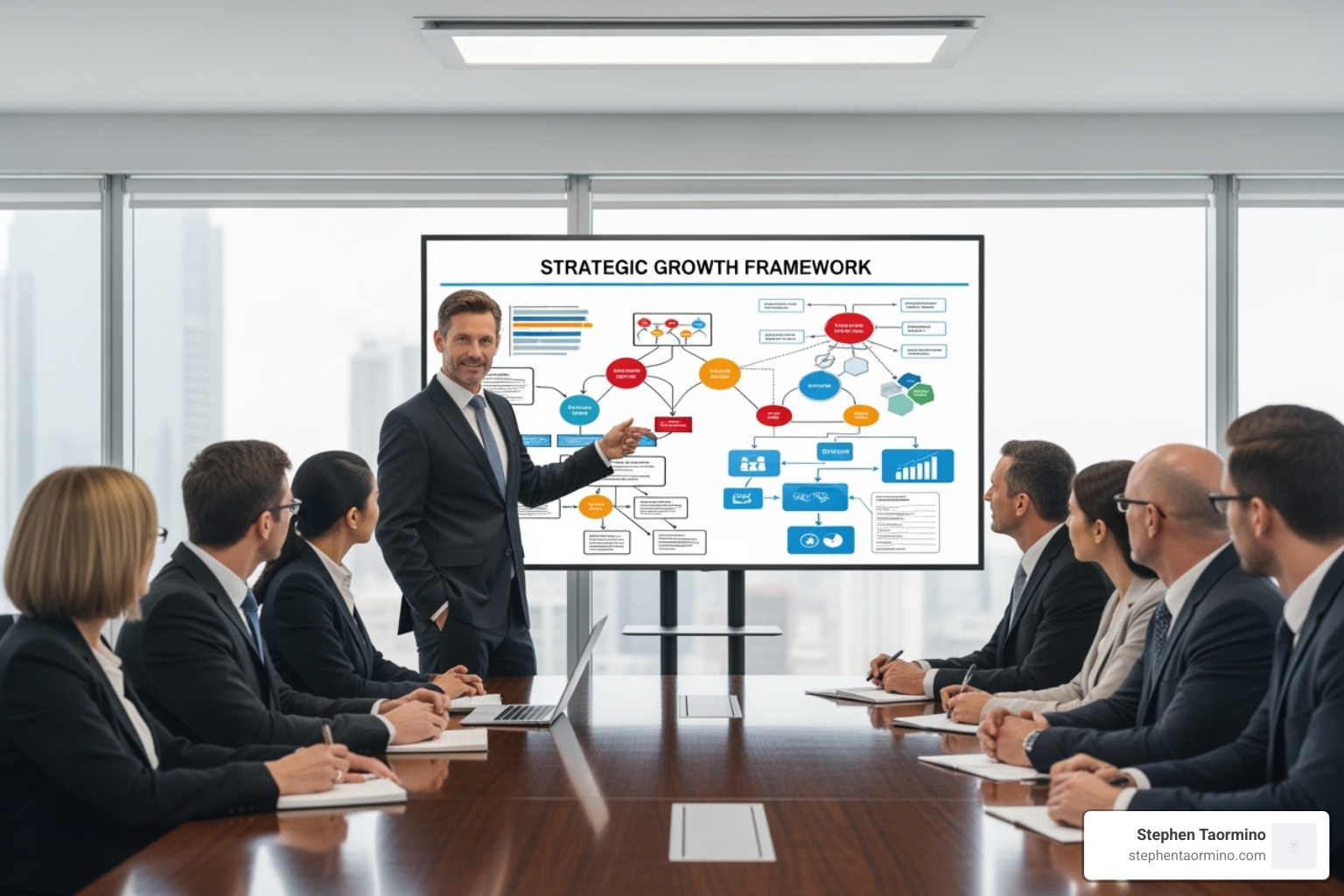
Different consulting firms use various tools and methods. Some prefer a structured, step-by-step plan, while others use research-backed, personalized coaching. The goal is to find a partner who truly understands your challenges and can build programs that match what your company stands for. When considering a partner, ask key questions to ensure the right fit:
- How do you assess our company’s strategy and leadership gaps?
- What specific methods or frameworks do you use?
- How do you measure program effectiveness and ROI?
- How do you customize programs for different leadership levels and cultures?
- What role does coaching play in your approach?
- How do you ensure learning is applied and retained?
- Can you share examples of how you’ve helped similar companies?
- How do you help build a culture of continuous learning?
The Strategists: Aligning Leadership with C-Suite Objectives
This top-down approach ensures that leadership development directly supports the goals of the CEO and the board. It involves a close look at the company’s long-term plans to identify the most critical leadership roles and ensure the right people are in them. A major part of this is CEO succession planning, which focuses on building a strong, diverse group of potential future leaders. These strategists also work to build high-performing senior leadership teams and shape an organizational culture that aligns with business goals and fosters innovation.
The Coaches: Fostering Growth Through Personalized Development
Personalized coaching is a huge part of modern leadership development consulting. While consulting often looks at broader company problems, coaching is typically a one-on-one or small-group process focused on helping an individual leader improve. Executive coaching gives senior leaders custom guidance to build confidence and self-awareness. Team coaching focuses on improving team dynamics and collaboration. Coaching is vital for making training stick, as it provides ongoing support and accountability to ensure leaders apply what they’ve learned in their daily work.
The Innovators: Applying Psychology and Servant Leadership
Innovation in leadership development consulting often comes from applying insights from fields like human behavior and marketing psychology. We believe great leadership starts with understanding how people think and act. This perspective treats development as a strategic partnership focused on open uping potential by building confidence and strong professional relationships. Some innovative approaches use models like Genuine Servant Leadership (GSL.i), which emphasizes leaders who put their team first to build a culture of empowerment. This bottom-up approach encourages smarter communication and stronger relationships, which is essential for navigating today’s complex and distributed teams.
Measuring Success and Overcoming Challenges in Your Leadership Program
Implementing a leadership development consulting program is a significant investment, so measuring its effectiveness and ROI is vital. This isn’t just about justifying the cost; it’s about demonstrating value, securing continued support, and refining your approach over time. However, this journey often comes with challenges.

How to Measure the ROI of Leadership Development Consulting
We focus on tangible results, not just whether participants liked the training. By tracking Key Performance Indicators (KPIs), we can assess business impact and use smart feedback loops for continuous improvement.
Key metrics to track include:
- Employee Retention and Promotion Velocity: Are your leaders staying longer and high-potential individuals moving up faster? For instance, a luxury group in Asia Pacific achieved a 17.3% reduction in attrition after leadership coaching.
- Team Performance Metrics: Are teams collaborating more effectively and are projects more successful?
- Engagement Survey Scores: Are scores related to leadership effectiveness and satisfaction climbing?
- Business Impact Analysis: This connects leadership growth directly to company goals like increased revenue or lower operational costs.
- 360-Degree Feedback Results: Tracking these over time shows real shifts in leadership behaviors.
- Qualitative Feedback: Stories from leaders and their teams often provide the richest insights into a program’s true value.
Common Challenges and How to Overcome Them
Many organizations face common problems that can derail even the best-intentioned programs. Here’s how to steer them:
- Training in a Vacuum: Leaders attend a workshop, get inspired, but the learning fades upon returning to their desks. Solution: Integrate learning into daily work with real-world action learning projects and ongoing coaching to ensure continuous application.
- Lack of Senior Leader Buy-in: Without visible support from the top, development efforts can feel like a low priority. Solution: Actively engage senior leaders as sponsors, mentors, and even participants to signal that growth is a core value.
- The “Forgetting Curve”: It’s human nature to forget what isn’t reinforced. Solution: Weave in micro-learning modules, personalized coaching, and strong accountability structures to ensure learning sticks.
- Irrelevant Content: If leaders don’t see how training applies to their job, they will disengage. Solution: Customize programs through thorough needs assessments to align content with strategic goals and daily realities.
- Difficulty Scaling: Maintaining quality when expanding a program can be difficult. Solution: Design scalable frameworks that blend self-paced digital components with personalized support.
- No Accountability: Leaders need clear incentives to apply new skills. Solution: Set clear milestones, foster peer accountability, and integrate development goals into performance reviews.
Frequently Asked Questions about Leadership Development Consulting
It’s natural to have questions when considering a significant investment like leadership development consulting. Here are some of the most common questions we hear.
How do you ensure leadership training actually sticks?
This is where many traditional programs fail. For training to create lasting change, it must be a system of continuous growth, not a one-time event. We ensure learning sticks by:
- Starting with Assessment: We pinpoint specific gaps to create individualized development plans.
- Using Experiential Learning: Leaders apply new skills directly to real business challenges through action learning projects.
- Integrating Ongoing Coaching: Consistent feedback and support reinforce new behaviors.
- Building Accountability: We help set clear expectations and often tie development goals to performance reviews.
This approach fosters an organizational culture that values continuous growth, making development an ongoing journey.
What is the difference between leadership coaching and consulting?
It’s easy to confuse these two, but they serve distinct, complementary purposes within leadership development consulting.
Leadership consulting operates at a broader, organizational level. Consultants diagnose systemic challenges and design comprehensive programs for entire teams or the whole organization, such as a new succession plan or competency framework. The outcome is typically a strategic plan or program.
Leadership coaching, on the other hand, is highly personalized and individual-focused. A coach works with individual leaders or small teams to develop specific skills, refine behaviors, and build self-awareness. Coaching helps leaders apply the broader strategies from consulting to their own practice.
How has the shift to hybrid work affected leadership development?
The shift to hybrid work has profoundly reshaped leadership development strategies. Micromanagement no longer works; leaders must lead with trust and autonomy, focusing on outcomes. Building team culture remotely requires new skills in fostering cohesion and inclusive communication.
Mastering digital tools for collaboration and connection is now paramount. As a result, leadership development consulting has adapted, with a heightened focus on skills like virtual presence and asynchronous communication. We now leverage sophisticated virtual programs to deliver interactive and effective learning experiences for distributed teams.
Conclusion: Choosing a Partner for Changeal Growth
In today’s business world, investing in leadership development consulting is a strategic imperative. While traditional training often misses the mark, modern consulting approaches tackle these challenges head-on. They offer custom solutions that align with your strategic goals, build crucial skills for the modern workplace, and deliver measurable results.
Effective leadership development is about more than just one-off workshops; it’s about building a culture of continuous learning. It means embracing personalized growth through coaching and using innovative approaches like marketing psychology to inspire human behavior. When development is woven into your organization’s fabric, it leads to tangible business success.
Finding the right partner means choosing someone who understands your unique needs, can address your leadership gaps, and has the expertise to guide your leaders through today’s complexities. It’s about selecting a partner committed to your long-term growth.
My journey at CC&A Strategic Media, specializing in marketing psychology and digital change, has taught me that understanding human behavior is the key to business growth. My passion is helping individuals and businesses open up their potential by building confidence, fostering strong professional relationships, and developing impactful leaders through the lens of marketing psychology.
Are you ready to transform your leadership and release your organization’s full potential?
Explore our expert insights on leadership and marketing
Traditional Leadership Training vs. Modern Leadership Development Consulting
| Feature | Traditional Leadership Training | Modern Leadership Development Consulting |
|---|---|---|
| Approach | One-off sessions, generic content, “check the box” | Holistic, integrated, systemic, continuous |
| Focus | Knowledge transfer, theoretical concepts, general skills | Behavioral change, practical application, strategic alignment |
| Delivery | Classroom-based, passive listening, large groups | Blended learning (virtual, in-person), coaching, action learning, custom |
| Measurement | Attendance, satisfaction surveys | ROI, KPIs (retention, promotion), performance metrics, 360 feedback |
| Goal | Impart information, fulfill compliance | Drive business results, foster culture, build future leaders |
| Key Challenge | “Training in a vacuum,” forgetting curve | Securing buy-in, ensuring accountability, sustained application |
| Value Proposition | Basic skill acquisition, awareness | Changeal impact, strategic partnership, sustainable growth |