English
  Spanish
  French
  German


Predictive Marketing Analytics: Transform 2025
Moving Beyond Guesswork in Marketing
Predictive marketing analytics uses data, AI, and machine learning to forecast customer behavior and future marketing outcomes, enabling you to make proactive, data-driven decisions rather than reacting to what already happened.
If your latest campaign underperformed despite having plenty of data, you’re not alone. But while many marketers analyze what went wrong after the fact, leading organizations—in fact, 91% of top marketers—are using predictive analytics to know what will work before they launch.
The difference is like using a GPS instead of a rear-view mirror. Traditional analytics shows you where you’ve been; predictive analytics shows you where you’re going and helps you adjust course before you waste time and budget.
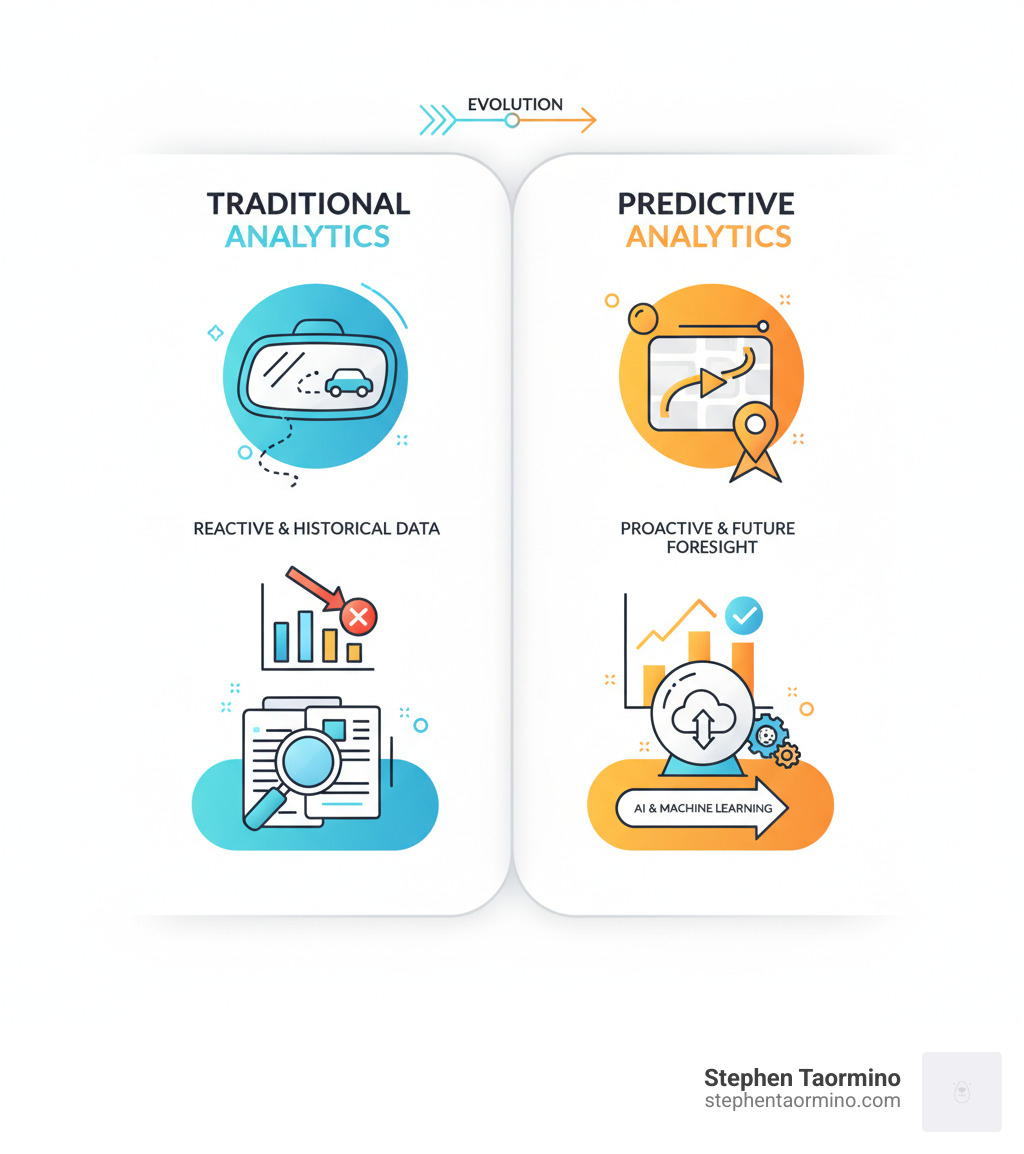
This shift is fundamental. Instead of asking, “Why did customers abandon their carts?” you can ask, “Which customers are about to abandon their carts, and how can we stop them?” It’s about anticipating customer needs, identifying high-value prospects, and optimizing every dollar based on predicted outcomes, not gut feelings.
I’m Steve Taormino, and with over 25 years in digital marketing, I’ve helped organizations worldwide use predictive analytics to turn reactive strategies into proactive growth engines. My focus has always been on the intersection of marketing psychology, human behavior, and technology to drive measurable results.
Let’s explore how predictive marketing analytics works and how you can implement it to stay ahead.
Predictive marketing analytics terms to know:
From Data to Decisions: How Predictive Marketing Analytics Works

Understanding how predictive marketing analytics transforms raw numbers into actionable strategies doesn’t require a Ph.D. in statistics. The process begins with data collection and preparation, the most critical step. We gather information from every customer touchpoint—website visits, email clicks, purchases, and social media interactions. This raw data is often messy, so it must be cleaned and organized. Duplicates are merged, incomplete entries are handled, and formats are standardized. The accuracy of every prediction depends on the quality of this foundation.
Once the data is clean, statistical modeling identifies relationships and patterns in customer behavior. These mathematical frameworks, like linear or logistic regression, create the foundation for forecasting.
Next, machine learning (ML) algorithms take over, spotting complex patterns in massive datasets that humans could never identify. These algorithms learn and improve over time, constantly refining their predictions as they process more data.
Finally, artificial intelligence (AI) orchestrates this entire process. AI automates the analysis, identifies emerging trends, and translates complex predictions into clear, actionable recommendations for marketers. The goal isn’t just prediction; it’s turning insights into concrete actions like personalizing an email campaign or reallocating ad spend. This process is a core component of any effective digital marketing transformation framework.
The Core Technologies: AI and Machine Learning
In 2025, AI is the engine that powers predictive analytics. It serves as the brain, processing enormous volumes of customer data at superhuman speeds to identify subtle correlations and emerging patterns. This capability transforms marketing from generalized campaigns into precision-targeted interactions.
Machine learning is the discipline within AI that makes this possible. Unlike traditional software, ML algorithms learn from the data itself, getting smarter with more information. Key ML approaches include:
- Classification algorithms: Categorize customers (e.g., will they buy or churn?).
- Regression algorithms: Predict specific values (e.g., how much will they spend?).
- Clustering algorithms: Group similar customers for segmentation.
These technologies, along with natural language processing (NLP) for understanding customer sentiment, enable pattern recognition, accurate forecasting, and real-time automation.
Crucial Data Sources for Accurate Predictions
The quality of your predictions depends entirely on the data you use. A holistic view is essential for generating insights that drive business results. Key sources include:
- CRM Data: The history of customer engagement, including purchases, service requests, and communication preferences.
- Website and App Analytics: Behavioral data like page views, clicks, and conversions that reveal user paths and purchase intent.
- E-commerce Transaction Data: Direct evidence of purchasing patterns, average order value, and product affinities.
- Social Media Engagement: A real-time window into customer sentiment, interests, and brand perception.
- Customer Service Interactions: Call logs, chats, and emails containing direct feedback on pain points and satisfaction.
- Third-Party Data: External information like demographic or market data to enrich customer profiles and add broader context.
By weaving these diverse data streams together, you create a comprehensive view that enables predictive models to generate powerful insights and increase digital marketing ROI.
The Business Case: Why Predictive Analytics is a Game-Changer
If you’re still making marketing decisions based on last quarter’s reports, you’re already behind. Predictive marketing analytics isn’t just another tool—it transforms how we do business, moving us from reacting to market shifts to proactively shaping our future. The benefits translate directly into tangible results.
Predictive analytics helps us make smarter decisions about where to allocate our budget. Instead of spreading resources thin, we can focus on initiatives and customers most likely to convert. The numbers tell the story: the average lift in conversion rate for sessions influenced by predictive intelligence is a remarkable 22.66%. That’s a significant improvement that directly impacts your goal to increase digital marketing ROI.
Beyond ROI, anticipating customer needs builds deeper, more resilient relationships that form the foundation of genuine customer loyalty. In a crowded marketplace, predicting future trends before your competitors is the edge that separates leaders from the rest. Companies that grow faster drive 40% more of their revenue from personalization than their slower-growing counterparts.
Boosting Customer Loyalty and Lifetime Value
True customer loyalty is earned through consistent, meaningful interactions. Predictive marketing analytics is our secret weapon for cultivating that loyalty and boosting customer lifetime value (CLV).
Today, real personalization means tailoring the entire buyer’s journey. Predictive models allow us to deliver hyper-personalized content, product recommendations, and offers that resonate with individual customers. This level of customization makes customers feel understood and builds genuine loyalty.
The real magic, however, is predicting what customers want before they know they want it. By analyzing past behavior and browsing patterns, we can proactively offer solutions that match their evolving needs.
Predictive models are also crucial for reducing customer churn. By identifying at-risk customers early, we can launch targeted retention campaigns to address their concerns before they leave. This proactive approach is far more cost-effective than acquiring new customers and is key to sustainable business growth through marketing.
Optimizing Marketing Spend and Improving ROI
Every marketing dollar needs to work hard. Predictive analytics ensures your budget is invested strategically, not just spent. Instead of guessing which channels will perform best, predictive models forecast performance with remarkable accuracy, allowing you to allocate your budget to the most promising initiatives.
Predictive lead scoring helps sales and marketing teams prioritize their efforts on leads most likely to convert into valuable customers. By personalizing content and targeting the right audience at the optimal time, we directly drive up conversion rates.
When we target more effectively, the cost of acquiring each new customer drops. For example, by using predictive segmentation, Pierre Cardin saw a 445% uplift in conversion rates and a 164.83% increase in return on ad spend (ROAS). Most impressively, their cost per acquisition (CPA) dropped by 67.95%. This is the profound financial impact of predictive strategies.
A Deep Dive into Predictive Models and Their Applications
Understanding the “how” of predictive marketing analytics means getting familiar with the different types of models we use. These are powerful tools designed to answer specific marketing questions and are crucial for driving AI driven customer engagement solutions.
The real power of predictive marketing lies in changing raw data into strategic action by building models that predict future customer actions. These aren’t guesses; they’re data-backed predictions that enable highly targeted and timely marketing efforts.
Common Types of Predictive Marketing Analytics Models
Let’s explore the most common and effective models that power modern marketing strategies.
-
Clustering Models: These automatically group customers into distinct segments based on shared characteristics or behaviors. Unlike manual segmentation, these algorithms can analyze dozens of dimensions simultaneously to reveal nuanced customer groups. Behavioral clustering groups customers by actions (e.g., frequent buyers, discount seekers), while product-based clustering identifies customers who purchase similar items, enabling relevant cross-sell recommendations.
-
Propensity Models: These predict the likelihood of a customer performing a specific action. Propensity to buy models identify high-intent customers, while propensity to churn models flag at-risk customers for retention efforts. We also use these models to calculate predicted customer lifetime value (CLV), which helps prioritize our most valuable customers.
-
Collaborative Filtering: This is the recommendation engine model used by giants like Amazon and Netflix. It recommends products or content based on a user’s past behavior and the behavior of similar users. This can be used for upsell, cross-sell, and next-sell recommendations to encourage continued engagement.
Applying Predictive Marketing Analytics Across Channels
The beauty of predictive marketing analytics is its versatility across virtually every marketing channel.
-
Website Personalization: Predictive models can dynamically change a site’s content, offers, and layout based on who is visiting in real-time, changing a static site into a personalized experience.
-
Email Marketing Optimization: Go beyond first-name personalization to send highly targeted campaigns with product recommendations and offers based on a customer’s predicted interests. This can lead to six times higher transaction rates.
-
Predictive SEO: Anticipate emerging keywords, content gaps, and shifts in user intent before they impact your site’s performance. This allows you to proactively optimize your content and maintain a competitive edge in search rankings.
-
Targeted Advertising: Segment potential customers into specific interest groups for highly targeted ad content. This precision leads to more effective campaigns and lower acquisition costs, as seen with Pierre Cardin’s 445% conversion uplift.
Predictive Marketing in Action: Real-World Success Stories

The results from predictive marketing analytics are remarkable. Let’s look at some companies that stopped guessing and started predicting.
Adidas knew its mobile experience needed improvement. Using predictive marketing to understand what mobile shoppers wanted, they saw their average order value jump by 259%. They also achieved a 13% increase in overall conversion rates, with mobile conversions climbing by 50.3%. Instead of treating every visitor the same, Adidas anticipated what each customer was looking for and delivered it seamlessly.
United Colors of Benetton faced common challenges like cart abandonment and low sign-up rates. They applied predictive insights to change the game.
- For cart abandonment, a smart web push notification strategy identified which carts were most likely to convert and when to send a nudge. The result was a 4.8% conversion rate—seven times higher than the industry average.
- For new user acquisition, they predicted which visitors were most likely to become engaged customers and targeted them with personalized messaging, achieving a 5.7% sign-up rate—ten times the industry standard.
These examples show that predictive analytics delivers changeal, not just incremental, results. These retail brands faced the same challenges as everyone else but set themselves apart by moving from reactive marketing to a predictive strategy. They started with clear goals, applied insights strategically, and measured the results. That’s the real lesson: identify where predictive insights can make the biggest impact and let the data guide your decisions. Companies winning with AI driven customer engagement solutions treat prediction as a strategic advantage.
The Future is Predictive: Emerging Trends in Marketing Analytics
The world of predictive marketing analytics is constantly evolving. As we look to 2025 and beyond, several trends are set to change how we connect with customers. According to a 2025 marketing trends report, AI is now the engine driving successful marketing.
We are moving toward hyper-personalization at a scale we’ve never seen before. This means creating truly individualized experiences across every touchpoint, anticipating a customer’s preferred channel, timing, and message type.
The next generation of AI-powered tools and automation will handle even more of the heavy lifting. Advanced AI will enable real-time decision-making, predict content performance before publication, and automate trend analysis. This frees up marketers to focus on strategy and creativity, which is a key part of the digital marketing industry trends reshaping our work.
Integration with the Internet of Things (IoT) will open new frontiers. Data from wearables, smart homes, and connected cars will provide unprecedented context about customer needs, allowing for more relevant and timely marketing.
With this power comes responsibility. Privacy and ethical considerations will become even more critical. We must ensure our practices are transparent, compliant with regulations like GDPR, and prioritize customer trust.
Finally, the human element remains irreplaceable. AI augments human insight; it doesn’t replace it. Marketers will still need to interpret predictions, apply strategic thinking, and infuse campaigns with creativity and empathy. Our role will shift from data crunchers to strategic orchestrators. The most successful teams will master the collaboration between human and artificial intelligence, combining AI’s processing power with human intuition and ethical judgment.
Frequently Asked Questions about Predictive Marketing Analytics
You’ve made it this far, which tells me you’re seriously considering predictive marketing analytics for your business. That’s great! But I also know that diving into something new—especially something that sounds as technical as this—can feel overwhelming. Let’s tackle some of the questions I hear most often, in plain English.
How does predictive marketing differ from traditional marketing analytics?
This is the question that really gets to the heart of the matter. The difference isn’t just technical; it’s fundamental to how we approach our entire marketing strategy.
Traditional marketing analytics is what most of us have been doing for years. It’s descriptive and diagnostic. It tells us what happened and helps us understand why it happened. Think of it like studying a game tape after the match is over. We analyze our campaign performance, review conversion rates, examine customer behavior patterns—all after the fact. Google Analytics, for instance, is a powerful tool for this kind of retrospective analysis. It’s valuable, don’t get me wrong, but it’s inherently reactive. We’re always looking in the rear-view mirror, trying to learn from what already occurred.
Predictive marketing analytics flips this entire approach on its head. Instead of looking backward, we’re looking forward. It asks fundamentally different questions: What will happen? Which customers are about to churn? What will this campaign’s performance look like before we launch it? It uses all that historical data we’ve been collecting, but applies statistical modeling, machine learning, and AI to forecast future outcomes and anticipate customer behavior before it happens.
The shift is from reactive to proactive. Instead of finding after your campaign launches that your messaging missed the mark, you can forecast performance and optimize before spending your budget. Instead of analyzing why customers left after they’ve already gone, you can identify who’s at risk of leaving and intervene while there’s still time to save the relationship.
It’s the difference between driving while constantly checking your rear-view mirror versus having a sophisticated GPS that shows you not just where you are, but where you’re heading, what obstacles lie ahead, and the best route to reach your destination. Both views matter, but only one helps you steer the future.
What are the essential features of a predictive marketing platform?
Choosing the right platform can feel like navigating a maze. There are countless options out there, each promising to revolutionize your marketing. So what should you actually look for?
First and foremost, robust data integration capabilities are non-negotiable. Your predictive platform needs to seamlessly connect with all your crucial data sources—your CRM system, e-commerce platform, website analytics, social media channels, customer service records, and more. Data silos are the enemy of accurate predictions. If your platform can’t pull together information from all these sources into one unified view, you’re starting with one hand tied behind your back.
Next, look for a user-friendly interface. I can’t stress this enough. The most sophisticated algorithm in the world is useless if your marketing team can’t figure out how to use it. You need intuitive dashboards, clear visualizations, and insights presented in language that actual humans can understand. Your marketers should be spending their time developing strategy and creative campaigns, not wrestling with complex software or trying to interpret cryptic data outputs.
Scalability matters more than you might think, even if you’re starting small. Your business is going to grow (that’s the plan, right?), and your data volumes will increase along with it. The platform you choose should be able to handle that growth without requiring you to start over with a new system in two years. It should accommodate more complex predictive models as your needs evolve and your sophistication increases.
Automation features are where predictive marketing really shows its power. The platform should allow you to automatically trigger actions based on predictive insights—sending a personalized email when someone’s propensity to buy hits a certain threshold, dynamically adjusting website content based on predicted preferences, or automatically reallocating ad spend when the platform forecasts better performance in a different channel. Predictions are most valuable when you can act on them immediately.
Finally, you need real-time insights and reporting. Predictions that arrive three days late aren’t predictions—they’re history. Look for platforms that provide real-time or near real-time insights, allowing you to adapt your campaigns on the fly and measure the immediate impact of your predictive strategies. The marketing landscape moves fast, and your tools need to keep up.
Is predictive marketing only for large enterprises?
I hear this question all the time, and I understand why. When you read case studies about companies like Adidas or see the massive data operations at Amazon, it’s easy to assume predictive marketing analytics is only for businesses with enormous budgets and teams of data scientists. But that’s simply not true anymore.
The landscape has changed dramatically. Yes, large enterprises with vast data reservoirs were the early adopters, but the rise of user-friendly SaaS platforms has democratized these capabilities. Today, there are scalable solutions designed specifically for small to medium-sized businesses that don’t require a Ph.D. in data science to implement or a Fortune 500 budget to afford.
Here’s what’s particularly exciting for SMBs: even with smaller datasets, you can gain significant advantages. When you’re a smaller business, every customer matters more, and every marketing dollar needs to work harder. Predicting which leads are most likely to convert, identifying customers at risk of churning, or optimizing your ad spend to focus on high-value prospects can have a disproportionately large impact. A 20% improvement in conversion rates or a 30% reduction in customer acquisition costs can be transformative for a growing business.
My advice? Start with one predictive model or a specific use case. Maybe begin with lead scoring to help your sales team prioritize their efforts, or churn prediction to reduce customer attrition. Choose something that addresses a clear pain point in your business. Implement it, measure the results, and scale up as you see measurable ROI. This controlled approach lets you demonstrate value without overwhelming your team or your budget.
The core principle remains the same regardless of your company’s size: leverage data to make smarter, more proactive marketing decisions. The tools and strategies to do this are now available to businesses of all sizes. The question isn’t whether you’re big enough to use predictive marketing—it’s whether you can afford not to.
Conclusion: Predict or Perish in the New Age of Marketing
We’ve covered a lot of ground together. From understanding how predictive marketing analytics works to seeing real businesses achieve remarkable results—259% AOV increases, 67.95% drops in acquisition costs, and conversion rates that soar above industry averages by 7x or more. These aren’t lucky breaks. They’re the natural outcome of knowing what your customers need before they do.
The shift from reactive to proactive marketing isn’t a nice-to-have anymore. It’s the difference between thriving and merely surviving. While some businesses are still analyzing last quarter’s failures, others are already optimizing next month’s campaigns based on what their data tells them will work. The gap between these two approaches grows wider every day.
But here’s what really matters: predictive marketing analytics isn’t about replacing human judgment with algorithms. It’s about giving talented marketers superpowers. The data tells you which customers are about to churn, but you craft the message that brings them back. The AI identifies high-value prospects, but you build the relationship that turns them into loyal advocates. Technology opens doors; people walk through them.
Throughout my 25+ years helping organizations transform their marketing strategies, I’ve seen one truth hold constant: the businesses that win are those that understand both technology and human nature. They know that behind every data point is a person with hopes, fears, and needs. They use predictive tools not to manipulate, but to serve—to anticipate what their customers genuinely need and deliver it at exactly the right moment.
The foundation of successful predictive marketing is solid data infrastructure. Without clean, comprehensive data flowing from your CRM, website analytics, transaction systems, and customer touchpoints, even the most sophisticated AI can’t help you. Start there. Build that foundation carefully, and the predictions that follow will be worth their weight in gold.
The marketing landscape of 2025 and beyond belongs to the anticipators. Those who wait for trends to emerge will always be a step behind. Those who predict them will shape the conversation. The choice isn’t whether to adopt these strategies—it’s whether you’ll lead or follow.
Your customers are already telling you what they’ll do next. The question is: are you listening?
To explore more about leveraging cutting-edge strategies and the intersection of technology with human behavior, explore more expert digital marketing presentation topics.