
Why Facilitating a Mission Vision Workshop is Critical for Success
Facilitating a mission vision workshop is the structured process of guiding a team to co-create three foundational statements — mission (what you do and why), vision (where you’re going), and values (how you behave) — using proven facilitation techniques to build genuine alignment and buy-in. In today’s rapidly shifting business landscape, the ability to anchor a team in a shared identity is not just a “nice-to-have” leadership skill; it is a fundamental requirement for organizational resilience and long-term growth.
Here’s what effective facilitation delivers:
- Shared purpose — Everyone understands why the organization exists beyond just making a profit.
- A decision-making framework — Teams use mission and values to prioritize work and say no to distractions that don’t align with the core.
- Team motivation — A compelling vision acts as a North Star that pulls people forward during challenging times.
- Stakeholder clarity — Clear statements set expectations with partners, customers, and investors, building trust through transparency.
- Lasting alignment — Outputs become embedded in hiring, strategy, and daily operations, ensuring the culture remains consistent.
Most organizations understand they need a mission and vision. The hard part isn’t knowing that — it’s getting a room full of leaders, contributors, and stakeholders to agree on words that actually mean something. Without a structured approach, these sessions often devolve into “word-smithing” marathons where the loudest voice wins, and the resulting statements are so generic they could apply to any company in any industry.
Done poorly, these workshops produce vague statements that collect dust on a wall. Done well, they create the kind of organizational clarity that shapes decisions for years. The difference almost always comes down to how the workshop is facilitated. A skilled facilitator doesn’t just run a meeting. They create the conditions for honest conversation, structured creativity, and real consensus — without letting one loud voice dominate or the group fall into the trap of writing by committee.
For a deeper look at what makes facilitation work across contexts, see our /facilitation-training-ultimate-guide/.
I’m Steve Taormino — President & CEO of CC&A Strategic Media, and a professional speaker with 25+ years of experience in strategic planning, leadership development, and marketing psychology. My work facilitating a mission vision workshop across industries — from startups to global organizations — has shown me exactly where these sessions succeed and where they break down. In this guide, I’ll walk you through everything you need to run one that actually sticks.
Similar topics to facilitating a mission vision workshop:
- /beyond-the-buzzword-your-guide-to-facilitated-workshops/
- /facilitation-training-ultimate-guide/
- /workshop-facilitator/
Foundations of Strategic Clarity: Mission, Vision, and Values
Before we dive into the “how-to” of facilitating a mission vision workshop, we must define the “what.” Many teams use these terms interchangeably, which leads to fuzzy thinking and even fuzzier statements. We need to establish a clear hierarchy of purpose that allows every team member to see how their daily tasks contribute to the larger whole.
When we facilitate these sessions, we view the process as an “inside-out” journey. It starts with the core purpose (Mission), looks toward the ultimate destination (Vision), and establishes the rules of the road (Values). This framework ensures that the strategy is not just a top-down mandate but a bottom-up reflection of the team’s collective identity.
| Element | Focus | Question Answered | Timeline |
|---|---|---|---|
| Mission | Present | Why do we exist today? | Now |
| Vision | Future | Where are we going? | 5-10 Years |
| Values | Behavior | How do we act along the way? | Eternal |
To be an effective leader in this space, you need specific /skills-for-facilitators/, primarily the ability to distinguish between these three pillars while keeping them interconnected. For a deep dive into the theoretical framework, you might explore this guide on creating vision and mission workshops.
Defining the Mission: Your Core Purpose
The mission statement is the heartbeat of the organization. It describes the present focus, the primary customer, and the specific impact the team makes. In our experience, the most common mistake is making the mission too broad. If it applies to every company in your industry, it isn’t your mission. A mission should be a filter; it should help you decide what not to do just as much as what to do.
A great technique for uncovering this is the “5 Whys” exercise. Start with what you do (“We sell software”) and keep asking why until you hit the emotional core of your purpose (“To empower small business owners to reclaim their time”). This process strips away the corporate jargon and reveals the human impact of the work.
We recommend aiming for a 20-word limit. Why? Because if your team can’t memorize it, they won’t live it. Use a mission fill-in-the-blank tool to help participants move past “writer’s block” and focus on the substance of the “Why.”
Defining the Vision: Your Aspirational Future
If the mission is the “why,” the vision is the “where.” It is an idealized, long-term goal. When facilitating a mission vision workshop, we often ask participants to look 5 to 10 years into the future. This requires a shift from tactical thinking to imaginative thinking. We want to know what the world looks like because your organization succeeded.
A powerful prompt we use is: “Wouldn’t it be fantastic if…”
This opens the door to ambitious, “stretchy” thinking. We aren’t looking for tactical goals like “increase revenue by 10%.” We are looking for emotional outcomes. For instance, a vision isn’t just “being the top-rated plumber in town”; it’s “ensuring no family in our community ever has to worry about a home emergency.” You can find more step-by-step instructions for formulating a vision to guide this specific segment.
Facilitating a Mission Vision Workshop Around Core Values
Values are the guiding principles that dictate how the team interacts, makes decisions, and handles conflict. They are the behavioral compass of the organization. Without clearly defined values, even the best mission and vision will fail because the culture won’t support the necessary actions.
We find that the most effective way to identify these is through a “personal-to-team” alignment process. We ask individuals to identify their own core values first, then find the intersection where those personal beliefs meet the organization’s needs. This creates a sense of ownership and authenticity.
To make values actionable, they must be measurable. Instead of just saying “Integrity,” define the behavior: “We do what we say we are going to do, even when it’s difficult.” For those looking to master this specific dynamic, /group-facilitation-training/ can provide the tools needed to navigate the deep emotional waters of value-setting.
Preparation and Participant Alignment
Preparation is 70% of the battle. You cannot walk into a room and expect magic to happen without a foundation. As a neutral facilitator, your job is to remain objective, ensuring that the CEO’s voice doesn’t drown out the intern’s insights. This requires a significant amount of pre-work to understand the current state of the organization and the expectations of the leadership team.
Before the workshop begins, we suggest:
- Stakeholder Mapping: Identify who needs to be in the room. This includes the “Decision Makers” (executives), the “Influencers” (key contributors), and the “Implementers” (those who will live the mission daily). A diverse group ensures that the final statements resonate across all levels of the company.
- Executive Buy-in: Ensure the leadership team is committed to the outcome, not just the meeting. If the CEO plans to ignore the workshop results or has already decided on the statements, the workshop shouldn’t happen. It will only breed cynicism.
- Pre-Workshop Surveys: Send out a simple questionnaire asking: “Why do we exist?” and “What does success look like in 5 years?” This primes the participants’ brains for the work ahead and allows the facilitator to identify common themes or potential areas of conflict before the session starts.
For more on the logistical side of preparation, check out our guide on /how-to-facilitate-a-training-workshop/. You can also find a comprehensive MVV facilitation toolkit to help structure your prep work.
Who Should Participate?
The “who” matters as much as the “how.” While it’s tempting to include everyone to be inclusive, a group larger than 12-15 can become unwieldy for deep creative work. If you have a larger organization, consider running departmental sessions first and then bringing representatives to a final executive session.
The ideal mix includes:
- Founders & CEO: To provide the original spark and final decision-making power.
- Management Team: To ensure the strategy is operationally sound and can be implemented.
- Key Contributors: High-performers who understand the “on-the-ground” reality and customer pain points.
- HR & Market Experts: To provide external perspective and cultural context.
Selecting the right /workshop-facilitator/—either internal or external—is the final piece of the puzzle. A neutral leader is essential for managing the power dynamics inherent in these groups and keeping the conversation focused on the future rather than past grievances.
Essential Tools and Materials
Whether you are meeting in a sun-drenched boardroom or a virtual Zoom space, you need the right tools to facilitate engagement and capture ideas effectively.
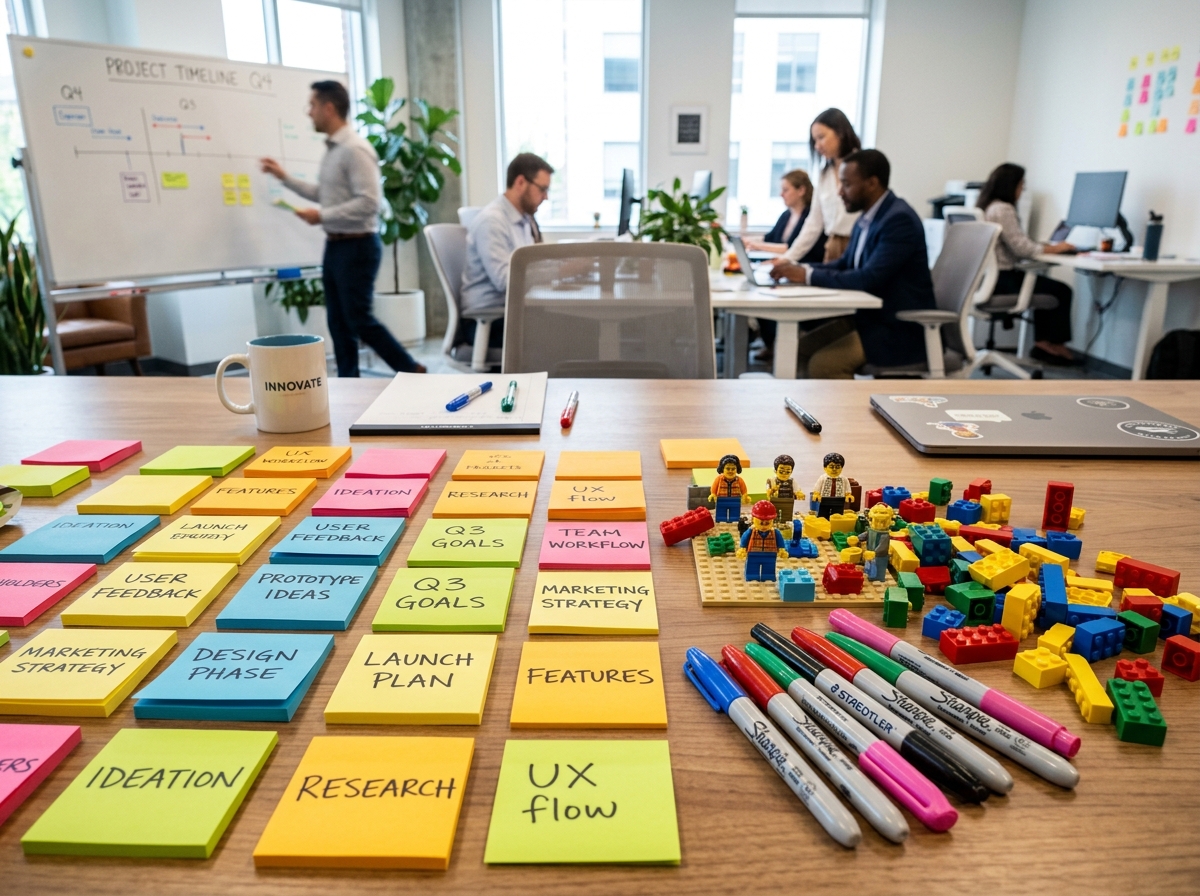
- For In-Person: Post-it notes (get the extra-sticky ones!), high-quality markers, large flip charts, and creative materials like LEGO bricks or magazines for collages. Physical movement is key to keeping energy high.
- For Virtual: Digital whiteboards are your best friend. Platforms like Miro offer excellent mission vision templates that allow for real-time clustering and voting. Ensure everyone is comfortable with the technology before the session starts.
Don’t underestimate the power of physical or digital “vision boards.” Using imagery often bypasses the logical brain and taps into the emotional “marketing psychology” that drives true brand loyalty. When people see a visual representation of their future, it becomes much more tangible and inspiring.
Facilitating a Mission Vision Workshop: A Step-by-Step Agenda

A typical facilitating a mission vision workshop should last between 4 to 8 hours, depending on the size of the team and the complexity of the organization. Here is a recommended structure that we use to keep energy high and outputs actionable. This agenda is designed to move the group through a logical progression of thought, from the abstract to the concrete.
- Icebreaker & Context Setting (30 mins): Use an exercise like “The Stinky Fish”—where participants share a fear or anxiety about the company’s future. This clears the air, builds psychological safety, and acknowledges the “elephants in the room” before trying to build something new.
- The Visioning Session (90 mins): Shift the focus to the long-term. Use the “Wouldn’t it be fantastic if…” prompt. Have everyone write 1-3 proposals individually before sharing. This prevents “groupthink” and ensures every voice is heard.
- The Mission Deep Dive (90 mins): Focus on the “Who, What, and Why” of today. Use the “5 Whys” to get past surface-level descriptions. This is often the most challenging part of the day as it requires intense focus and clarity.
- Values Identification (60 mins): Use card sorting or attribute listing to find the core behaviors that define the culture. Focus on “lived” values rather than “aspirational” ones that no one actually follows.
- Clustering & Voting (60 mins): Group similar ideas together. Use “dot voting” to see which concepts resonate most with the group. This provides a clear visual representation of consensus.
This flow is designed to move from divergent thinking (generating many ideas) to convergent thinking (selecting the best ones). For more advanced techniques, see /the-design-thinking-facilitators-playbook-from-novice-to-maestro/.
Creative Exercises for Mission and Vision
Standard brainstorming can be boring and often leads to the same old ideas. To get the best results, we use creative exercises that engage different parts of the brain and encourage “out of the box” thinking:
- LEGO Serious Play: Ask participants to build a 3D model of the company’s future. It sounds silly, but the metaphors people build are incredibly revealing and help articulate complex ideas that words alone cannot capture.
- Storyboarding: Have the team draw a “customer journey” from the future. What are the customers saying about the company in 2030? What problem did you solve for them?
- Collage Building: Provide magazines and scissors (or digital equivalents). Ask the team to create a visual representation of the brand’s “vibe.” This helps define the emotional tone of the mission and vision.
- The 20-Word Challenge: Once the core ideas are on the board, challenge groups to synthesize them into a single sentence of 20 words or less. This forces clarity and brevity.
These exercises are part of what we cover in our mission vision workshop templates.
Identifying and Defining Core Values
Values shouldn’t just be words on a wall; they should be “verbs in action.” During the workshop, we use Attribute Listing. We ask: “What are the characteristics of our team at its absolute best?” and “What behaviors do we never tolerate?”
Once we have a list, we use peer feedback to narrow it down. We look for themes. If “Honesty,” “Transparency,” and “Straight-talk” all appear, the core value is likely “Radical Candor.” We then define what that looks like in daily practice.
The final step is consensus building. Everyone must agree that they are willing to be hired, fired, and promoted based on these values. This is where your /skills-for-facilitators/ are most tested—ensuring that everyone feels heard and that the final selection is something the entire team can stand behind.
Refinement, Implementation, and Lasting Impact
The workshop ends, but the work is just beginning. One of the biggest mistakes in facilitating a mission vision workshop is leaving the room with “raw” notes and never touching them again. This leads to a “flavor of the month” perception among employees and erodes trust in leadership.
The facilitator (or a small task force) must take the raw input and polish it. Don’t try to word-smith the final version with 15 people in the room—that’s a recipe for “bland” writing and frustration. Instead, take the core concepts and produce 2-3 polished options for the leadership team to review and finalize.
Once the statements are finalized, create a 30/60/90-day plan for implementation.
- 30 Days: Announce the new statements to the entire company with a clear explanation of the “why” behind them. Celebrate the work done in the workshop.
- 60 Days: Integrate the values into performance reviews and hiring rubrics. Start recognizing employees who embody the values.
- 90 Days: Update the website, onboarding materials, and physical office space. Ensure the mission and vision are visible and referenced in strategic planning.
You can use a team development worksheet to keep track of these post-workshop refinements.
Common Pitfalls When Facilitating a Mission Vision Workshop
Avoid these “Strategic Sins” to ensure your workshop has a lasting impact:
- Writing by Committee: The workshop is for gathering ideas and alignment, not for final editing. Refine the language in a smaller group afterward to ensure it is punchy and memorable.
- Skipping the Values: Many teams find values “fluffy” and skip them to get to the “real work.” This is a mistake. Without values, you have no culture, and without culture, your strategy will fail.
- Copying Competitors: If your mission statement could be swapped with a similar organization in your space, you haven’t dug deep enough. Your mission should highlight your unique value proposition.
- The “One and Done” Mentality: If you don’t refer to these statements in your weekly meetings and decision-making processes, they will die. They must be integrated into the rhythm of the business.
- Facilitator Bias: If you are the boss and the facilitator, you will inadvertently steer the group toward your own ideas. Consider hiring an outside /workshop-facilitator/ to keep the process pure and ensure all voices are equal.
Integrating Outputs into Daily Operations
To make the workshop’s impact last, the outputs must become “living” documents that guide the organization’s evolution.
- Onboarding: New hires should be introduced to the mission and values on Day 1. They should understand how their role contributes to the vision.
- Quarterly Check-ins: During strategic reviews, ask, “How did our work this quarter move us closer to our Vision?” and “Did we stay true to our Mission?”
- Decision Gut-Checks: When faced with a tough choice or a new opportunity, ask, “Which option best aligns with our Core Values?” If it doesn’t align, don’t do it.
- Stakeholder Communication: Use your mission and vision in investor decks, customer-facing marketing, and annual reports to build a consistent brand narrative.
When these elements are integrated, they stop being “corporate speak” and start being a competitive advantage. This is the essence of what we do as a /workshop-facilitator/.
Frequently Asked Questions
How long should a mission vision workshop typically last?
While a “condensed” session can be done in two 60-minute blocks (often focusing on just one element), a comprehensive facilitating a mission vision workshop usually requires a full day (6-8 hours). For complex global organizations or teams with significant internal conflict, we often recommend a two-day retreat to allow for deep reflection and “overnight” processing of ideas. You can see various timing options in this MVV facilitation toolkit.
How do you ensure buy-in from all participants?
Buy-in is earned through participation and psychological safety. We use anonymous “dot voting” and small-group breakouts to ensure that even the quietest voices are heard and that high-status individuals don’t dominate. Neutral moderation is key—the facilitator must actively manage the room to ensure the process is fair and transparent. For more on this, explore our /group-facilitation-training/.
What is the best way to refine raw workshop ideas?
The best approach is “Synthesis then Validation.” The facilitator takes the raw notes and clusters of sticky notes and crafts them into coherent, impactful statements. These are then sent back to the participants for a “Validation Round” to ensure the original intent wasn’t lost in the polishing. This prevents the “committee writing” trap while still maintaining /beyond-the-buzzword-your-guide-to-facilitated-workshops/.
Can these workshops be done effectively online?
Yes, with the right tools. Digital whiteboards and breakout rooms allow for the same level of collaboration as in-person sessions. However, virtual sessions require more frequent breaks and a higher level of facilitation to keep participants engaged and prevent “Zoom fatigue.”
Conclusion
Facilitating a mission vision workshop is one of the most high-leverage activities a leader can undertake. It is the bridge between “having a job” and “having a calling.” By using marketing psychology and structured facilitation, we can transform a group of individuals into a unified force with a clear destination and a shared set of rules. This alignment is the foundation upon which all successful strategies are built.
At Stephen Taormino’s CC&A Strategic Media, we specialize in this kind of digital and cultural transformation. Whether you are looking for a keynote speaker to inspire your team or a strategic partner to lead your next executive retreat, we are here to help you unlock your organization’s potential.
Ready to align your team and drive real business growth? Let’s talk about your next /workshops/.