
Why Panel Discussion Preparation Determines Your Event’s Success
Panel discussion preparation is the difference between a forgettable event and one your audience talks about for weeks. In the world of high-stakes communication, a panel is not just a collection of experts; it is a live, choreographed production that requires a deep understanding of marketing psychology and audience engagement. When you bring multiple authorities together, you are leveraging social proof to build credibility, but without a rigorous framework, that potential is often squandered on rambling introductions and disjointed conversations.
Here’s a quick-start checklist to get you on track:
- Choose your topic and format – Pick a clear theme and decide if it’s moderator-led or audience Q&A
- Select 4-5 panelists – Aim for diverse perspectives and complementary expertise
- Prepare your documents – Run of Show, moderator guide, panelist prep guide, and promotion plan
- Brief your panelists – Hold individual 30-minute prep calls before the event
- Set up your space – Semi-circle seating, no tables, lapel mics, no slides
- Plan audience engagement – Polls, roving mics, and planted questions ready to go
- Manage time tightly – Aim for 40 minutes of discussion, 20 minutes of Q&A
A great panel looks effortless on stage. But behind the scenes? It’s a well-choreographed production. Too many panels fail not because the speakers lack expertise — but because no one did the prep work. Vague themes, rambling introductions, panelists who talk too long, and audiences who disengage — these are all preventable problems. By focusing on the psychological flow of the conversation, you ensure that the audience remains in a state of “cognitive ease,” allowing them to absorb your message without the friction of poor logistics.
This guide walks you through every stage of preparation, from planning documents to room setup to moderating with confidence. I’m Steve Taormino, President & CEO of CC&A Strategic Media, and my work in marketing psychology and communications strategy has given me a front-row seat to what makes high-stakes conversations land — or fall flat. Panel discussion preparation is a core part of how I help leaders show up with clarity, credibility, and impact. Let’s build your strongest panel yet.
Glossary for Panel discussion preparation:
Essential Planning Documents for Panel Discussion Preparation
Think of a panel discussion as a theatrical production. You wouldn’t expect a Broadway cast to show up without a script or a stage manager, and you shouldn’t expect your panelists to wing it either. Meticulous panel discussion preparation starts with the “Big Three” documents: the Run of Show, the Agenda, and the Script. These documents serve as the blueprint for your event, ensuring that every stakeholder—from the AV crew to the keynote speakers—is aligned on the mission and the timeline.

A common mistake is treating these documents as interchangeable. They aren’t. Each serves a specific stakeholder and ensures that the technical, logistical, and conversational elements of the event move in harmony. Without a clear Run of Show, your technical team is guessing when to fade the lights or switch the mics. Without a Script, your moderator is left to fill dead air with filler words that erode authority.
The Planning Document Breakdown
| Document | Primary Audience | Purpose | Key Contents |
|---|---|---|---|
| Run of Show | Organizers & Tech Crew | Detailed technical execution | Time-stamped segments, lighting/AV cues, transition music. |
| Agenda | Attendees & Stakeholders | High-level flow | Start/end times, topic titles, panelist names. |
| Script | Moderator | Conversational roadmap | Opening remarks, moderator planning guide, specific questions, and closing. |
When we dive into how to moderate a panel, we emphasize that the moderator should be the most prepared person in the room. This includes having contingency plans. What happens if a panelist’s microphone dies? What if the first 10 minutes of audience Q&A are met with dead silence? Your planning documents should account for these “what-ifs” so the energy never dips. A professional moderator uses the script not as a crutch, but as a safety net that allows for greater spontaneity.
Crafting the Panel Discussion Preparation Script
The script is the moderator’s best friend, but it shouldn’t be a word-for-word monologue. A rigid script kills the spontaneity that makes panels exciting. Instead, think of it as a panel discussion script guide that highlights key milestones. It should include the “hooks” that grab attention and the “bridges” that connect disparate ideas.
Focus on these critical areas:
- The Hook: A powerful opening that defines the “why” of the session. Why does this topic matter right now?
- The Introductions: Never let panelists introduce themselves—they often ramble and lose the audience’s interest. Use 1-2 minute prepared bios to establish their authority immediately.
- Transition Phrases: “That’s a great segue into our next point…” or “Building on what [Panelist Name] just said…”
- Legal Sensitivities: Note any off-limits topics or specific phrasing required by sponsors or compliance departments.
- The Closing: A brisk final question that summarizes key takeaways before starting a panel discussion wrap-up.
Developing a Panel Discussion Preparation Promotion Plan
You can have the most brilliant minds on stage, but if the room is empty, the impact is lost. Effective panel discussion preparation includes a robust promotion strategy that begins at least six weeks before the event. We recommend identifying who would most benefit from the discussion and where they spend their time—whether that’s LinkedIn, niche industry newsletters, or internal Slack communities.
A successful promotion plan includes:
- Unique Hashtags: Create a specific tag to track engagement and unify the online conversation across platforms.
- Speaker Toolkits: Provide your panelists with pre-written social media posts, high-resolution graphics, and short video teasers. This makes it easy for them to leverage their own networks.
- Value Propositions: Don’t just list the speakers; tell the audience what they will learn. Use bullet points to highlight the specific problems the panel will solve.
- LinkedIn Strategy: Use conference panel tips to tag speakers and organizations, creating a “ripple effect” of visibility that extends far beyond your immediate followers.
Selecting and Briefing Your Expert Panelists
The “casting” of your panel is perhaps the most critical step in panel discussion preparation. You don’t just want five people who agree with each other; you want a mix of roles that create dynamic tension and comprehensive coverage. From a marketing psychology perspective, the audience needs to see their own challenges reflected in the speakers on stage. If everyone is a C-suite executive, the “boots on the ground” audience members may feel the advice is unattainable.
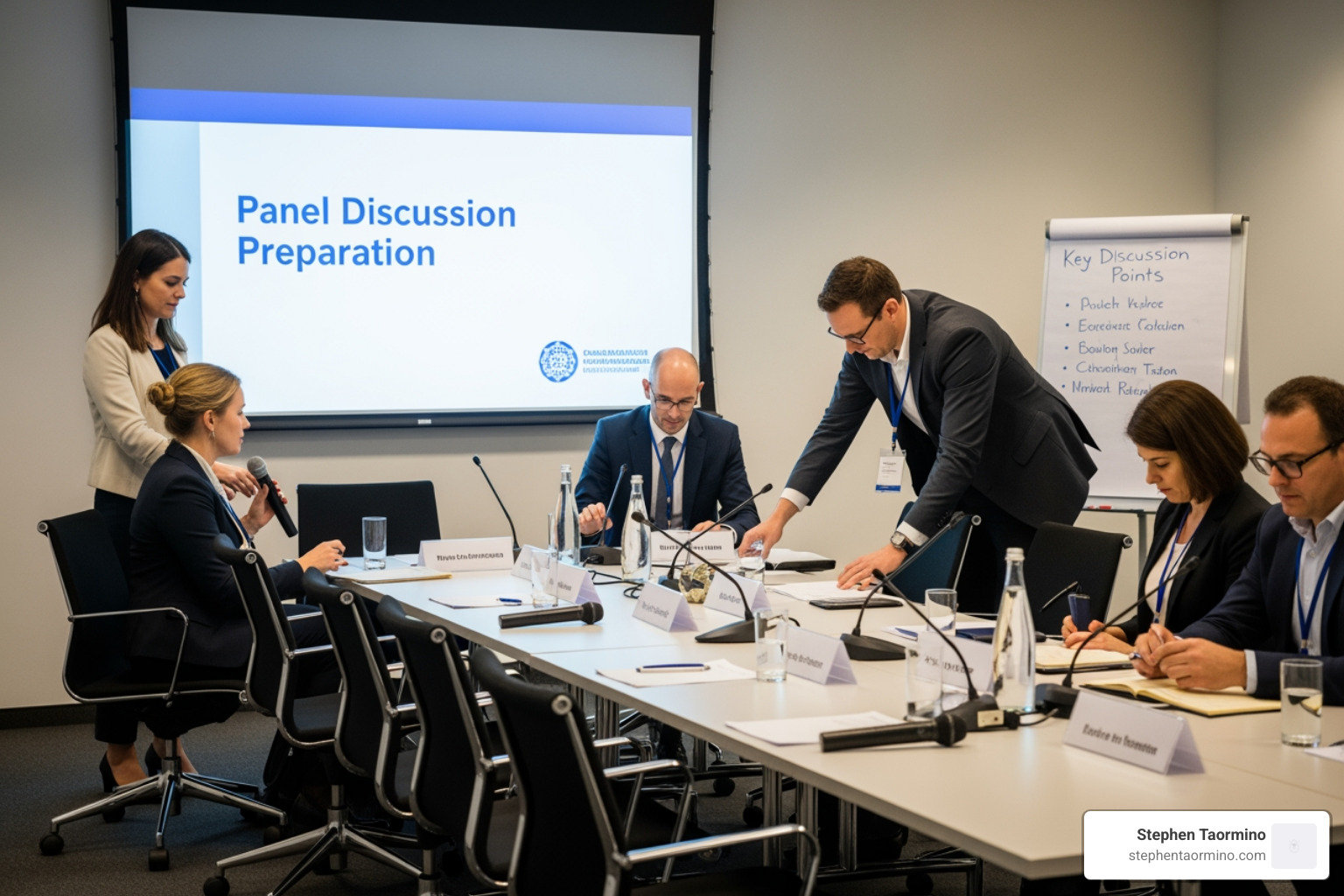
Consider these roles when selecting your team:
- The Sage: The veteran with decades of industry wisdom who can provide historical context.
- The Relator: Someone currently “in the trenches” who can provide practical, day-to-day insights and tactical advice.
- The Wild Card: A contrarian or someone from a tangential industry who offers “out of the box” thinking and challenges the status quo.
- The Exotic: An international perspective or a niche specialist who brings a unique lens to the conversation.
Once you’ve selected your panel, move into the briefing phase. We suggest conducting individual 30-minute prep calls. This allows the moderator to build rapport and uncover interesting stories that might not come out in a group setting. According to researchers at the University of Kansas, people are more likely to consider opposing viewpoints when they hear lived experiences. Use these prep calls to identify those specific “testimonials” your panelists can share to make the data more relatable.
Preparing Panelists for Maximum Impact
Help your panelists shine by providing them with a “Cheat Sheet.” This document should be no more than two pages and include the event goals, audience demographics, and best moderator tips. It should also clearly state the “No-Fly Zones”—topics that are off-limits or too technical for the general audience.
Encourage your panelists to:
- Prepare Three Key Takeaways: What are the three things they want the audience to remember? If they can’t summarize their message in three points, the audience won’t either.
- Use Storytelling: Data tells, but stories sell. One well-placed anecdote about a failure or a hard-won victory is worth ten slides of statistics.
- Embrace Vulnerability: Being honest about failures or “what I wish I knew” builds instant trust and rapport with the audience.
- Practice Brevity: Avoid “it depends” answers. We want specific, punchy insights that move the needle.
- Listen Actively: The best panels are conversations, not a series of mini-keynotes. Encourage them to build on each other’s points or offer respectful moderated panel discussion strategies for disagreeing without being disagreeable.
Mastering the Art of Moderation and Flow
The moderator is the “pilot” of the panel. If the moderator is weak, the panel will veer off-course into technical jargon or personal tangents. If the moderator is too dominant, the panelists can’t fly, and the audience feels like they are watching an interview rather than a discussion. Mastering this balance is a core part of best practices for moderating a panel discussion.
A great moderator needs a “backbone.” This means being willing to politely interrupt a rambling speaker or steer the conversation back to the theme if it gets too technical. Use subtle body language, such as leaning forward or making eye contact, to signal when it’s time to wrap up a point. A skilled moderator also knows how to “bridge” between panelists, connecting a point made by the Sage to a practical application from the Relator.
Timing is everything. TED guidelines for event timing suggest that most expert talks or panels should last around 90 minutes to maintain peak attention. However, for a standard conference session, we recommend a 40/20 split: 40 minutes of moderated discussion and 20 minutes of audience Q&A. This ensures the audience feels involved without the session dragging on too long. If you have a 60-minute slot, aim for 40 minutes of content and 20 minutes of interaction.
Directing the Conversation
The secret to a lively flow is asking provocative, open-ended questions. Instead of asking “What do you think about [Topic]?”, try “What is the biggest mistake people make when approaching [Topic]?” or “What is one trend in this industry that keeps you up at night?” These questions force panelists to move beyond their prepared talking points and engage with the reality of the industry.
Refer to our moderator questions guide for a bank of high-impact prompts. As the moderator, your job is also to manage “airtime.” If one panelist is dominating, pivot the conversation: “I’d love to hear [Other Panelist]’s take on that, especially given your background in…” This ensures a balanced perspective and keeps the energy moving across the stage.
Finally, always conclude briskly. Summarize the key points in a way that reinforces the event’s value proposition. Give each panelist 30 seconds for a final “parting thought” or a “call to action” before thanking the audience and organizers. A strong finish is just as important as a strong start.
Technical Logistics and Room Setup Best Practices
Physical environment dictates the psychological “vibe” of the discussion. If you want a formal, stiff presentation, put everyone behind a long table with “skirting.” If you want a dynamic, engaging conversation, remove the barriers. In panel discussion preparation, the stage layout is a silent communicator that tells the audience whether they are expected to be passive observers or active participants.
Best Practices for Room Setup:
- Semi-Circle Seating: Arrange chairs in a slight curve. This allows panelists to see each other and the audience simultaneously, fostering a more natural conversational flow.
- No Tables: Tables create a physical and emotional wall between the speakers and the audience. They also hide body language, which accounts for a significant portion of human communication. If panelists need a place for water, use small side tables.
- High-Backed Stools: If the audience is large (over 100), use bar stools so the panelists are visible from the back of the room. Just be sure to warn panelists about attire—short skirts or certain fabrics can become an accidental focus on a high stool!
- Microphones: For audiences over 75, amplification is mandatory. Individual lavaliere (clip-on) or headset mics are best because they allow for natural hand gestures and movement. Avoid passing a single handheld mic, as it kills the spontaneity of the debate.
- Screen Placement: If you must use a screen for a single title slide or hashtag, place it “upstage right” (to the left of the stage from the audience’s perspective) so it doesn’t distract from the speakers’ faces.
Don’t forget the basics: provide room-temperature water, paper pads, and pens for every panelist. If you have remote panelists, ensure they are integrated into the stage view via a large monitor rather than just a voice over the speakers. This keeps the “human” element intact and prevents the remote speaker from being forgotten during the heat of the discussion.
Strategies for High-Impact Audience Engagement
Engagement should start in the first five minutes, not the last ten. Waiting until the very end to “open the floor” often leads to a “cold” audience and awkward silences. In the context of panel discussion preparation, engagement is a strategy to keep the audience’s “attention clock” reset throughout the session.
To keep the energy high:
- Early Polls: Use a live Q&A platform for crowdsourcing questions or a simple show of hands to understand the audience’s experience level immediately. This allows the moderator to tailor the depth of the questions to the room.
- Planted Questions: If you’re worried about a slow start to Q&A, “plant” a question with a trusted colleague in the audience. Once the first person speaks, the psychological barrier is broken, and others usually follow.
- Roving Microphones: Always have staff members ready to run wireless mics to audience members. Repeating questions from the stage is tedious and breaks the flow; let the audience be heard directly.
- Breakout Sessions: For longer panels, consider a 5-minute “turn and talk” where audience members discuss a specific prompt with their neighbor before sharing their collective thoughts with the panel.
The goal of panel discussion preparation is to create a two-way street. When the audience feels like they are part of the conversation, they are much more likely to retain the information and act on the key takeaways. Digital engagement, such as live-tweeting or a dedicated Slack channel, can also extend the life of the panel long after the session ends.
Frequently Asked Questions about Panel Preparation
How many panelists are ideal for a discussion?
We recommend 4 to 5 panelists maximum. Any more than that, and it becomes impossible to give everyone enough airtime to provide depth. Fewer than three can lack diversity of thought. Staying within this range ensures the moderator can maintain the conference panel management tight and professional.
Should panelists use PowerPoint slides?
Generally, no. Slides are for presentations; panels are for conversations. PowerPoint often kills the natural flow and forces the audience to look at a screen instead of the speakers. If you must use visuals, limit it to a single title slide with the panelist’s photos, names, and a social media hashtag. This keeps the focus on the human interaction.
How long should the Q&A session last?
Aim for 15 to 30 minutes of Q&A in a 60-to-90-minute session. If the discussion is 45 minutes, 15 minutes of Q&A is the sweet spot. Use a live audience polling tool to let attendees “upvote” the best questions so you address what the room actually cares about, rather than just the person who speaks the loudest.
How do I handle a panelist who dominates the conversation?
A skilled moderator uses “The Pivot.” Wait for a brief pause, then jump in with: “That’s a fascinating point, [Name]. I want to make sure we get [Other Panelist]’s perspective on that as well.” Physical cues, like a small hand gesture toward the other speaker, can also help shift the focus without being rude.
Conclusion
Mastering panel discussion preparation is about more than just checking boxes; it’s about applying marketing psychology to human connection. By focusing on storytelling, clear structure, and intentional room setup, you transform a standard meeting into a powerful platform for leadership and growth. The effort you put into the “backstage” work will always reflect in the “on-stage” results, building your credibility as a thought leader.
At CC&A Strategic Media, we believe that every professional relationship is built on the foundation of smarter communication. Whether you are organizing a global summit or a local career panel, the principles of clarity and engagement remain the same. Ready to take your event to the next level? Explore more of our resources on mastering your next panel discussion and building the confidence to lead with impact. Let’s make your next panel the one everyone remembers.