English
  Spanish
  French
  German


Why Your Moderator Speech in Panel Discussion Makes or Breaks the Experience
Moderator speech in panel discussion is the invisible force that transforms a collection of expert voices into a cohesive, engaging experience. Here’s what effective moderator speech accomplishes:
- Sets the tone and establishes credibility in the first 5 minutes
- Guides conversation flow using key transition phrases like, “Explain what you mean by…” and, “Let me get another panelist’s take on this.”
- Maintains neutrality while ensuring balanced participation from all panelists
- Manages time effectively to allow for audience Q&A and meaningful conclusions
- Engages the audience through strategic interaction and clear takeaways
The statistics tell the story: 95% of annual meetings feature panel discussions, yet they’re only a “fifty-fifty proposition” for being genuinely valuable. The difference between a forgettable panel and a memorable one often comes down to the moderator’s preparation and execution.
Most panel moderators simply replicate what they’ve seen before, missing opportunities to create truly dynamic discussions. The best moderators understand they’re not performers—they’re facilitators whose primary job is serving the audience’s needs while drawing out the expertise of their panelists.
As Steve Taormino, I’ve spent over 25 years helping leaders master strategic communication and audience engagement. Through my work developing moderator speech in panel discussion frameworks for executives and thought leaders, I’ve seen how the right approach transforms both the moderator’s confidence and the audience’s experience. This comprehensive guide will equip you with the scripts, techniques, and strategic insights to lift every panel you moderate.
Moderator speech in panel discussion terms at a glance:
Introduction: The Moderator as the Conductor
Think of your moderator speech in panel discussion as the invisible thread that weaves individual expert voices into something magical—a cohesive, engaging experience that leaves your audience genuinely enlightened. You’re not the star of the show; you’re the conductor ensuring every instrument gets heard and the symphony of ideas resonates long after people leave their seats.
Here’s the truth: most panel moderators wing it. They ask a few prepared questions, hope for the best, and wonder why their discussions feel flat or disjointed. But when you approach moderation strategically—with the right framework, preparation, and mindset—you transform from someone simply asking questions into someone orchestrating meaningful conversations.
This guide provides exactly that: a comprehensive script and framework that takes you from your first moment of preparation through your final closing remarks. Whether you’re moderating your first panel or your fiftieth, you’ll find how to master the art of panel moderation with confidence and authenticity.
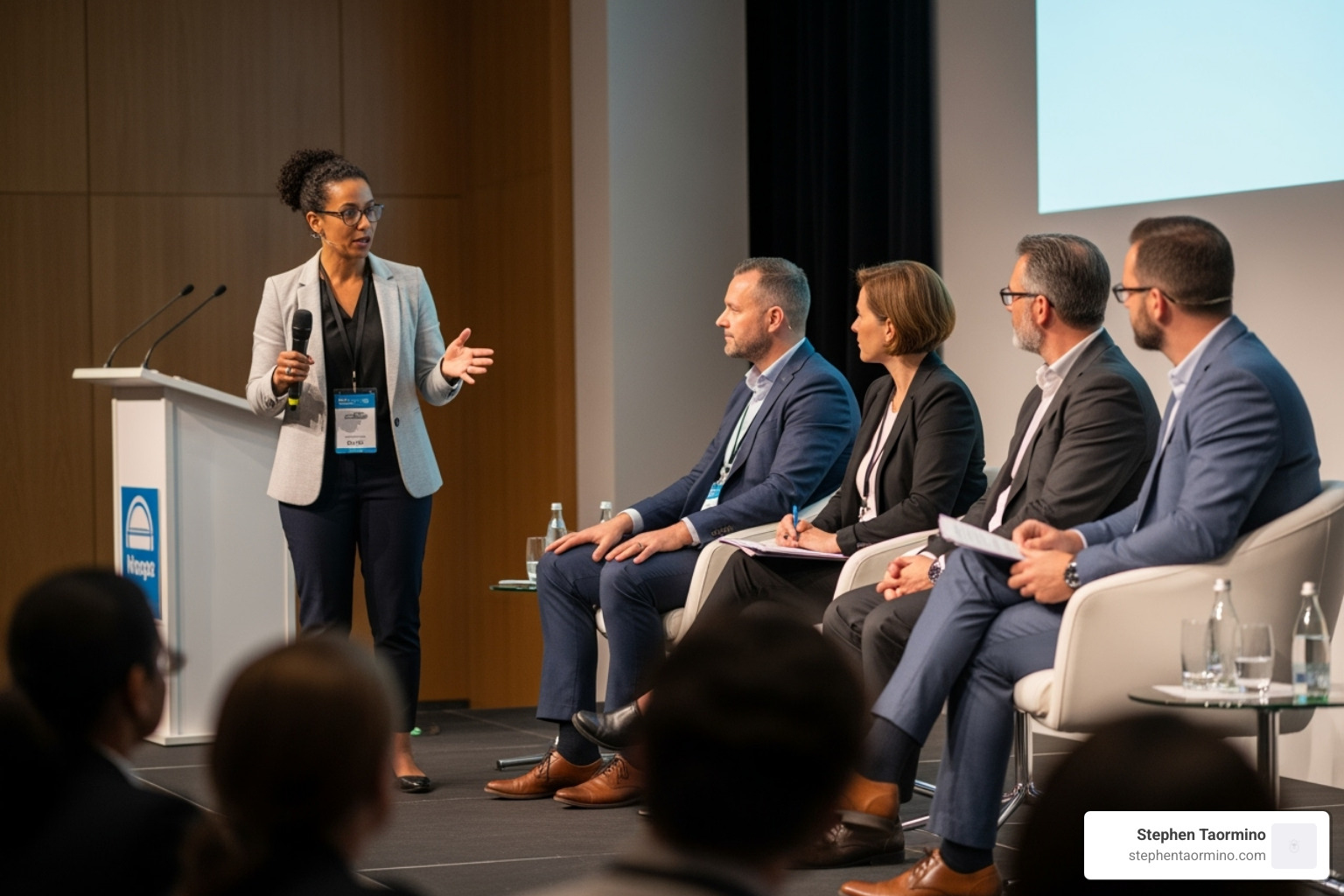
As the conductor of your panel discussion, you’re actually juggling six distinct roles, each essential for creating that memorable experience your audience deserves. Let me walk you through what this looks like in practice.
Your primary hat is Facilitator—the person who guides conversations with purpose. You’re not just lobbing questions and hoping something sticks. Instead, you’re creating genuine dialogue, ensuring smooth transitions between speakers and topics, and making complex ideas accessible to everyone in the room. When a panelist uses industry jargon, you step in with “Explain what you mean by that for those of us who aren’t familiar with the term.”
The Timekeeper role might seem mundane, but it’s absolutely critical. Panel discussions live and die by time management. You’re the one ensuring everyone gets their fair share of airtime, that the discussion starts and ends on schedule, and that there’s meaningful time for audience interaction. Pro tip: keep a visible timer where you can see it—your best friend during any panel.
Perhaps most importantly, you serve as the Audience Champion. Every decision you make should filter through this lens: what serves the audience best? When panelists drift into inside baseball conversations or start agreeing too much, you redirect toward what your audience actually needs to hear. You clarify confusing points, ensure relevance, and make sure people leave feeling their time was well spent.
Sometimes you need to be a gentle Instigator. Not to create drama, but to prevent what I call the “dashboard dog effect”—where everyone just nods along politely. You probe beneath surface-level answers, identify areas where panelists might have different perspectives, and encourage exploration of those differences. You’re seeking revelation, not just pleasant agreement.
Your role as Energizer keeps the discussion from becoming a monotonous lecture. Your enthusiasm is contagious—when you’re engaged and energetic, both panelists and audience members feed off that energy. Strategic use of humor, genuine curiosity in your questions, and your overall presence set the tone for the entire experience.
Finally, you’re the Logistician ensuring everything runs smoothly behind the scenes. While event staff often handles the heavy lifting, you’re ultimately responsible for panelist comfort, microphone functionality, and overall stage setup. In virtual environments, this becomes even more crucial—camera angles, lighting, and audio quality can make or break your discussion.
The beauty of understanding these roles is that you can consciously shift between them as needed. When the discussion gets too comfortable, lean into your instigator role. When energy dips, amp up your energizer presence. When someone’s dominating the conversation, your timekeeper and facilitator roles work together to gently redirect.
This isn’t about perfection—it’s about preparation and awareness. When you know what role the moment requires, your moderator speech in panel discussion becomes natural and effective, creating those moments of genuine insight and connection that make panels truly worthwhile.
Before the Curtain Rises: The Art of Preparation
Think of preparation as the foundation that transforms a good moderator speech in panel discussion into an exceptional one. This isn’t just about jotting down a few questions the night before—it’s about creating an environment where meaningful conversations can flourish naturally.
The best panel discussions feel effortless to the audience, but that effortlessness comes from meticulous behind-the-scenes work. When you’re thoroughly prepared, you can handle unexpected moments with grace, whether it’s a technical glitch or a panelist who goes completely off-script.
Research: Know Your Topic, Panelists, and Audience
Before crafting your moderator speech in panel discussion, you need to become the most informed person in the room—not to show off, but to serve your audience better.
Topic research goes beyond surface-level understanding. You’re looking for the current trends, the debates that matter, and the practical implications for your audience. What challenges are people facing right now? What opportunities are emerging? This deep dive helps you ask the questions that truly matter and clarify jargon when panelists slip into expert-speak.
Panelist backgrounds deserve special attention. Read their recent articles, watch their previous speaking engagements, and understand their unique perspectives. What makes each expert different? What specific insights can only they provide? This research pays dividends when you’re introducing them and crafting personalized questions that showcase their expertise.
Don’t forget to write out the phonetic spelling of challenging names—there’s nothing quite like mispronouncing someone’s name to start things off on the wrong foot!
Audience demographics and needs shape everything you do. Are you speaking to seasoned professionals or newcomers to the field? What problems keep them up at night? Understanding your audience allows you to bridge the gap between expert insights and practical application.
Here’s a technique that works wonders: conduct a pre-mortem. Imagine your panel has completely flopped. What went wrong? Maybe one panelist dominated the conversation, or the discussion got too technical, or the audience seemed disengaged. By identifying these potential pitfalls in advance, you can develop strategies to prevent them.
More info about moderated panel discussions
The Pre-Panel Huddle: Aligning Expectations
The magic of a smooth panel discussion often happens before anyone steps on stage. A well-orchestrated prep call with panelists sets the tone for everything that follows.
During this huddle, you’re not just reviewing logistics—you’re building relationships. Panelists need to feel comfortable with you and trust that you’ll make them look good. Share your vision for the discussion, explain how you’ll manage time, and address any concerns they might have.
Agenda creation becomes your roadmap. Share a detailed timeline that includes approximate speaking time for each panelist. This transparency helps everyone understand their role and reduces anxiety about being cut off mid-thought.
Establish clear ground rules with a gentle touch. You might say something like, “I’ll be keeping us on track for time, so don’t be surprised if I jump in to move us along—it’s all in service of giving the audience the best experience possible.”
For virtual panels, technical preparation becomes absolutely critical. Test everything twice: audio quality, camera positioning, internet stability (aim for at least 5 Mbps upload speed), and platform familiarity. Consider having a backstage support person ready to troubleshoot issues during the live event.
In-person logistics matter too. Visit the venue if possible. Are the chairs comfortable and positioned to encourage natural conversation? Can everyone easily reach their microphones? These details might seem small, but they contribute to the overall flow of your discussion.
Most importantly, use this time to establish rapport. Remind your panelists that you’re there to facilitate their success. When panelists feel supported and confident, it shows in their participation.
Crafting Your Questions
Your questions are the steering wheel of the entire discussion. They need to be thoughtfully crafted, strategically ordered, and designed to serve your audience’s needs above all else.
Prepare 10+ questions as your insurance policy. You’ll likely use only six or seven, but having extras gives you flexibility when the conversation takes unexpected turns or when you need to pivot quickly.
Focus on open-ended questions that invite discussion rather than simple yes-or-no responses. Instead of asking, “Is this trend important?” try “What makes this trend so significant for our industry right now?”
Don’t shy away from provocative questions that might create healthy tension or reveal different perspectives. These moments often produce the most memorable insights. The goal isn’t conflict—it’s revelation.
Ensure you have one question per panelist that specifically highlights their unique expertise. This guarantees everyone gets their moment to shine and demonstrates why you chose each person for this particular discussion.
Your first question should be broad enough to let everyone warm up while establishing a foundation for the audience. Think of it as the gentle on-ramp to deeper discussion.
Your last question needs to be crisp and designed for powerful takeaways. “If you could leave the audience with one actionable insight…” often works beautifully.
Plan how you’ll handle audience-submitted questions. Will you sprinkle them throughout or save them for a dedicated segment? Have backup questions ready in case audience participation is slower than expected.
Questions to Ask When Moderating a Panel
Preparation isn’t about controlling every moment—it’s about creating the structure that allows authentic, valuable conversations to emerge naturally. When you’ve done this groundwork thoroughly, you can focus on what matters most during the actual discussion: serving your audience and facilitating genuine insights from your expert panelists.
Crafting Your Moderator Speech in Panel Discussion: The Opening Act
The first five minutes are critical. Your opening sets the tone, establishes your credibility, and hooks the audience. A strong start assures attendees they are in capable hands and that the discussion will be a valuable use of their time.
Think of your opening as the overture to a great symphony. Just as a conductor raises their baton to signal the beginning of something special, your moderator speech in panel discussion must immediately capture attention and set expectations. The audience is making split-second judgments about whether this panel will be worth their time, and you have mere moments to convince them it will be.
The opening act of your moderator speech in panel discussion flows through three distinct but connected movements: the welcome and hook, panelist introductions, and setting the stage for engagement. Each serves a specific purpose in building momentum toward a dynamic conversation.
The Welcome and Hook (First 2 Minutes)
Your opening moments should feel like a warm handshake combined with an intriguing invitation. Start by welcoming the audience genuinely — not with a perfunctory “good morning” but with energy that says you’re genuinely excited to be there. When you introduce yourself, keep it brief but establish your credibility for this specific topic. Just as I leverage my background in marketing psychology to moderate business panels, you want to quickly signal why you’re the right person to guide this conversation.
The magic happens when you state the panel’s purpose with clarity and impact. Instead of simply describing what you’ll discuss, frame it around change. Rather than “Today we’re talking about digital marketing trends,” try “Today, we’re exploring how the latest digital marketing shifts are reshaping customer relationships, and what that means for your business strategy.” This approach immediately tells the audience why they should care.
Your hook can be a compelling statistic or thought-provoking question that creates an “aha” moment. 95% of meetings feature panels, but most attendees have sat through their share of forgettable ones. You might say, “You’ve probably been in panels where you checked your phone more than you took notes. Today, we’re aiming for something different — insights you’ll actually use next week.”
The key is explaining the audience benefit explicitly. Tell them exactly what they’ll gain: “By the end of this conversation, you’ll walk away with three specific strategies to…” This isn’t just politeness; it’s a promise that frames their listening experience.
Introducing the Panelists with Pizazz (3 Minutes)
Panelist introductions are where many moderators lose momentum, but they should actually build excitement. Your goal isn’t to recite resumes — it’s to create anticipation for what each expert will contribute to the conversation ahead.
Keep introductions brief but impactful, typically 15-30 seconds per person. The secret is highlighting relevance over credentials. Instead of listing every degree and award, focus on why this person’s insights matter for this topic and this audience. “Joining us is Dr. Sarah Chen, whose recent research on consumer psychology directly addresses the questions many of you submitted” is far more engaging than a lengthy bio.
Balance is crucial — ensure each panelist gets equal introduction time and energy. If you’re enthusiastic about one expert, match that energy for all of them. This sets the stage for balanced participation throughout the discussion.
Don’t forget the basics: practice pronouncing names correctly and have phonetic spellings handy. A mispronounced name can immediately create awkwardness and signal lack of preparation. It’s a small detail that makes a big difference in establishing respect and professionalism.
Avoid the laundry list trap. Select one to three key details that connect directly to the panel’s focus. Your introductions should build a sense of “these are exactly the right people to explore these questions with us today.”
Setting the Stage: Rules of Engagement
Before diving into your first question, take a moment to outline the format clearly. This isn’t bureaucratic housekeeping — it’s creating a framework that helps everyone participate effectively. Explain whether you’ll start with moderator questions before opening to audience participation, or if you’ll weave audience questions throughout the discussion.
Explain how the audience can interact with specificity. Will they raise hands, use a digital platform, or submit questions via text? If you’re using technology like live polls or Q&A platforms, briefly mention how those will improve the experience. The goal is removing any barriers to participation.
Set time expectations so everyone knows what to anticipate. If there’s a dedicated Q&A segment, let them know when. If you plan to keep things interactive throughout, mention that too. This helps the audience pace their attention and prepare their questions.
You can also set gentle expectations for panelists with a touch of humor: “I’ll be your friendly timekeeper today, so if you see me giving subtle signals, it just means I’m trying to ensure everyone gets their moment to shine.” This acknowledges your role as facilitator while keeping the tone light and collaborative.
The entire opening act should feel seamless and energetic, building toward the first substantial question. You’re not just providing information — you’re creating an atmosphere where meaningful dialogue can flourish.
How to Moderate a Panel Discussion
The Main Event: Guiding a Dynamic and Balanced Conversation
This is where your role as a facilitator truly shines. Your job is to guide the conversation, ensure fairness, manage time, and keep the energy high. It’s a dynamic dance of listening, intervening, and redirecting.
The Core of Your Moderator Speech in Panel Discussion: Key Phrases for Flow Control
The heart of effective moderator speech in panel discussion lies not just in asking great questions, but in actively shaping how the conversation unfolds. Think of yourself as a conductor guiding an orchestra—you need to know when to bring in different instruments and when to let the music flow naturally.
Active listening becomes your superpower here. When you truly listen to what panelists are saying, you can catch those golden moments where one person’s comment perfectly sets up another’s expertise. You’ll spot areas where panelists agree or disagree, and you can use those dynamics to create more engaging discussions.
The magic happens in your transitions between speakers. Instead of awkwardly jumping from person to person, you create bridges that make the conversation feel natural. Try phrases like, “That’s a fascinating point, and I’d like to ask another panelist how that resonates with their experience,” or “Let me get another panelist in on this. From your perspective, what are the biggest challenges here?”
Your audience will thank you for clarifying jargon that experts often use without thinking. When someone drops industry-specific terms, jump in with: “Explain what you mean by that term. Could you break that down for us?” or “For those of us not immersed in this field, what does that concept truly entail?”
Sometimes you’ll need to keep answers concise without being rude about it. Have these phrases ready: “In one sentence, how would you describe that concept?” or “Could you give us the elevator pitch version of that idea?” When someone has gone on too long, a simple “Thank you for that comprehensive answer. Let’s move on to…” works perfectly.
Ensuring a Balanced and Neutral Discussion
Maintaining balance and neutrality isn’t just good moderating—it’s essential for credibility. Your audience needs to trust that you’re facilitating fairly, not pushing an agenda.
Equal airtime requires constant attention. If you notice someone hasn’t spoken in a while, bring them in: “We haven’t heard from one of our panelists on this yet. What are your thoughts on this topic?” This isn’t just about fairness; quiet panelists often have the most thoughtful insights.
Handling dominant speakers is an art form. Some panelists naturally take up more space, while others love to go off on tangents. When someone’s dominating, you can use polite interruptions: “Thank you for that insight. I want to make sure we hear from everyone. To our next panelist, what’s your take on this?”
Body language cues often work before you need words. Subtle eye contact, a slight head nod toward the next speaker, or even physically moving toward another panelist can send the message. If that doesn’t work, try direct intervention: “That’s a very interesting point, but I want to bring us back to our core topic. Could you briefly summarize your key takeaway on that point?”
Here’s a pro tip: avoid saying “That’s a great point” or “Brilliant” after every answer. It can make other panelists feel like their contributions are lesser. Neutral acknowledgments like “Thank you for that” work much better.
Strict neutrality means you never take sides or express your own opinions on the subject matter. Your role is to facilitate the discussion, not become a panelist yourself. Save your content contributions for when the discussion truly stalls and needs a jumpstart.
Best Practices for Moderating a Panel Discussion
Engaging the Audience and Managing Interaction
An engaged audience transforms a good panel into a great one. The key is making them feel like active participants, not passive observers.

Audience engagement should start early and continue throughout. Begin with warm-up activities like asking, “In one word, what comes to mind when you hear about this topic?” This gets people thinking and participating from the very beginning.
Live polls can be incredibly powerful. Tools that let you ask questions and display real-time results create a dynamic feedback loop. You might poll the audience about their biggest challenges with the topic, then invite panelists to comment on what they’re seeing. This makes the data immediately relevant and actionable.
Consider using a Q&A platform to crowdsource questions. These platforms let audience members submit and even upvote questions, ensuring you address what they really want to know. Plus, it takes pressure off you to come up with every single question.
Sprinkling Q&A throughout the discussion often works better than saving everything for the end. When energy dips or you need a transition, pull an audience question. It keeps people engaged because they know their question might come up at any moment.
For in-person events, brief your microphone runners beforehand. They should move quickly and efficiently, making sure everyone can hear the questions clearly. Nothing kills momentum like struggling to get a microphone to someone.
When you encounter off-topic questions, handle them gracefully: “That’s a great question, perhaps one for a one-on-one conversation afterward, but for the benefit of the broader audience, let’s focus on the main topic.” You’re acknowledging their interest while keeping everyone else engaged.
In-Person vs. Virtual: Adapting Your Approach
The core principles of great moderation remain the same, but virtual panels require some specific adjustments that can make or break the experience.
Virtual moderation demands higher energy levels from you as the moderator. What feels natural and engaging in person can come across as flat on screen. You need to amp up your enthusiasm and camera presence to compensate for the digital barrier between you and your audience.
Technical issues are simply part of virtual life. Have a backstage support person ready to help with audio problems, internet hiccups, or platform glitches. Brief your panelists on backup plans—what happens if their internet cuts out? How quickly can they rejoin?
For virtual panels, encourage panelists to invest in good lighting and audio equipment. A participant with poor video or audio quality can drag down the entire experience. Consider requiring a technical rehearsal, especially for high-stakes events.
In-person moderation lets you use the full room and your physical presence. You can move around the stage, use eye contact more effectively, and read body language more easily. Stage presence matters—your physical energy influences both panelists and audience members.
The energy levels you need differ dramatically between formats. In-person events feed off collective energy, while virtual events require you to generate more energy yourself. In virtual settings, longer pauses feel more awkward, so you need to keep things moving at a brisker pace.
Both formats benefit from clear technical setup and logistics planning, but virtual events require more detailed preparation. Test everything twice, have backup plans ready, and remember that what works perfectly in rehearsal might still go wrong during the live event.
The key is adapting your natural facilitation skills to each format while maintaining the warm, engaging approach that makes panels memorable and valuable for everyone involved.